UAPA Accused Needs Umbilical Hernia Surgery, Seeks Treatment in Mumbai; Delhi High Court Permits 30-Day Custody Bail for Private Hospital Treatment in Delhi

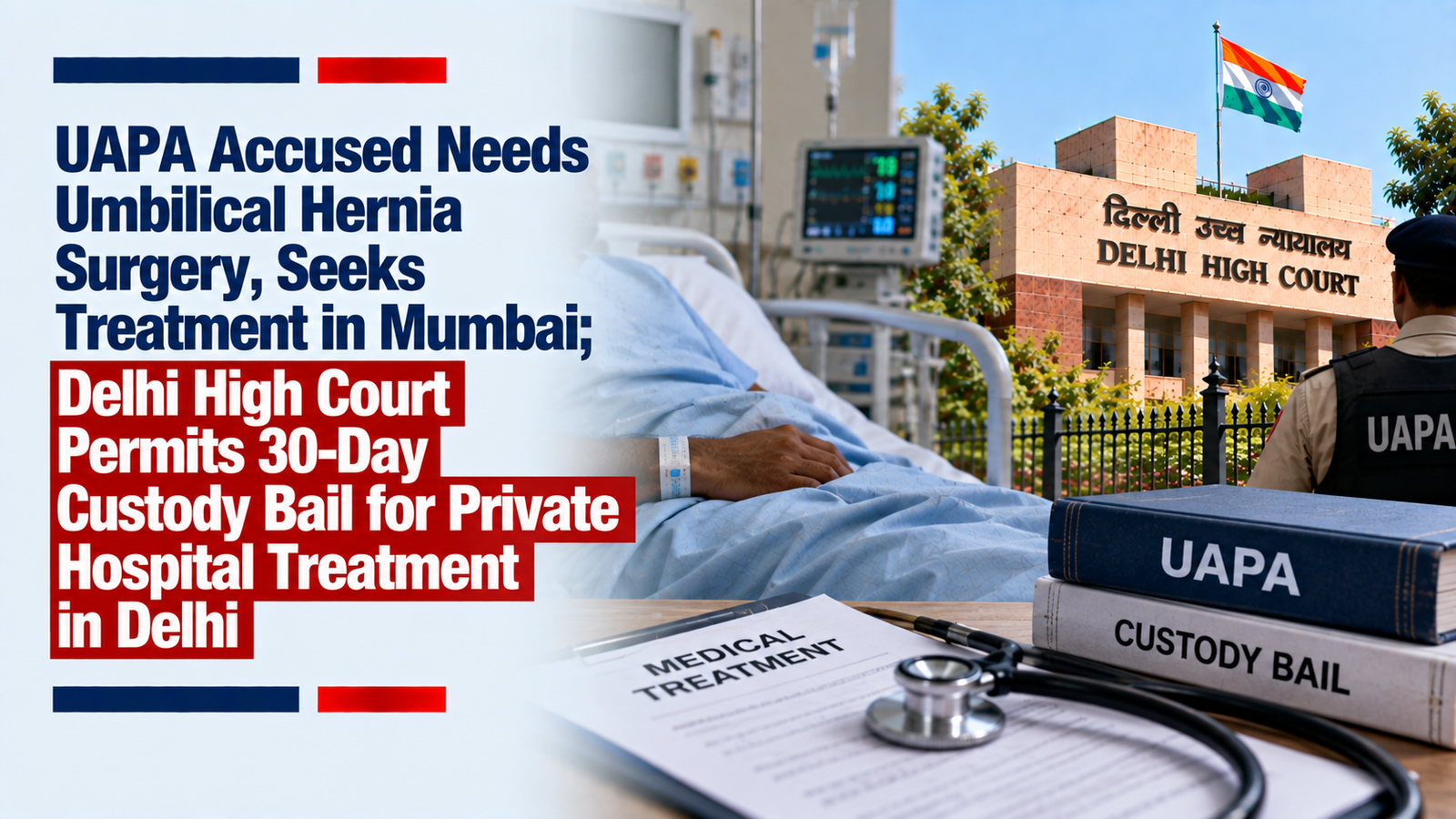
Accused Cannot Be Prevented From Taking Private Medical Treatment at His Own Expense Merely Because He Is in Custody: Delhi High Court
Facts
The appellant, Farhan Ansar Suse, was in judicial custody in connection with NIA FIR No. RC-29/2023/NIA/DLI. He challenged an order dated 1 August 2026 by which the Special NIA Court at Patiala House Courts had rejected his application for interim bail on medical grounds.
The NIA had charge-sheeted him under Sections 120B and 387 IPC and Sections 13, 18, 18A, 20, 38 and 39 UAPA. The principal charge-sheet was filed on 21 March 2024, followed by a supplementary charge-sheet on 3 June 2024.
According to the NIA’s allegations, the appellant was part of a conspiracy involving Saquib Nachan, who was allegedly operating for ISIS in India. The NIA alleged that the appellant participated in an extortion network, circulated messages on behalf of ISIS, took an oath of allegiance and collected money from businessmen in the Padgha area of Maharashtra to support ISIS.
The trial was still at the stage of arguments on charge.
The appellant sought interim bail because he was suffering from umbilical hernia, bronchial asthma and Type-II diabetes. DDU Hospital had advised surgery for the hernia.
Appellant’s Arguments
The appellant submitted that the principal allegation against him concerned extortion and that the alleged connection with ISIS remained to be established during trial.
He pointed out that the alleged prime accused, Saquib Nachan, had died.
He further submitted that:
- the prosecution proposed to examine more than 500 witnesses;
- he had already undergone approximately 2 years and 9 months of incarceration; and
- he required interim bail to meet his family in Mumbai and undergo treatment at a private hospital there.
NIA’s Arguments
The NIA opposed the appeal.
It alleged that the appellant was an active member of ISIS in India and that the Padgha group was involved in spreading ISIS ideology, taking oaths of allegiance and raising funds.
The agency described the appellant as one of the alleged principal conspirators associated with Saquib Nachan.
It further argued that the appellant had changed his position during the proceedings—first challenging his arrest as illegal and subsequently, after the death of Saquib Nachan, seeking pardon and expressing willingness to become an approver.
On the medical issue, the NIA maintained that the appellant was already receiving proper treatment in Delhi.
Analysis of the Law
1. Court Confined Itself to Medical Relief
The High Court deliberately refrained from expressing any opinion on the merits of the serious allegations against the appellant.
Although it reproduced the NIA’s allegations that he had allegedly collected large amounts of cash for ISIS and operated bank accounts, the Court expressly stated that it did not wish to make observations on those allegations at this stage.
The only question before the Court was whether limited relief should be granted because of the appellant’s medical condition.
This distinction is important: the order was not a finding weakening the UAPA allegations or granting regular bail on merits.
2. Surgery Was Admittedly Required
The Court recorded that the appellant admittedly required surgery for an umbilical hernia and had been receiving treatment at DDU Hospital.
The appellant, however, wished to undergo surgery at a private hospital.
The High Court held:
“the Appellant, being medically unwell, cannot be prevented from undergoing treatment at a private hospital at his own expense.”
This became the central basis for the relief granted.
3. Private Treatment Allowed, but Not in Mumbai
The appellant specifically wanted treatment at a private hospital in Mumbai.
The Court declined that request.
It considered treatment in Mumbai not feasible at that stage because of the network which the appellant was alleged to have in Padgha and neighbouring areas of Maharashtra.
The Court instead permitted him to select any private hospital of his choice in Delhi/NCR.
Thus, the Court sought to accommodate the appellant’s medical autonomy while addressing the security concerns arising from the prosecution’s allegations.
4. Relief Was “Custody Bail”, Not Unrestricted Interim Release
A significant feature of the order is that the appellant was not permitted to freely leave custody.
The Court granted 30 days’ custody bail for private hospital treatment.
Once he informs the Jail Superintendent of his chosen hospital in Delhi/NCR, he is to be admitted there while remaining under custody, and all treatment expenses are to be borne by him.
Accordingly, describing the order simply as “medical bail” without mentioning the custodial conditions would be incomplete.
5. Thirty Days Runs From Hospital Admission
The 30-day period does not run from the date of the High Court’s order.
It commences from the date on which the appellant is admitted to the private hospital.
If the treating doctor declares him medically fit after surgery before the 30 days expire, he must immediately be shifted back to jail.
Any extension beyond the initial period would depend upon medical advice.
6. Strict Restrictions on Visitors and Communication
The Court imposed stringent safeguards.
Only two immediate family members, namely his spouse or children, may accompany him during hospitalisation.
The appellant cannot communicate or meet with other relatives, friends or acquaintances, whether through mobile phone or otherwise.
Most importantly, he is expressly prohibited from communicating, directly or indirectly, with any person named in the charge-sheet.
Precedent Analysis
The judgment does not turn on an elaborate analysis of earlier bail precedents.
Instead, the Court adopted a fact-specific medical approach, balancing:
the admitted need for surgery + the accused’s preference for private treatment + his continued custodial status + security concerns arising from the NIA allegations.
Accordingly, the judgment is particularly relevant to cases involving an accused who does not necessarily seek unrestricted release but seeks permission to obtain private specialised medical treatment while remaining under custody.
Court’s Reasoning
The Court found that the need for hernia surgery was not genuinely in dispute.
It did not consider it necessary to examine why the appellant preferred private treatment over continued treatment at the government hospital. Once the accused was medically unwell and willing to bear the expense himself, he could not be prevented from obtaining treatment at a private hospital.
At the same time, the Court was unwilling to permit him to travel to Maharashtra because of the NIA’s allegations regarding his network in Padgha.
It therefore crafted an intermediate arrangement:
private treatment — yes; Mumbai treatment — no; release from custody — no; treatment at a Delhi/NCR private hospital under custody — yes.
The Court also expressly clarified that none of its observations would affect any other pending proceedings.
Conclusion
The Delhi High Court disposed of the appeal by granting the appellant 30 days’ custody bail for medical treatment at any private hospital of his choice in Delhi/NCR.
The appellant would remain under custody during hospitalisation, bear his own treatment expenses and be permitted to have only limited immediate-family presence. He was barred from communicating with other persons, particularly anyone named in the NIA charge-sheet.
If declared fit before 30 days, he must be returned to jail immediately; any extension would depend upon medical advice.
Case Details
Case: Farhan Ansar Suse (In JC) v. National Investigation Agency & Ors.
Court: Delhi High Court
Case No.: CRL.A. 777/2026
CNR: DLHC010374002026
Coram: Justice Prathiba M. Singh and Justice Vikas Mahajan
Date of Decision: 17 September 2026
Result: Appeal disposed of; 30-day custody bail granted for private hospital treatment in Delhi/NCR, subject to strict custodial and communication restrictions.