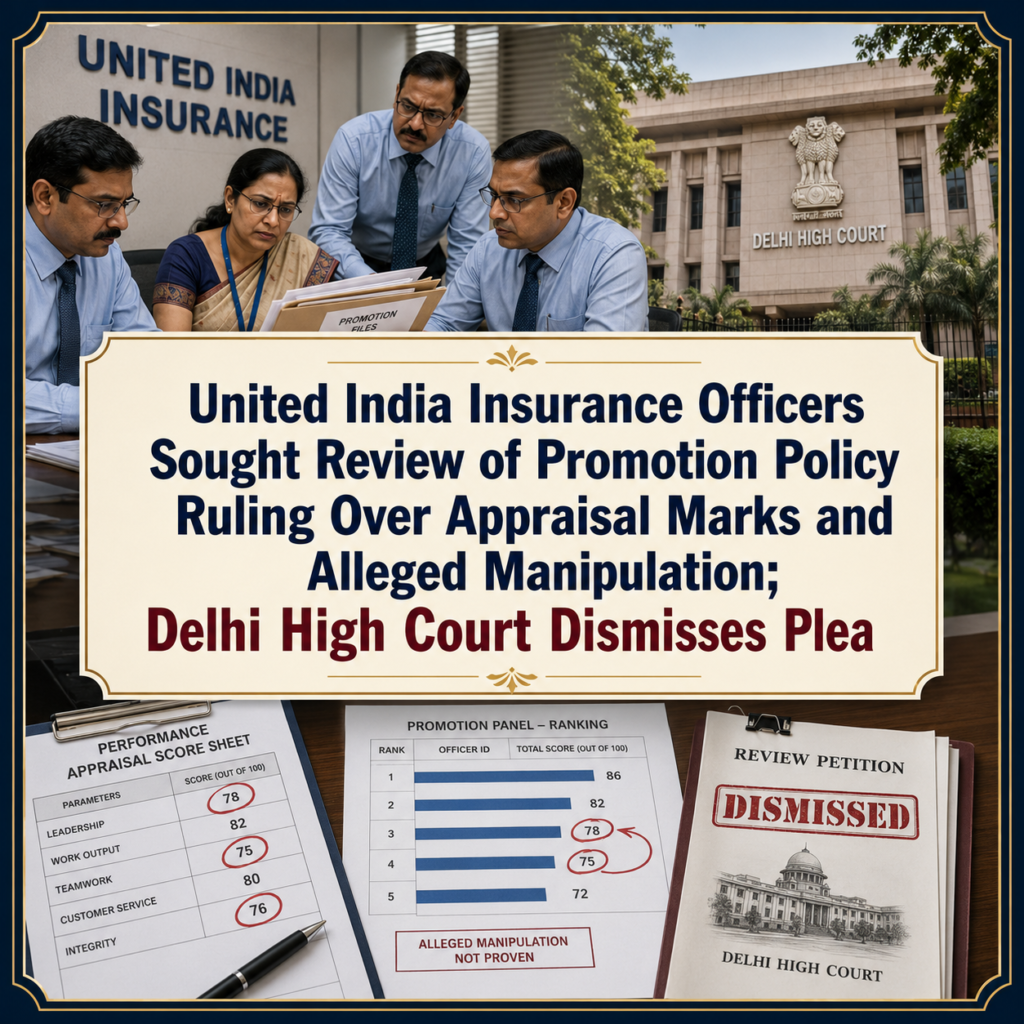
United India Insurance Officers Sought Review of Promotion Policy Ruling Over Appraisal Marks and Alleged Manipulation; Delhi High Court Dismisses Plea

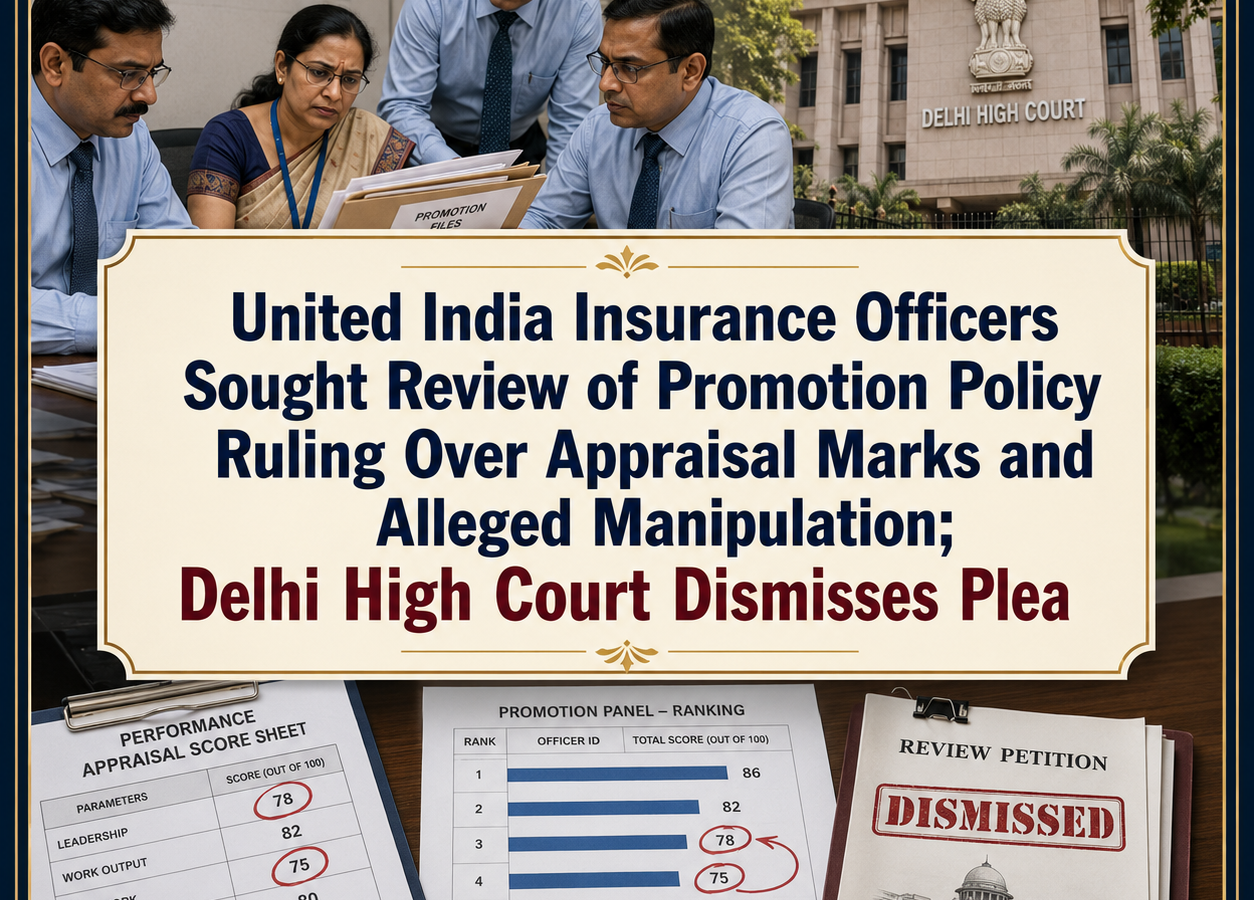
Employees Challenged United India Insurance Promotion Rules on Appraisal Marks, Interviews and Merit Vacancies; Delhi High Court Refuses to Reopen Case
Facts
The petitioners had filed a writ petition challenging the Promotion Policy for Officers, 2006 followed by United India Insurance Company Limited. Their challenge arose from a notification dated March 29, 2022, commencing the promotion exercise for 2022–23 from April 12, 2022.
In the original writ petition, the petitioners questioned several aspects of the promotion process, including:
- The alleged non-disclosure of numerical marks awarded on the basis of Annual Performance Appraisal Reports.
- Rule 14.1, under which the Interview Committee allegedly had access to candidates’ marks in different assessment components.
- The alleged power of the Interview Committee to alter or moderate marks.
- Relaxation of promotion standards or qualifying criteria.
- Rule 14A(f), dealing with the transfer of vacancies from the merit channel to the non-merit channel.
- Paid leave and pre-promotion training provided to candidates belonging to the Other Backward Classes.
- Alleged discrimination and manipulation of promotions in favour of pre-decided candidates.
On June 4, 2026, the Delhi High Court dismissed the writ petition. It held that the promotion policy was neither arbitrary nor discriminatory against the petitioners and that none of their requested reliefs could be granted.
The petitioners then filed the present review petition under Section 114 read with Order XLVII of the Code of Civil Procedure, 1908. They argued that the earlier judgment contained errors apparent on the face of the record because the Court had misunderstood the factual background and the precise nature of their prayers.
Issues
- Whether the earlier judgment contained an error apparent on the face of the record warranting review.
- Whether the Court had incorrectly accepted that the petitioners possessed or had been informed of their numerical appraisal marks.
- Whether the Court failed to consider the true scope of Rule 14.1 and the allegation that the Interview Committee could manipulate or moderate candidates’ marks.
- Whether the Court wrongly upheld relaxation in the promotion criteria as a permissible welfare measure.
- Whether the earlier judgment misunderstood the petitioners’ challenge to the transfer of merit vacancies under Rule 14A(f).
- Whether paid leave for pre-promotion training of Other Backward Class candidates amounted to reservation in promotion.
- Whether the petitioners could seek review on the ground that they had never alleged personal discrimination.
- Whether the review petition was a genuine attempt to correct an obvious error or an impermissible attempt to reargue the original case.
Petitioner’s Arguments
The petitioners argued that their prayer concerning appraisal marks had been rejected on the basis of a non-existent and unverified method for converting alphabetical Annual Performance Appraisal Report grades into numerical marks. They claimed that the formula or methodology had never been disclosed to them despite repeated requests.
They contended that the Court had accepted the insurance company’s assertions without supporting evidence. According to them, the absence of proof was used to reject their case even though the company had withheld the material necessary to establish their allegations.
Regarding Rule 14.1, the petitioners maintained that the Interview Committee knew the marks awarded to candidates under all relevant parameters and possessed the power to:
- Alter appraisal marks for the preceding three years.
- Adjust interview marks with reference to the total marks.
- Modify marks on the ground of regional imbalance.
They argued that the earlier judgment wrongly limited the controversy to the Interview Committee’s knowledge of candidates’ marks without examining the Committee’s alleged power to manipulate or moderate them. They further claimed that they could not produce direct evidence because the relevant information was not furnished despite a request under the Right to Information Act, 2005.
On relaxation in promotion standards, the petitioners contended that the insurance company’s assertion regarding a 10% relaxation in qualifying criteria was incorrect because the promotion policy did not prescribe any qualifying criteria. They also asserted that nearly 80% of promotions were made without a written examination.
Concerning Rule 14A(f), the petitioners said that their challenge was not merely against alteration in the number of vacancies. They objected to the transfer of an available merit vacancy to the non-merit channel when a required number of candidates did not qualify for each vacancy. According to them, this could result in an employee who had not qualified in the written examination or interview being promoted while a qualified merit candidate was disregarded.
The petitioners also challenged the provision of paid leave for pre-promotion training to Other Backward Class candidates. Relying on Indra Sawhney v. Union of India, they argued that reservation in promotion for Other Backward Classes was impermissible.
Lastly, they claimed that the original writ petition challenged the promotion policy itself and did not allege personal discrimination. They therefore argued that the earlier judgment had erroneously dealt with a case of discrimination that they had never pleaded.
Respondent’s Arguments
United India Insurance Company had stated in its counter-affidavit that the complete contents of the petitioners’ Annual Performance Appraisal Reports had been disclosed in accordance with its circular dated March 18, 2014. This position had also been admitted during proceedings in an earlier case, W.P.(C) 3218/2021.
The company denied the allegation that the appraisal marks had been withheld. Significantly, the petitioners had not filed a rejoinder denying this statement in the counter-affidavit.
The respondents maintained that mere access by the Interview Committee to written-test, appraisal and seniority marks did not establish manipulation. No material had been produced showing that any candidate’s marks had actually been altered improperly.
The insurance company defended relaxation of the promotion criteria as a welfare measure. It also maintained that Rule 14A(f) was intended to balance merit, competency, seniority and the organisation’s operational requirements.
In relation to Other Backward Class candidates, the respondents’ position was that the policy only provided pre-promotion training and paid leave for such training. It did not confer reservation in promotion.
Analysis of the Law
The review petition was governed by Section 114 and Order XLVII Rule 1 of the Code of Civil Procedure, 1908.
A court may review its judgment principally where:
- New and important evidence has been discovered which, despite due diligence, was not within the applicant’s knowledge or could not have been produced earlier.
- There is a mistake or error apparent on the face of the record.
- Another sufficient reason exists which is analogous to the grounds specifically provided under Order XLVII Rule 1.
An error apparent on the face of the record must be obvious from a straightforward examination of the judgment or record. If the supposed error can be established only through lengthy arguments, reinterpretation of the evidence or a detailed process of reasoning, it is not an error apparent warranting review.
The power of review permits correction of a patent mistake. It does not permit the Court to substitute a different view merely because another interpretation may be possible.
A review proceeding is also distinct from an appeal. The Court does not sit in appeal over its own judgment, and the unsuccessful party cannot use review proceedings to obtain a complete rehearing on the merits.
On the promotion policy, the Court reiterated that an employer may adopt measures balancing merit, competency, seniority and its operational requirements, provided those measures are not arbitrary or contrary to constitutional requirements.
The Court also distinguished pre-promotion training from reservation in promotion. Providing training or paid leave to help candidates prepare does not, by itself, reserve promotional posts for those candidates.
Precedent Analysis
Indra Sawhney v. Union of India, 1992 Supp (3) SCC 217
The petitioners relied upon this Supreme Court judgment to argue that reservation in promotion for Other Backward Class candidates was impermissible.
The Delhi High Court found the precedent inapplicable because United India Insurance Company’s policy merely provided pre-promotion training and paid leave to Other Backward Class candidates. It did not reserve promotional vacancies for them.
The distinction was therefore between:
- Reserving promotional posts for a particular category; and
- Giving candidates training or preparatory assistance before the promotion process.
Only the former involved reservation in promotion. Consequently, Indra Sawhney did not support the petitioners’ challenge to the training facility.
Principles governing review jurisdiction
Although the judgment did not separately name further precedents in its discussion, it applied the settled principles that:
- Review cannot be used to rehear and correct an allegedly erroneous decision.
- An error requiring lengthy reasoning is not an error apparent on the face of the record.
- Review is meant to correct an evident mistake and not to substitute one judicial view with another.
- A review petition cannot operate as an appeal in disguise.
Court’s Reasoning
The Court found no factual inaccuracy or evident legal error in its earlier judgment.
On disclosure of appraisal marks, the insurance company had specifically stated in its counter-affidavit that the entire contents of the Annual Performance Appraisal Reports were disclosed. The petitioners had not filed a rejoinder disputing that assertion. Their claim that the earlier judgment relied upon an unsupported statement was therefore factually incorrect.
Regarding Rule 14.1, the Court had already examined the relevant pleadings and documents. Mere knowledge by the Interview Committee of a candidate’s written-test, appraisal and seniority marks could not establish that interview marks were manipulated. The petitioners had produced no material demonstrating actual manipulation. Their allegations remained speculative.
The arguments concerning relaxation in promotional standards had also been considered earlier. The Court had already held that the insurance company was entitled to provide relaxation as a welfare measure and that doing so was neither unlawful nor inconsistent with Article 335 of the Constitution.
The challenge to Rule 14A(f) had similarly been addressed in the original judgment. The rule sought to prevent promotions from being based solely on seniority without sufficient attention to merit and competency. It balanced the interests of senior employees with the organisation’s operational requirements. Disagreement with that reasoning did not constitute a ground for review.
The Court rejected the reliance on Indra Sawhney because pre-promotion training for Other Backward Class candidates did not amount to reservation in promotional posts.
It also rejected the claim that the petitioners had never alleged discrimination. The writ petition had specifically claimed that Petitioner No. 2 was denied promotion because he had complained against company officials. It had further alleged that the policy was designed to promote pre-decided, corrupt and ineligible officers. The petitioners could not disown those allegations during review proceedings.
Overall, every issue raised in the review petition had either been addressed in the original judgment or required reconsideration of the case on its merits. Neither circumstance justified exercising review jurisdiction.
Conclusion
The Delhi High Court held that the petitioners had failed to demonstrate any new evidence, factual inaccuracy or error apparent on the face of the record.
Their objections concerning appraisal marks, the Interview Committee’s powers, relaxation of promotion criteria, transfer of merit vacancies, pre-promotion training and discrimination had already been considered in the original judgment.
The Court concluded that the petitioners were attempting to reargue the writ petition through review proceedings. Since a review petition cannot be converted into a rehearing or an appeal in disguise, the review petition and the pending application were dismissed. No order was made as to costs.
Case Details
Case: Pankaj Prakash & Another v. United India Insurance Company Limited & Another
Court: High Court of Delhi at New Delhi
Case Number: Review Petition 287/2026 and CM Application 41015/2026 in W.P.(C) 6073/2022
Judge: Chief Justice Devendra Kumar Upadhyaya and Justice Tejas Karia
Date: July 17, 2026
Result: Review petition and pending application dismissed; no order as to costs.