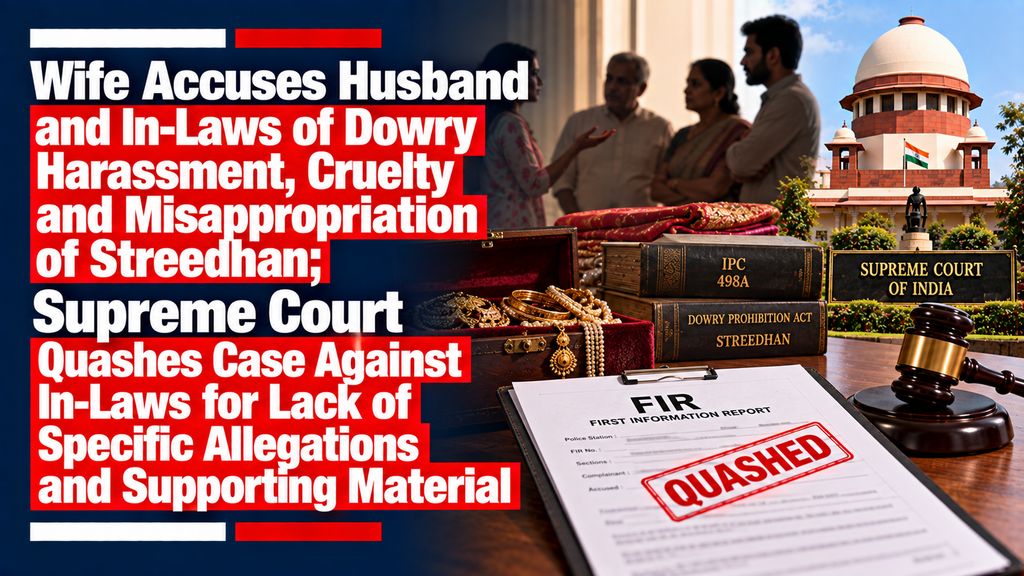
Wife Accuses Husband and In-Laws of Dowry Harassment, Cruelty and Misappropriation of Streedhan; Supreme Court Quashes Case Against In-Laws for Lack of Specific Allegations and Supporting Material

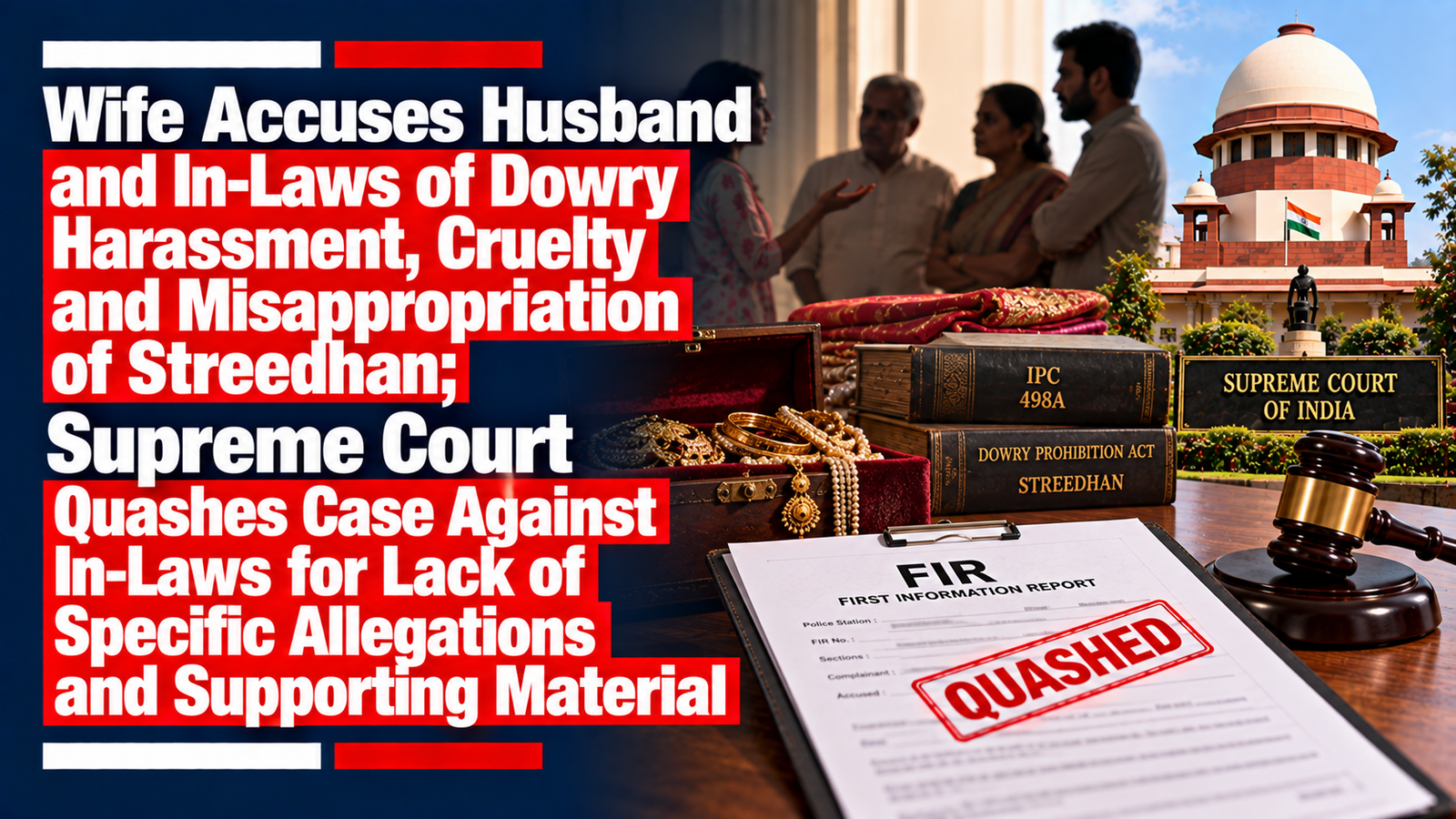
Parents-in-Law Roped Into Matrimonial Case Under Sections 498A, 406 and 506 IPC; Supreme Court Says Omnibus Allegations Cannot Subject Relatives to Criminal Trial
Facts
The appellants, Prasanta Kumar Dhar and another, are the father-in-law and mother-in-law of Respondent No.2, the complainant. The complainant married their son on 1 February 2021 in Darjeeling. The couple initially lived in a separate town, but after the husband was transferred to Siliguri, the complainant began residing with the appellants. A daughter was born on 17 July 2023.
Matrimonial disputes subsequently arose. The complainant alleged verbal taunts, dowry demands including a four-wheeler, inadequate support during pregnancy and taunts after the birth of a girl child.
She further alleged that on 11 November 2023, the first appellant and her husband went to her parental home and compelled her to sign a declaration stating that she had received all her streedhan and valuable articles after leaving the matrimonial home.
On 21 November 2023, FIR No.152/2023 was registered at Siliguri Women Police Station, District Darjeeling, against the husband and the two appellants under Sections 498A, 406, 506 and 323 IPC and Sections 3 and 4 of the Dowry Prohibition Act, 1961.
After investigation, Chargesheet No.175/2023 dated 21 December 2023 was filed against all three accused. The proceedings were pending before the trial court at the stage of framing of charges.
The appellants approached the Calcutta High Court under Section 482 Cr.P.C. The High Court, by order dated 12 November 2024, quashed only the charge under Section 323 IPC but declined to quash the remaining offences.
The father-in-law and mother-in-law therefore approached the Supreme Court seeking complete quashing of the criminal proceedings against them.
Issues
Whether general allegations of matrimonial cruelty and dowry demand, without specific overt acts or supporting investigative material against the parents-in-law, are sufficient to compel them to face a criminal trial.
Whether the materials collected during investigation disclosed the ingredients of cruelty under Section 498A IPC against the appellants.
Whether the allegations disclosed offences under Sections 3 and 4 of the Dowry Prohibition Act when particulars of the alleged demands, occasions and independent supporting material were absent.
Whether criminal breach of trust under Section 406 IPC was made out without particulars of the property entrusted to the appellants or evidence of dishonest misappropriation.
Whether criminal intimidation under Section 506 IPC was established against the appellants merely on the basis of the complainant’s allegations and statements of her parents.
Whether the High Court ought to have exercised its inherent jurisdiction under Section 482 Cr.P.C. to quash the entire proceedings against the appellants.
Appellants’ Arguments
The appellants argued that the matrimonial dispute was essentially between the complainant and her husband and that they had been implicated merely because they were his parents.
They submitted that there was no material demonstrating cruelty or harassment by them and that they had rarely shared the same household with the couple because their son worked in a different town.
Regarding the allegation that the complainant had been forced to sign a declaration concerning return of streedhan, the appellants argued that neither the FIR nor the chargesheet disclosed injuries to any person or damage to property supporting the allegation of force.
They also relied on the ten-day delay between the alleged incident of 11 November 2023 and registration of the FIR on 21 November 2023 as a circumstance undermining the accusation.
The appellants contended that the High Court erred in quashing only Section 323 IPC while requiring them to stand trial for the remaining offences despite the absence of specific allegations and supporting material.
Respondents’ Arguments
The State argued that the complaint specifically referred to dowry demands, cruelty and harassment and that questions concerning falsity or sufficiency of evidence should be determined at trial rather than in proceedings under Section 482 Cr.P.C.
The complainant similarly argued that the Supreme Court should not undertake an assessment of the correctness or veracity of the evidence, which falls within the domain of the trial court.
It was contended that the allegations, taken at face value, disclosed cognizable offences and that their truth could be tested during trial.
The complainant also emphasised that cruelty under Section 498A IPC includes mental cruelty and harassment, for which medical evidence may not ordinarily exist. The absence of medical evidence therefore could not by itself render the allegations false.
Analysis of the Law
The Supreme Court reiterated the principles governing quashing under Section 482 Cr.P.C. from State of Haryana v. Bhajan Lal. Criminal proceedings may be quashed where the allegations, even if accepted in their entirety, do not constitute an offence; where the uncontroverted material does not disclose commission of an offence; where allegations are inherently improbable; or where proceedings are maliciously instituted and amount to abuse of process.
The Court stressed that matrimonial and domestic disputes require a nuanced approach. Courts must protect genuine victims of domestic violence and dowry harassment, but criminal law cannot be indiscriminately extended to every relative of the husband without a clear factual foundation.
Allegations against each accused must be specific, distinct and supported by prima facie material showing active involvement in the alleged cruelty, harassment or unlawful dowry demand. Mere relationship with the husband is not enough.
For Section 498A IPC, the Court examined whether there was material showing wilful conduct likely to cause grave injury or danger to the complainant’s life or health, or harassment intended to coerce an unlawful demand for property or valuable security. It found no such independent material against the appellants.
For Sections 3 and 4 of the Dowry Prohibition Act, the Court noted that although the complainant alleged payment of Rs.5 lakh at marriage and a demand for a four-wheeler, the investigation did not reveal particulars of the demands, occasions, independent witnesses or supporting material attributable specifically to the appellants.
For Section 406 IPC, criminal breach of trust requires entrustment and dishonest misappropriation or conversion. The investigation did not identify what property had specifically been entrusted to the appellants or how they had misappropriated it.
For Section 506 IPC, the Court found no specific details of threats made by the appellants to the complainant, her family, property or reputation. The allegation of coercion regarding the streedhan declaration was supported only by the complainant and statements of her parents, without other material implicating the first appellant.
Precedent Analysis
State of Haryana v. Bhajan Lal, 1992 Supp (1) SCC 335, supplied the governing framework for exercise of inherent jurisdiction under Section 482 Cr.P.C. The Court relied particularly on the categories covering allegations that do not constitute an offence, uncontroverted material that does not disclose an offence, inherently improbable allegations and proceedings amounting to abuse of process.
Arti Mehta v. State of Madhya Pradesh, 2026 SCC OnLine SC 933, was relied upon to emphasise that filing of a chargesheet or pendency of domestic-violence proceedings does not bar quashing where the FIR and investigative material disclose no prima facie case against relatives of the husband.
Arti Mehta also stressed that while victims’ rights and dignity must be safeguarded, relatives cannot be prosecuted merely because of matrimonial acrimony. There must be specific overt acts, active participation or direct involvement supported by foundational facts.
Geddam Jhansi v. State of Telangana, 2025 SCC OnLine SC 263, was relied upon for the principle that invoking criminal process carries serious penal and coercive consequences. In domestic disputes, courts must therefore insist on specific allegations and credible supporting material before allowing criminal proceedings to continue against family members.
Court’s Reasoning
The Court examined each surviving offence separately rather than treating the chargesheet as sufficient merely because it had been filed.
For Section 498A IPC, neither the complaint nor the investigation disclosed material showing that the appellants caused grave injury to the complainant’s physical or mental health or specifically harassed her to meet an unlawful demand for property.
The dowry allegations were found deficient in particulars. The complaint did not identify with sufficient specificity the occasions, manner or individual acts by which the appellants allegedly demanded dowry, and the investigation yielded no independent supporting material.
The Section 406 IPC charge could not survive because there were no particulars identifying property entrusted to the appellants or showing that they dishonestly misappropriated or converted such property.
The Section 506 IPC allegation was likewise unsupported by specific material showing threats by the appellants. The allegation concerning coercion of the complainant into signing the streedhan declaration was supported only by the complainant and statements of her parents.
Applying Bhajan Lal, Arti Mehta and Geddam Jhansi, the Court concluded that the allegations against the appellants were neither specific, cogent nor credible and did not attribute any distinct overt act to either parent-in-law.
The Court distinguished the position of the complainant’s husband. It recorded that specific allegations of cruelty, harassment and dowry demands had been made against him, but he was not a party to the proceedings before the High Court or Supreme Court. The judgment therefore expressed no opinion on the merits of the case against him.
The High Court should consequently have quashed the entire criminal proceedings against the appellants rather than quashing only Section 323 IPC.
Conclusion
The Supreme Court allowed the appeal and set aside the Calcutta High Court’s order dated 12 November 2024 to the extent that it had refused to quash proceedings against the appellants under Sections 498A, 406 and 506 IPC and Sections 3 and 4 of the Dowry Prohibition Act.
All proceedings arising from FIR No.152/2023 registered at Siliguri Women Police Station, District Darjeeling, were quashed insofar as the father-in-law and mother-in-law were concerned.
The Court clarified that its observations were confined to the maintainability of criminal proceedings against the appellants and should not be treated as an expression on the merits of the case against the husband or on any civil remedy available to the complainant.
Case Details
Case: Prasanta Kumar Dhar & Anr. v. State of West Bengal & Anr.
Citation: 2026 INSC 1087
Court: Supreme Court of India, Criminal Appellate Jurisdiction
Case Number: Criminal Appeal arising out of Special Leave Petition (Criminal) No.16908 of 2024
Bench: Justice Nongmeikapam Kotiswar Singh and Justice N.V. Anjaria
Judgment by: Justice Nongmeikapam Kotiswar Singh
Date: 5 October 2026
Offences: Sections 498A, 406, 506 and 323 IPC; Sections 3 and 4, Dowry Prohibition Act, 1961
Result: Appeal allowed; all proceedings arising from FIR No.152/2023 quashed insofar as the father-in-law and mother-in-law were concerned.