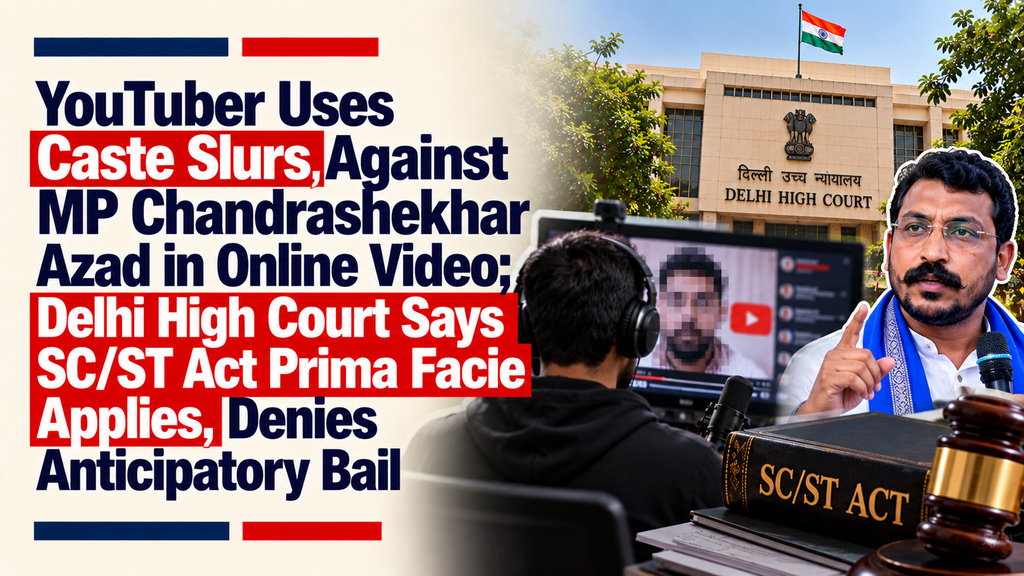
YouTuber Uses Caste Slurs Against MP Chandrashekhar Azad in Online Video; Delhi High Court Says SC/ST Act Prima Facie Applies, Denies Anticipatory Bail

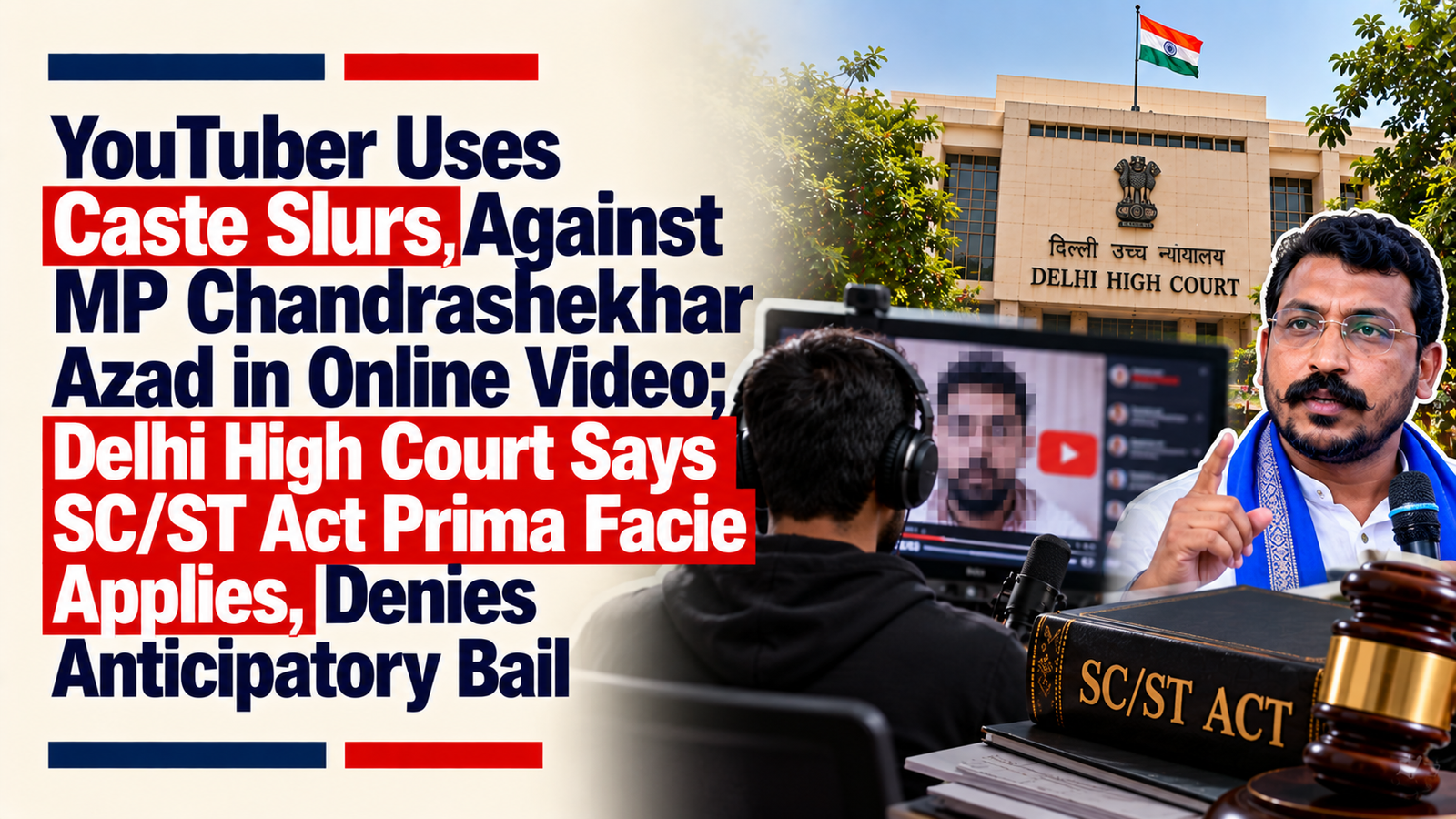
Caste Slurs in Publicly Accessible Online Video Attract SC/ST Act Prima Facie; Delhi High Court Dismisses Anticipatory Bail Plea
Facts
The applicant, Ajeet Bharti, sought anticipatory bail in FIR No. 30/2026 registered at Police Station North Avenue under several provisions of the Scheduled Castes and Scheduled Tribes (Prevention of Atrocities) Act, 1989, Section 67 of the Information Technology Act and Sections 196(1)(c) and 351(3) of the Bharatiya Nyaya Sanhita.
The FIR was lodged at the instance of the Delhi State President of the Azad Samaj Party. The allegations concerned an audio-visual programme uploaded and circulated through the applicant’s social-media presence which had approximately 23,100 views at the time of registration of the FIR.
According to the complainant, the video contained repeated caste-based abuse, caste names/slurs and derogatory remarks particularly directed against Chandrashekhar Azad, Member of Parliament from Nagina, as well as remarks concerning Dr. B.R. Ambedkar and members of Scheduled Caste and Scheduled Tribe communities generally.
Issue
The decisive question was whether the allegations in the FIR prima facie disclosed an offence under the SC/ST Act.
This was crucial because Sections 18 and 18A(2) of the SC/ST Act exclude anticipatory bail where a prima facie offence under the Act is disclosed.
The Court therefore first had to determine whether the case fell within the statutory bar before examining ordinary considerations governing anticipatory bail.
Applicant’s Arguments
The applicant relied, among other authorities, upon the Supreme Court judgment in Shajan Skaria v. State of Kerala.
The legal proposition advanced was that the bar under Section 18 is not attracted merely because provisions of the SC/ST Act have been inserted into an FIR. If the necessary ingredients of an offence under the Act are absent on a prima facie reading, anticipatory bail remains legally available.
The applicant also contended that the remarks had been made following provocation by another person online.
His counsel, however, admitted that the applicant did not belong to an SC/ST community and also accepted, considering the public character and wide audience of the social-media platform, that the video was aired in a place “within public view.”
Respondents’ Arguments
The complainant and the State opposed anticipatory bail.
Their case was that the statements were not merely offensive or general remarks. The applicant had allegedly used specific caste names/slurs while referring directly and indirectly to Chandrashekhar Azad, and the overall context reflected caste-based humiliation and notions of caste hierarchy.
The State relied upon the video itself, its transcript and the widespread accessibility of the content online.
Analysis of the Law
1. Anticipatory Bail Under the SC/ST Act
The Court relied extensively upon Shajan Skaria v. State of Kerala and Kiran v. Rajkumar Jivraj Jain.
The governing test is narrow.
If, on the first reading of the FIR, the essential ingredients of an SC/ST Act offence are absent, the statutory bar does not prevent consideration of anticipatory bail.
But once the FIR itself prima facie contains all ingredients of the offence, Sections 18 and 18A(2) operate and anticipatory bail becomes unavailable.
The Court cannot conduct a mini-trial or enter deeply into disputed evidence while making this assessment.
2. Social Media Can Satisfy “Within Public View”
This is one of the judgment’s important observations.
The applicant’s counsel accepted that the social-media publication was within public view. The Court nevertheless elaborated upon the nature of online publication.
It observed that the internet is presently among the fastest modes of dissemination. Content uploaded on the worldwide web to an openly accessible digital platform can be seen, heard, consumed, engaged with and reshared by anyone at any time.
Consequently, the Court said there was no requirement for the victim to be physically present when the impugned content is freely available online.
Importantly, this observation was made in a case where the “public view” element was itself admitted by the applicant’s counsel.
3. Court Personally Examined the Video
The impugned video was the central piece of material.
The Court watched the relevant portions in chambers from a pen drive supplied by the Investigating Officer and also examined the exact transcript forming part of the record.
The Court found that the applicant had prima facie made caste-based abuses, caste names/slurs and derogatory remarks directed at humiliating or dishonouring Chandrashekhar Azad.
4. Caste Slurs Were Connected With the Named Individual
The Court did not treat the statements as isolated words removed from context.
It noted that one statement immediately followed a direct reference to Chandrashekhar Azad and contained explicit caste slurs. Later, the applicant again referred to an “MP” together with a caste slur, which the Court considered sufficient at this stage to connect the statements with the named individual.
The Court therefore prima facie found that the caste references were directed at Chandrashekhar Azad rather than being detached or generic commentary.
5. “Savarna” Marriage Remark Was Material to Caste-Hierarchy Context
The Court attached further significance to the applicant’s statement that Chandrashekhar Azad would have to make himself sufficiently worthy to seek the hand of a “savarna” person’s daughter.
Counsel for the applicant acknowledged that “savarna” had been used to refer to so-called upper-caste individuals.
The Court considered this remark, in the context of the preceding caste slurs, as prima facie invoking notions of caste hierarchy and superiority.
Reading the statements collectively—the language, tone, context and manner of expression—the Court concluded that the FIR prima facie disclosed caste-based abuse intended to humiliate the named individual within Sections 3(1)(r) and 3(1)(s).
Precedent Analysis
Shajan Skaria v. State of Kerala
This precedent was especially significant because it was relied upon by the applicant himself.
The Supreme Court had clarified that not every insult directed against an SC/ST person constitutes an offence under Section 3(1)(r).
The humiliation must be linked to caste identity. The provision is attracted where the insult or intimidation is connected with historically entrenched notions such as upper-caste superiority, untouchability, purity and pollution.
The Delhi High Court distinguished the facts before it from Shajan Skaria.
Here, the Court found repeated express caste references, rather than allegations containing no reference to the victim’s caste.
It held that the remarks were not merely reckless, general or stray, but prima facie involved explicit caste references coupled with notions of caste superiority in the context of marriage.
Kiran v. Rajkumar Jivraj Jain
The Court also relied on Kiran for the proposition that the Section 18 bar is ordinarily absolute where the FIR contains specific allegations constituting an offence under the Act.
The limited exception arises only where on the face of the FIR itself, the SC/ST Act offence is not made out. Courts cannot enter the evidentiary realm or conduct a mini-trial to create such an exception.
Court’s Reasoning
The Court found a prima facie case under Sections 3(1)(r) and 3(1)(s) because:
- the applicant admittedly did not belong to an SC/ST community;
- the online publication was admittedly within public view;
- the statements contained repeated caste names/slurs;
- the statements could prima facie be connected directly with Chandrashekhar Azad;
- the remarks were not isolated or stray when read in their complete context; and
- the marriage-related “savarna” remark prima facie invoked notions of caste hierarchy and superiority.
The applicant’s plea of online provocation was rejected. The Court observed that the alleged provocation did not come from Chandrashekhar Azad and, in any event, could not operate as a shield against the statements attributed to the applicant. It also noted that no subsequent clarification, retraction or apology was pleaded.
Conclusion
The Delhi High Court held that offences under Sections 3(1)(r) and 3(1)(s) of the SC/ST Act were prima facie made out.
Consequently, the statutory prohibition contained in Sections 18 and 18A(2) became applicable, making the anticipatory bail application not maintainable.
The Court did not consider it necessary at this stage to examine the other invoked provisions of the SC/ST Act, IT Act or BNS because the finding under Sections 3(1)(r) and 3(1)(s) was itself sufficient to attract the statutory bar.
It expressly clarified that all observations on merits were confined to deciding the anticipatory bail application and would have no bearing on the overall proceedings.
Case: Ajeet Bharti v. State of NCT of Delhi & Anr.
Court: Delhi High Court
Case No.: Bail Application No. 3808/2026
Judge: Justice Saurabh Banerjee
Date: 24 September 2026
Result: Anticipatory bail application dismissed as not maintainable because a prima facie case under Sections 3(1)(r) and 3(1)(s) SC/ST Act was found, attracting Sections 18 and 18A(2).