

Court’s decision
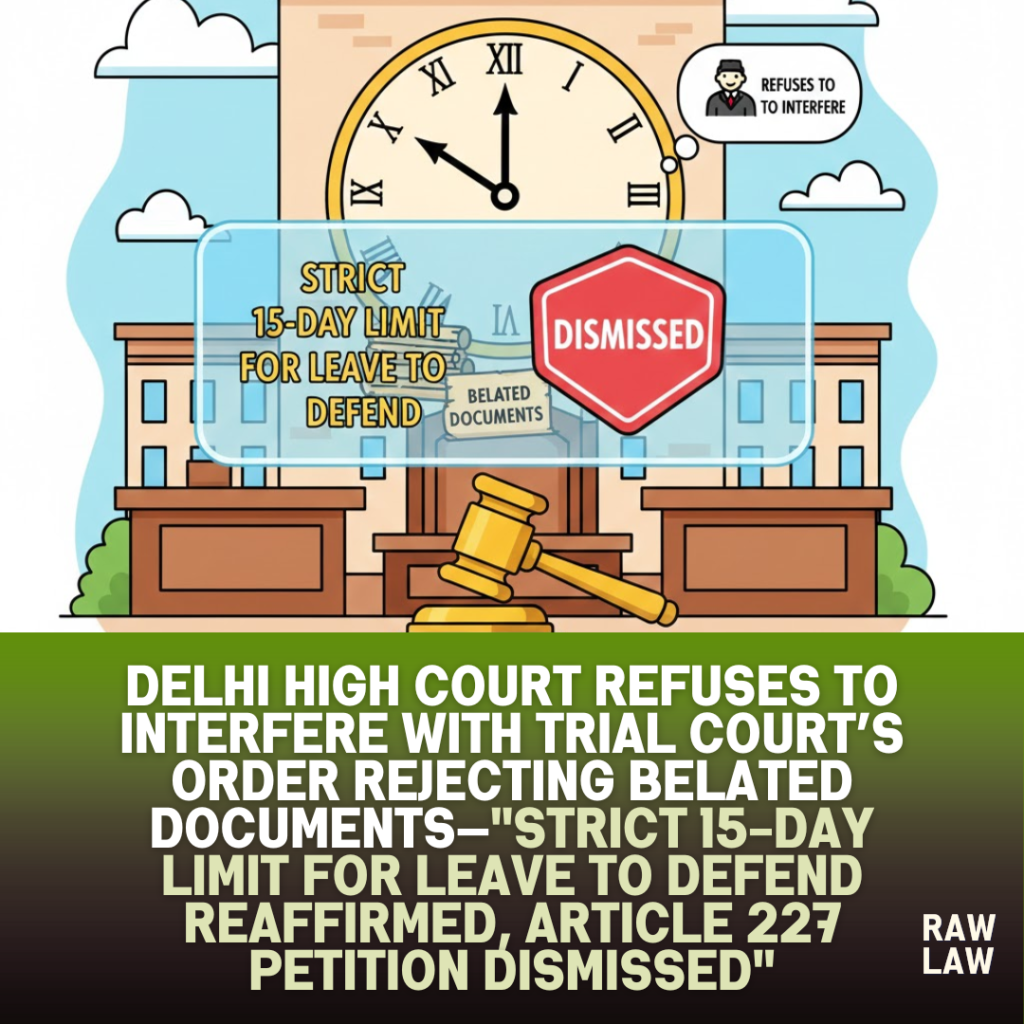
The Delhi High Court declined to exercise its supervisory jurisdiction under Article 227 of the Constitution to interfere with a trial court order refusing to take additional documents on record in an eviction proceeding. Upholding the sanctity of the statutory 15-day period prescribed for filing a leave to defend application, the Court held that documents which were admittedly available at the relevant time could not be introduced later through an application under Order VIII Rule 1A of the Code of Civil Procedure. Finding no illegality or perversity in the impugned order, the Court dismissed the petition as devoid of merit.
Court’s decision
The High Court dismissed the petition challenging the trial court’s order dated 13 December 2025, which had rejected an application seeking to place additional documents on record. The Court condoned a short delay in refiling the petition but, on merits, affirmed that the trial court was correct in holding that permitting additional documents at a belated stage would destroy the sanctity of the statutory time limit for raising grounds in a leave to defend application. No interference was warranted under Article 227.
Facts
The petitioner approached the High Court under Article 227 assailing an order passed by the trial court in an eviction-related proceeding. Before the trial court, the petitioner had filed an application under Order VIII Rule 1A read with Section 151 of the Code of Civil Procedure seeking permission to place on record additional documents, including photographs, pagri-related documents, receipts, income tax returns, telephone bills, and insurance papers.
The trial court dismissed the application, holding that all the documents were available with the petitioner at the time of filing the leave to defend application and that introducing them later would violate the mandatory time framework governing summary eviction proceedings. Aggrieved, the petitioner invoked the High Court’s supervisory jurisdiction.
Issues
The central issue before the High Court was whether the trial court had committed any jurisdictional error or material irregularity in refusing to take additional documents on record after the expiry of the statutory period for filing a leave to defend application. Ancillary to this was the question of whether such refusal warranted interference under Article 227 of the Constitution.
Petitioner’s arguments
The petitioner contended that the trial court had acted in haste and failed to grant sufficient opportunity to file the documents in question. It was argued that the rejection of the application under Order VIII Rule 1A CPC was overly technical and that the documents were necessary for a just adjudication of the dispute. The petitioner submitted that denial of permission to place the documents on record caused prejudice and that the trial court had not properly appreciated the factual circumstances leading to the delay.
Respondent’s arguments
The respondent opposed the petition, arguing that the application for additional documents was a clear attempt to delay the proceedings. It was submitted that multiple opportunities had already been granted to the petitioner, including at the stage of filing the rejoinder, but the petitioner failed to act diligently. The respondent relied on settled law governing summary eviction proceedings to submit that the statutory time period for filing a leave to defend application is inflexible and cannot be diluted by permitting subsequent filings.
Analysis of the law
The Court examined the scope of Order VIII Rule 1A CPC in the context of summary proceedings, particularly those governed by strict timelines. It reiterated that the statutory period prescribed for filing a leave to defend application is mandatory and that all material facts and documents available at the relevant time must be disclosed within that period. Allowing subsequent documents would undermine the legislative intent of expeditious disposal.
The Court also emphasised the limited nature of jurisdiction under Article 227, which is meant to correct jurisdictional errors or patent illegality and not to reappreciate facts or substitute the High Court’s view for that of the trial court.
Precedent analysis
The trial court, whose reasoning was approved by the High Court, relied on authoritative precedents holding that the 15-day period for filing a leave to defend application is inflexible. The Court noted reliance on Supreme Court jurisprudence and Delhi High Court rulings which caution against permitting amendments or additional material that would erode the sanctity of the prescribed timeline. These precedents were applied to conclude that belated documents could not be entertained as a matter of discretion.
Court’s reasoning
After perusing the impugned order, the High Court found that the trial court had passed a detailed and reasoned decision, correctly applying settled law. It noted that the documents sought to be placed on record were admittedly available with the petitioner at the time of filing the leave to defend application. The Court agreed that permitting their belated introduction would defeat the purpose of the statutory scheme.
Finding no perversity, illegality, or procedural irregularity, the Court held that the case did not meet the threshold for interference under Article 227.
Conclusion
The Delhi High Court dismissed the Article 227 petition, affirming the trial court’s refusal to allow additional documents to be placed on record beyond the prescribed period. While the delay in refiling the petition was condoned, the substantive challenge failed on merits. The Court reiterated that procedural discipline and statutory timelines cannot be compromised in summary proceedings.
Implications
This decision reinforces the strict approach adopted by courts in summary eviction proceedings and similar matters governed by rigid timelines. It serves as a caution to litigants that all available material must be placed on record within the statutory period and that attempts to supplement pleadings later are unlikely to be entertained. The ruling also underscores the restrained scope of Article 227, signalling that High Courts will not interfere with well-reasoned trial court orders merely because another view is possible.
Case law reference
- Sanctity of leave to defend timeline: Courts have consistently held that the statutory period for filing leave to defend is inflexible and cannot be diluted by amendments or additional documents.
- Scope of Article 227: Supervisory jurisdiction is limited to correcting jurisdictional errors or patent illegality, not reappreciation of facts.
- Application in present case: These principles were applied to uphold the trial court’s refusal to take belated documents on record.
FAQs
Q1. Can additional documents be filed after the leave to defend period expires?
Generally, no. Courts have held that documents available at the time of filing must be produced within the statutory period, failing which they cannot be introduced later.
Q2. Will the High Court interfere under Article 227 in such matters?
Only if there is patent illegality or jurisdictional error. Reasoned trial court orders are rarely interfered with.
Q3. Why is the 15-day period treated as strict?
Because summary proceedings are designed for speedy adjudication, and relaxing timelines would defeat legislative intent.


