

Court’s decision
The Delhi High Court dismissed a petition under Section 482 of the Code of Criminal Procedure, 1973 challenging concurrent orders of the Metropolitan Magistrate and the Additional Sessions Judge, which had dismissed a private complaint under Section 200 CrPC.
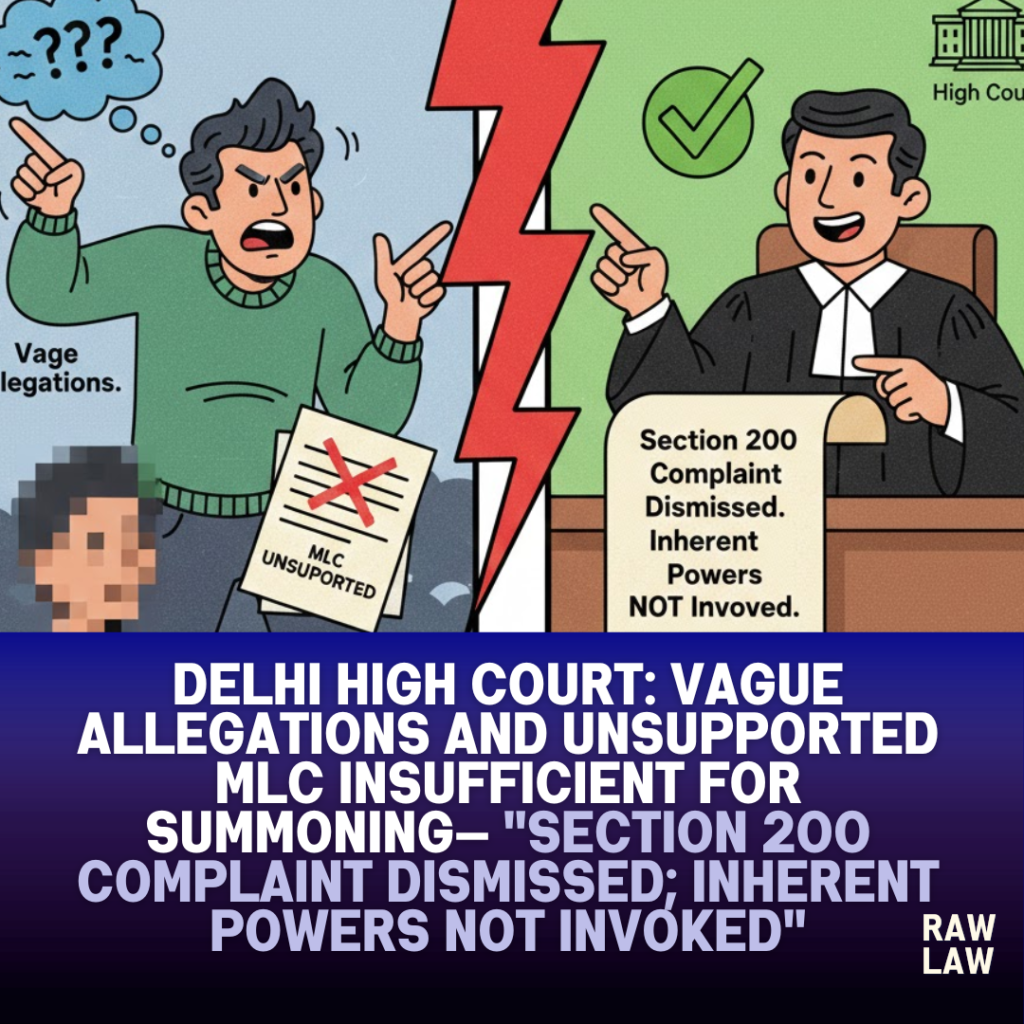
The Court held that the complaint alleging offences under Sections 307/511/323/34 IPC did not disclose sufficient prima facie material to warrant summoning of the accused. Vague assertions regarding a financial dispute and an alleged attempt to burn the complainant were found unsupported by medical and corroborative evidence. The petition was dismissed as devoid of merit.
Facts
The petitioner filed a complaint under Section 200 CrPC alleging that the accused persons had threatened her, grappled with her, and attempted to pour kerosene oil on her body. It was claimed that the incident occurred on 09.09.2009 outside her residence in Rohini, Delhi.
According to the complaint, after returning from the police station earlier that day, one accused allegedly abused and threatened her to withdraw a pending case. It was further alleged that his wife poured kerosene oil on her and that she was taken to B.S.A. Hospital, where her statement was recorded and an MLC prepared.
The complaint also included allegations that the accused compelled her to become an agent in an R.C.M. scheme, took ₹6,000 from her, and failed to refund the amount.
The Metropolitan Magistrate dismissed the complaint on 22.01.2019, finding lack of sufficient material. The revision petition was dismissed by the Sessions Court on 07.12.2019.
Issues
The High Court examined whether the Magistrate erred in dismissing the complaint at the pre-summoning stage under Section 200 CrPC.
It also considered whether the revisional court failed to appreciate the medical evidence and sworn testimony of the complainant.
The scope of inherent powers under Section 482 CrPC in interfering with concurrent findings was also in issue.
Petitioner’s arguments
The petitioner contended that her sworn testimony and the Medical Legal Certificate corroborated her allegations of assault and attempt to burn.
It was argued that the lower courts failed to appreciate that the MLC established prima facie injuries consistent with her account. The petitioner asserted that her version, supported by a hospital record and oral evidence, was sufficient to summon the accused.
She further argued that the financial dispute involving ₹6,000 under the R.C.M. scheme and repeated threats were overlooked by the courts below.
Respondents’ arguments
The respondents submitted that the allegations were vague, unsupported by independent witnesses, and lacked material particulars.
It was pointed out that the MLC did not record any injury consistent with an attempt to burn or serious assault. The alleged delay of approximately three and a half hours in lodging the complaint remained unexplained.
The respondents argued that no date, receipt, or documentary evidence was provided regarding the alleged payment of ₹6,000, rendering the financial allegations unsubstantiated.
It was contended that both courts rightly found no sufficient ground to proceed.
Analysis of the law
The Court reiterated that at the stage of taking cognizance under Section 200 CrPC, the Magistrate must be satisfied that sufficient grounds exist for proceeding against the accused.
Mere allegations without supporting material do not mandate issuance of process. The Court emphasized that summoning an accused is a serious matter and requires application of judicial mind to ascertain whether a prima facie case is made out.
The inherent powers under Section 482 CrPC are to be exercised sparingly and only to prevent abuse of process or secure the ends of justice. Interference with concurrent findings is unwarranted unless there is manifest illegality or perversity.
Precedent analysis
The Court applied settled principles governing dismissal of complaints at the pre-summoning stage. It reaffirmed that vague, bald, and unsupported allegations cannot justify criminal process.
The judicial threshold at the stage of summoning is not proof beyond reasonable doubt, but there must exist prima facie material indicating commission of an offence.
In the absence of medical corroboration, independent witnesses, or documentary evidence, the complaint failed to meet even this threshold.
Court’s reasoning
The Court examined the MLC and found that no injury was specified that could support the assertion of assault or attempt to burn. The alleged incident occurred at 9:00 AM, while the complaint was lodged at 12:35 PM, with no explanation for the delay.
Though it was claimed that neighbours gathered at the spot, none were examined. The husband, who allegedly accompanied her to the hospital, was also not examined to corroborate the version.
Regarding the ₹6,000 allegedly taken under the R.C.M. scheme, no date of payment, receipt, or documentary proof was placed on record. Even representations to authorities did not specify dates or particulars.
The Court concluded that the complaint lacked material particulars and supporting evidence necessary to summon the accused.
Both the Magistrate and the Sessions Court had correctly appreciated the evidence and applied settled legal principles.
Conclusion
The Delhi High Court held that the complaint did not disclose any prima facie offence and that there was no infirmity in the concurrent orders of dismissal.
Finding no ground to invoke inherent jurisdiction under Section 482 CrPC, the petition was dismissed along with pending applications.
Implications
This judgment reinforces:
- Summoning of accused requires prima facie material, not mere allegations.
- Medical evidence must substantiate claims of serious assault.
- Financial allegations require specific particulars and documentary support.
- Section 482 CrPC cannot be invoked to reappreciate evidence absent perversity.
- Concurrent findings of lower courts are accorded judicial deference.
The ruling underscores the judiciary’s caution in preventing misuse of criminal process through vague private complaints.
Case law references
- (Statutory Reference)
Section 200, Code of Criminal Procedure, 1973
Mandates that a Magistrate must assess sufficiency of grounds before issuing process. - Section 482, Code of Criminal Procedure, 1973
Inherent powers to prevent abuse of process or secure ends of justice.
FAQs
1. Can a Magistrate dismiss a private complaint before summoning the accused?
Yes. If the complaint lacks prima facie material or sufficient grounds to proceed, it may be dismissed under Section 200 CrPC.
2. Is medical evidence necessary in assault cases?
While not always mandatory, absence of medical corroboration may weaken allegations of serious assault.
3. Can High Courts interfere under Section 482 CrPC in such cases?
Interference is limited and exercised sparingly. Concurrent findings are rarely disturbed unless perverse or illegal.


