

Court’s decision
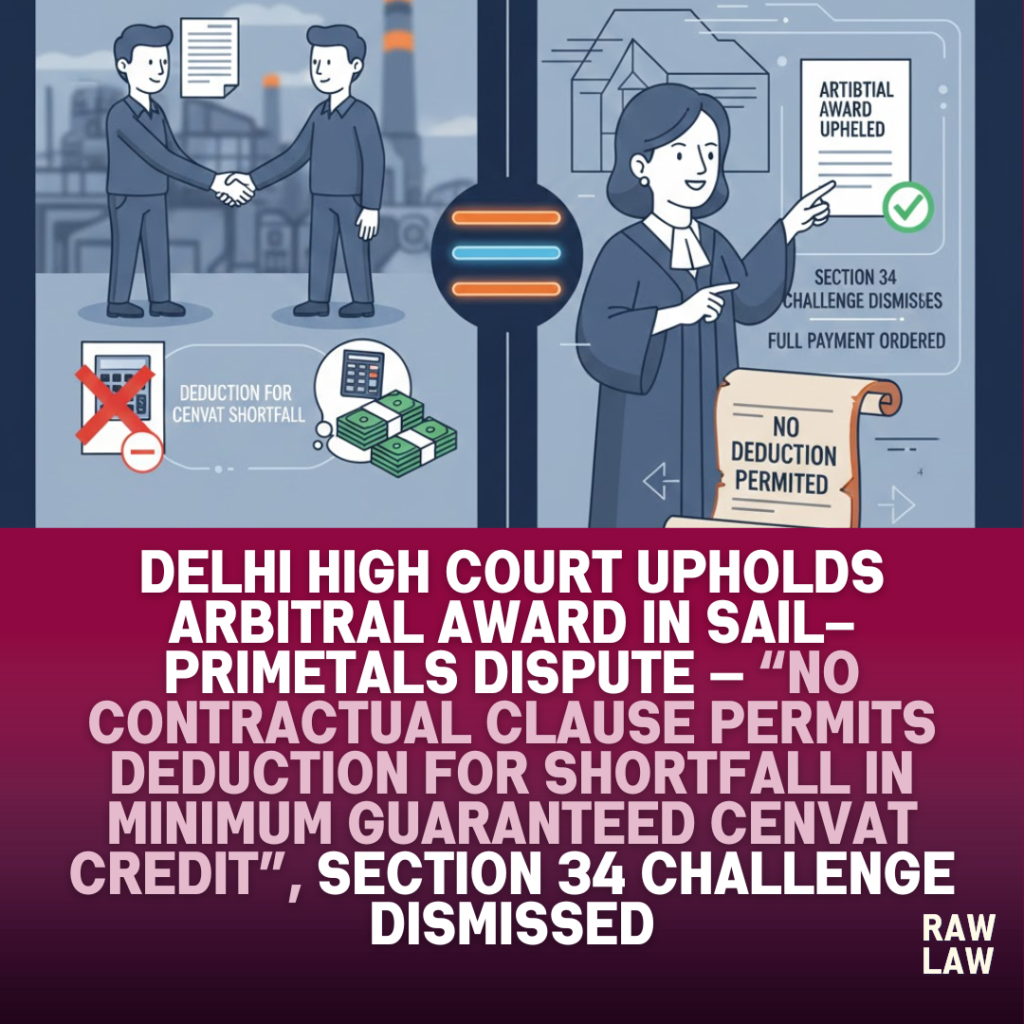
The Delhi High Court dismissed a Section 34 petition filed by Steel Authority of India Limited challenging an arbitral award in favour of M/s Primetals Technologies India Pvt. Ltd. The Court held that the arbitral tribunal had rightly concluded that there was no contractual provision permitting deduction of the shortfall in minimum guaranteed CENVAT credit (MGCC) from the net contract price.
Finding no perversity, patent illegality, or violation of public policy, the Court upheld the award granting reimbursement of Rs.1,40,38,523/- along with pendente lite and post-award interest. The Court reaffirmed that interpretation of contractual clauses lies within the arbitrator’s domain and cannot be reappreciated in Section 34 proceedings.
Facts
The dispute arose out of a 2007 contract for replacement of existing MG Sets at Bhilai Steel Plant. The contract price was Rs.44.93 crore, subject to a minimum guaranteed CENVAT credit of Rs.4.65 crore to be passed on to the employer.
The project was commissioned in 2010 and finally accepted in 2013. Final invoices were submitted in May 2018 after obtaining necessary No Objection Certificates. Payment was released in July 2018 after deducting liquidated damages and Rs.1.40 crore on account of shortfall in MGCC.
Conciliation failed, and arbitration was invoked in December 2021. The tribunal ruled in favour of the contractor, holding that deduction of shortfall in MGCC was impermissible under the contract.
Issues
The High Court examined:
- Whether the arbitration was barred by limitation.
- Whether the contractor had waived its right to object to the deduction.
- Whether the contract permitted deduction of shortfall in MGCC from the net contract price.
- Whether the award was non-speaking or violated Section 31(3) of the Arbitration and Conciliation Act, 1996.
Petitioner’s arguments
Steel Authority of India Limited contended that the claim was time-barred since a notice dated 17.05.2014 had proposed deduction. It argued that the contractor failed to object at that stage and had executed a final discharge certificate, thereby waiving its rights.
On merits, it was argued that Article 2.1 required the contractor to pass on MGCC and that failure entitled the employer to deduct the shortfall. It was submitted that the tribunal rewrote the contract and ignored Clause 14.5.2 and 14.6 governing CENVAT documentation and tax variations.
The petitioner also challenged the award as non-speaking and excessive in awarding litigation costs.
Respondent’s arguments
The contractor contended that cause of action arose only in July 2018 when the deduction was actually made. The 2014 notice merely used the phrase “if any” and did not quantify or effect deduction.
It was argued that the contract did not contain any clause permitting deduction of shortfall in MGCC. At best, failure to furnish documents would result in non-reimbursement, not recovery from the contract price.
The contractor maintained that the arbitrator’s interpretation was plausible and immune from interference under Section 34.
Analysis of the law
The Court held that limitation commenced from the date of actual deduction in July 2018. Arbitration invoked in December 2021 was within three years and further protected by the Supreme Court’s extension of limitation during the COVID-19 pandemic.
On waiver, the Court relied on settled principles that waiver requires conscious and informed relinquishment of a known right. Since no deduction was made in 2014, there was no occasion to object or waive rights at that stage.
Interpreting Article 2.1 and Clause 14.5.2, the Court observed that the contract stipulated non-reimbursement upon failure to furnish CENVAT documents but did not authorize deduction of shortfall from the net contract value. The arbitrator’s construction was consistent with the contract’s structure.
Precedent analysis
The Court relied on Supreme Court judgments including Dyna Technologies v. Crompton Greaves, Som Datt Builders v. State of Kerala, National Highways Authority of India v. Hindustan Construction Company, Indian Oil Corporation v. Shree Ganesh Petroleum, and Parsa Kente Collieries v. Rajasthan Rajya Vidyut Utpadan Nigam.
These decisions reiterate that:
- An arbitral award need not resemble a court judgment.
- Interpretation of contract terms lies within the arbitrator’s domain.
- Courts under Section 34 do not sit in appeal and cannot substitute their own view unless the interpretation is perverse or patently illegal.
The High Court found that the tribunal’s reasoning was neither irrational nor contrary to the contract.
Court’s reasoning
The Court reasoned that the gross contract price was Rs.44.93 crore. After reimbursement of actual CENVAT credit of Rs.3.25 crore, the net cost effectively remained the same as envisaged. The employer had already retained the shortfall amount by not reimbursing it.
There was no contractual clause allowing further deduction from the net contract value. In absence of an express provision, such deduction could not be implied.
The award provided intelligible reasoning and complied with Section 31(3). The arbitrator’s interpretation was plausible and did not warrant judicial interference.
Conclusion
The Delhi High Court dismissed the Section 34 petition and upheld the arbitral award. It reaffirmed that courts cannot rewrite contracts or re-evaluate evidence under limited supervisory jurisdiction.
The ruling underscores that deduction of shortfall in minimum guaranteed CENVAT credit requires explicit contractual authorization. In absence of such a clause, recovery from the contract price is impermissible.
Implications
This judgment strengthens the principle of minimal judicial interference in arbitral awards. It clarifies that contractual silence cannot be converted into implied recovery rights.
For public sector undertakings and contractors, the ruling highlights the importance of precise drafting of tax and reimbursement clauses. Employers cannot deduct amounts from contract price unless expressly permitted.
The decision also reinforces that Section 34 proceedings are not appellate forums and will not entertain reinterpretation of plausible arbitral findings.
Case Law References
- Dyna Technologies Private Limited v. Crompton Greaves Limited (2019) 20 SCC 1 – Arbitral awards need not be elaborate judgments.
- Som Datt Builders Ltd. v. State of Kerala (2009) 10 SCC 259 – Reasons must exist but need not be detailed.
- National Highways Authority of India v. Hindustan Construction Company Ltd. (2024) 6 SCC 809 – Courts cannot sit in appeal over contractual interpretation.
- Indian Oil Corporation Ltd. v. Shree Ganesh Petroleum (2022) 4 SCC 463 – Plausible interpretation cannot be interfered with.
- Parsa Kente Collieries Ltd. v. Rajasthan Rajya Vidyut Utpadan Nigam Ltd. (2019) 7 SCC 236 – Arbitrator’s reasonable construction must stand.
FAQs
1. Can an employer deduct shortfall in minimum guaranteed CENVAT credit from contract price?
Only if the contract expressly permits such deduction. In absence of a specific clause, deduction from net contract value is impermissible.
2. When does limitation start for arbitration in deduction disputes?
Limitation begins from the date when actual deduction is made, not from issuance of a tentative notice.
3. Can courts reinterpret contractual clauses under Section 34?
No. Courts will not reappreciate contractual interpretation unless the award is perverse, patently illegal, or against public policy.


