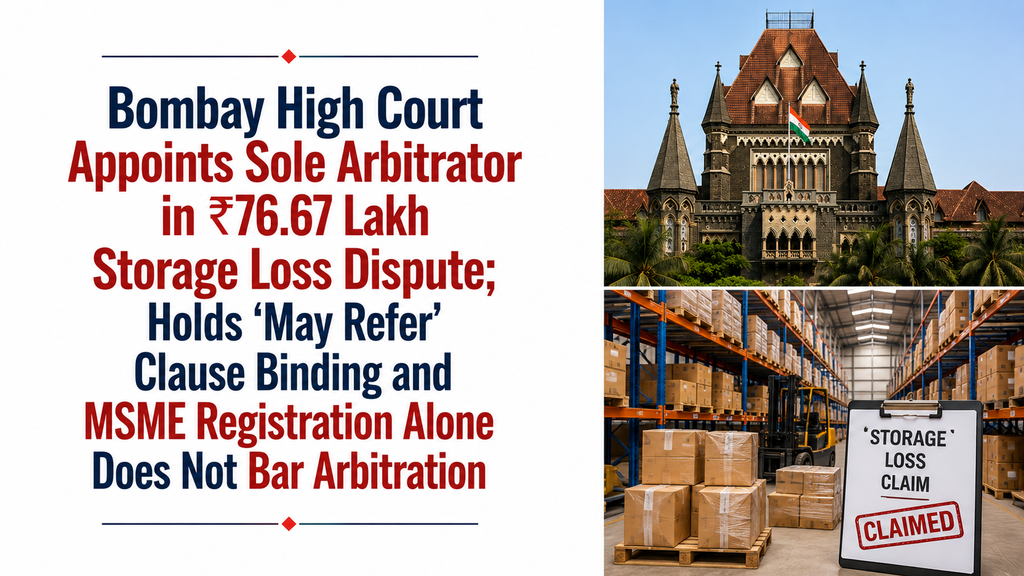
Bombay High Court Appoints Sole Arbitrator in ₹76.67 Lakh Storage Loss Dispute; Holds ‘May Refer’ Clause Binding and MSME Registration Alone Does Not Bar Arbitration

Bombay High Court Appoints Sole Arbitrator in Crates-and-Pallets Loss Dispute; Holds Clause Using ‘May’ Still Creates Binding Arbitration Agreement Between Parties
Facts
Qwik Supply Chain Private Limited filed an application under Section 11 of the Arbitration and Conciliation Act, 1996 seeking appointment of an arbitrator under Clause 19 of a Cold Storage Facility Service Agreement dated 27 April 2021 entered into with CRPL Infra Private Limited. The agreement required disputes first to be attempted to be settled amicably for 30 days and thereafter permitted either party to refer the dispute to arbitration by issuing a Request for Arbitration. The arbitration was to be conducted in Mumbai.
Clause 19 contemplated a three-member tribunal. The party invoking arbitration had to nominate its arbitrator, while the other party had 30 days to nominate its arbitrator. Importantly, if the other party failed to nominate within that period, the arbitrator named by the invoking party would decide the dispute as sole arbitrator.
The parties subsequently executed amendment agreements dated 20 April 2022 and 14 November 2022, principally concerning additional storage facilities and service-provider details. Those amendments expressly preserved the other terms of the main agreement except where specifically modified.
A dispute arose after crates and pallets allegedly entrusted during the contractual arrangement went missing. CRPL lodged a complaint, resulting in FIR No. 122 of 2023 at Sankrail Police Station, Howrah. CRPL thereafter acknowledged a shortage and stated that it had occurred due to theft, while expressing willingness to compensate uncovered losses through deductions from monthly service bills. Qwik ultimately demanded ₹76,67,613 towards the alleged loss.
On 24 June 2024, Qwik invoked arbitration and nominated its arbitrator. CRPL did not nominate an arbitrator in response within the contractual period. Instead, by letter dated 29 July 2024, it stated that as an MSME it intended to refer the dispute to the MSME Facilitation Council. CRPL itself later issued a Section 21 arbitration notice on 26 August 2024. Qwik then approached the Bombay High Court under Section 11.
Issues
The principal issues were whether:
- Clause 19 constituted a binding arbitration agreement despite using the expression “either Party may refer such Dispute to arbitration”;
- the subsequent amendment agreements displaced or excluded Clause 19;
- CRPL’s MSME registration ousted the High Court’s jurisdiction under Section 11;
- the MSMED Act automatically overrode the contractual arbitration clause;
- the dispute concerning missing crates and pallets became non-arbitrable because a theft FIR had also been registered;
- non-joinder of the persons allegedly involved in the theft or owners of the goods defeated arbitration;
- CRPL’s failure to nominate an arbitrator within 30 days triggered the contractual consequence that Qwik’s nominee would act as sole arbitrator; and
- which issues should be decided by the Section 11 Court and which should be left to the Arbitral Tribunal.
Applicant’s Arguments
Qwik argued that the mere use of the word “may” did not make arbitration optional.
Its submission was that Clause 19 had to be read as a whole. The clause contained a complete dispute-resolution machinery: an amicable-settlement period, a Request for Arbitration, nomination procedure, timelines, consequences for failure to nominate, Mumbai as the arbitral seat, English as the language and a final and binding award. This demonstrated a concluded intention to arbitrate rather than a future agreement to consider arbitration.
Qwik also argued that the respondent’s own Section 21 notice dated 26 August 2024 demonstrated that CRPL itself understood the agreement to contain a binding arbitration clause.
On the amendment agreements, Qwik submitted that these were merely amendments to the parent agreement and did not constitute independent contracts. Since Clause 19 was neither deleted nor replaced, it continued to bind the parties.
Regarding MSME status, Qwik contended that mere registration could not automatically bar Section 11 proceedings, particularly where no actual reference under Section 18 of the MSMED Act had been made before the High Court proceedings.
It further argued that the dispute was a civil claim for damages or compensation for missing goods entrusted under the contract, distinct from the question whether a third party committed theft. Criminal proceedings could therefore coexist with arbitration.
Respondent’s Arguments
CRPL argued that the expression “may refer” showed that Clause 19 did not create a mandatory or concluded arbitration agreement and required further consent after a dispute arose.
It further submitted that the operative rights arose under the amendment/addendum agreement and that the arbitration clause in the original agreement should not automatically govern those later contractual arrangements.
CRPL relied heavily on its status as an MSME, arguing that the MSMED Act was special legislation and that disputes ought to be taken before the Micro and Small Enterprises Facilitation Council rather than through Section 11 arbitration proceedings.
It also argued that persons allegedly responsible for theft and the alleged owners of the crates and pallets had not been joined, and therefore the dispute could not properly be adjudicated through the proposed arbitration.
Analysis of the Law
“May Refer to Arbitration” Can Still Create a Binding Agreement
The Court rejected the respondent’s argument based purely on the word “may.”
Justice Amit Borkar held that one word could not be isolated from the rest of the arbitration clause. The real test was whether the parties had already agreed to arbitration or whether, after a dispute arose, they still needed to enter into a fresh agreement or provide further consent.
Clause 19 showed that the parties had already made their choice. “May” merely gave either party the option to commence the already agreed arbitration process after the 30-day amicable-settlement period. It did not require renewed mutual consent.
The Court further noted that Clause 19 contained the full procedural framework for arbitration, including constitution of the tribunal, timelines, Mumbai as the arbitral place, English language and binding nature of the award. That made it fundamentally different from clauses which merely contemplate possible future arbitration.
Amendment Agreements Did Not Destroy Clause 19
The Court held that the 2022 amendments did not substitute the principal agreement.
They were limited amendments to Schedule V and other identified portions. The original agreement remained the parent contractual instrument and Clause 19 was never deleted, modified or replaced.
The reference to exclusive jurisdiction of Mumbai courts was not inconsistent with arbitration; it could operate for court proceedings arising under the Arbitration Act.
Accordingly, the arbitration agreement continued to govern disputes arising under both the main agreement and the amendments.
MSMED Act
The Court accepted the general proposition that the MSMED Act is special legislation and, where Chapter V is properly attracted and Section 18 is invoked, its statutory mechanism can override an independent arbitration agreement.
However, the Court rejected the broader submission that mere MSME registration automatically nullifies every contractual arbitration clause.
The Court noted two important circumstances.
First, CRPL had only stated an intention to approach the Facilitation Council; the material did not establish that it had actually made a reference under Section 18(1) before the Section 11 proceedings.
Second, Qwik’s claim was not, on its face, an ordinary claim by an MSME supplier for an unpaid amount for goods or services under Section 17. Rather, Qwik was claiming compensation of ₹76.67 lakh for allegedly lost crates and pallets.
The Court therefore held that MSME registration alone did not establish a jurisdictional bar to the Section 11 application. Questions concerning the ultimate applicability of the MSMED Act were left open for the arbitrator.
Precedent Analysis
Jagdish Chander v. Ramesh Chander
The Court applied Jagdish Chander for the distinction between:
- a clause under which parties merely contemplate agreeing to arbitration in the future; and
- a concluded arbitration agreement under which either party may invoke a pre-agreed mechanism.
The Court held that Clause 19 fell into the second category because no future agreement or fresh consent was necessary.
Alchemist Hospitals Ltd. v. ICT Health Technology Services India Pvt. Ltd.
The Court accepted the principle that merely describing a provision as an “arbitration clause” is insufficient if the actual language does not demonstrate a binding intention to arbitrate.
However, Alchemist Hospitals was distinguished because the present Clause 19 contained a complete arbitration mechanism and a concluded arrangement.
BGM and M-RPL-JMCT (JV) v. Eastern Coalfields Ltd.
This judgment was also distinguished. The Court explained that the relevant distinction was between a clause requiring future agreement to arbitrate and one in which the arbitration machinery was already agreed.
Here, either party could invoke arbitration unilaterally after the settlement period expired, and no further consent was required.
Mahakali Foods Pvt. Ltd.
This precedent was important to the MSME issue.
The Court recognised that Mahakali Foods holds that Chapter V of the MSMED Act overrides the Arbitration Act in disputes concerning amounts due under Section 17 where the statutory mechanism is properly available and invoked.
But the Court stressed that Mahakali Foods does not mean that every dispute involving an MSME automatically falls under Section 17 or overrides a contractual arbitration agreement. The party must satisfy the definition of “supplier,” the relevant statutory conditions and the nature of the dispute must fall within Chapter V.
Ajay Madhusudan Patel v. Jyotrindra S. Patel
The Court relied upon the limited scope of scrutiny at the Section 11 stage.
Once the Court finds a real arbitration agreement, it should not conduct a detailed trial into every jurisdictional or arbitrability objection. Such matters may be decided by the arbitral tribunal under Section 16.
Court’s Reasoning
The Court found a valid and operative arbitration agreement.
Clause 19 was not a loose statement that the parties might someday consider arbitration. It contained a comprehensive and enforceable arbitration procedure.
The respondent’s own conduct supported this interpretation because it subsequently issued its own Section 21 notice invoking arbitration.
The amendment agreements did not supersede or remove Clause 19.
CRPL’s MSME registration did not, standing alone, prevent the High Court from exercising Section 11 jurisdiction, particularly where no actual Section 18 reference was shown to have been made before the application and the dispute was not self-evidently a Section 17 payment claim.
Likewise, the existence of a theft FIR did not by itself prevent determination of the civil contractual liability between Qwik and CRPL. Questions about theft, ownership, necessary parties, liability and the scope of the MSMED Act could appropriately be examined by the arbitrator.
Failure to Nominate Arbitrator
The Court also gave effect to the specific consequence agreed in Clause 19.3.
Qwik had invoked arbitration and nominated an arbitrator on 24 June 2024. CRPL did not nominate its arbitrator within the stipulated 30 days. Its letter dated 29 July 2024 merely expressed disagreement and an intention to approach the MSME Council; it was not a nomination under Clause 19.3.
Its later independent Section 21 notice dated 26 August 2024 could not undo the consequence already triggered by the contractual default.
Clause 19.3 expressly provided that upon such failure, the arbitrator nominated in the original Request for Arbitration would decide the dispute as sole arbitrator.
Conclusion
The Bombay High Court allowed the Section 11 application and appointed Mr. Vikramjit Grewal, Advocate, as sole arbitrator to decide disputes arising from the Cold Storage Facility Service Agreement dated 27 April 2021 and its amendments dated 20 April 2022 and 14 November 2022.
The Court expressly kept open before the arbitrator all questions concerning:
- jurisdiction;
- arbitrability;
- applicability of the MSMED Act;
- maintainability of claims;
- liability and quantum;
- ownership of the goods;
- necessary parties; and
- all other merits-based objections.
The arbitrator was directed to make the disclosure required under Section 12(1), with Mumbai as the seat and venue and English as the language of arbitration. All observations in the judgment were confined to the Section 11 stage.
Case Details
Case: Qwik Supply Chain Private Limited v. CRPL Infra Private Limited
Court: High Court of Judicature at Bombay, Ordinary Original Civil Jurisdiction, Commercial Division
Case Number: Commercial Arbitration Application No. 377 of 2025; CNR No. HCBM020201772025
Judge: Justice Amit Borkar
Date: 25 August 2026
Result: Application allowed. Mr. Vikramjit Grewal appointed sole arbitrator; MSME, arbitrability, liability, ownership and other objections left open for determination by the tribunal.