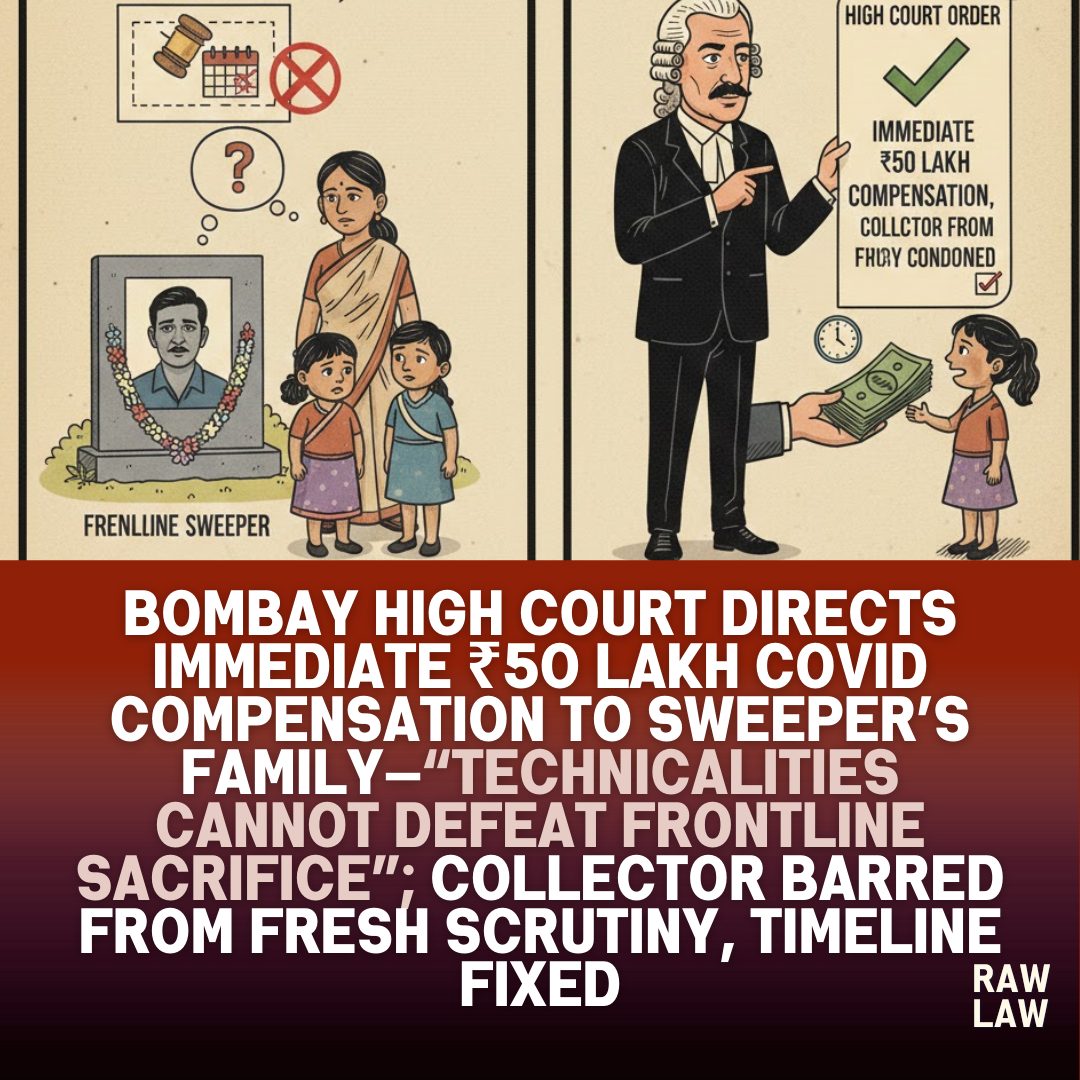
Bombay High Court directs immediate ₹50 lakh Covid compensation to sweeper’s family—“Technicalities cannot defeat frontline sacrifice”; Collector barred from fresh scrutiny, timeline fixed

1. Court’s decision
The Bombay High Court allowed a writ petition filed by the legal heirs of a Class IV municipal employee who died due to Covid-19 while deployed as frontline force staff. The Court directed the Collector, Nashik to process and forward the proposal for ₹50 lakh ex-gratia compensation under the Government Resolution dated 11 February 2022, without subjecting it to fresh verification.
Holding that procedural technicalities cannot override substantive entitlement, the Court fixed strict timelines and warned that any attempt to delay the claim on technical grounds would be viewed seriously.
2. Facts
Late Shri Unmesh Sharad Kulkarni had served as a Class IV employee with Manmad Municipal Council since 1990. On 9 January 2021, during the Covid-19 surge, he was assigned force duty at Dr. Babasaheb Ambedkar Playground and Railway Institute to tackle pandemic-related exigencies.
He contracted Covid-19 and died in harness on 29 March 2021. The Municipal Council compiled and forwarded a proposal dated 22 November 2021 to the District Administrative Officer with appointment orders, Covid duty letter, medical reports, death certificate mentioning Covid-19 as cause of death, treatment reports, and attendance records.
The State Government had issued a GR dated 4 August 2021 and a subsequent GR dated 11 February 2022 providing ₹50 lakh compensation to municipal frontline workers who died due to Covid-19. However, payment was stalled.
3. Issues
The primary issue was whether the petitioners were entitled to immediate Covid compensation under the Government Resolution, despite procedural objections regarding hospital admission and portal uploading.
A related issue concerned whether the Collector could insist on fresh scrutiny and verification under the GR procedure, given that the proposal had been pending since 2021.
The Court also examined whether admission in a private hospital or non-uploading of data on the ICMR portal could defeat the claim.
4. Petitioners’ arguments
The petitioners contended that all requisite documents were submitted and certified by the Municipal Council. The death certificate and hospital records confirmed Covid-19 as the cause of death.
They argued that the employee was undeniably a frontline worker deployed during the pandemic surge and that denial of compensation based on technical lapses such as non-uploading on the ICMR portal was arbitrary.
It was further submitted that the Government Resolution was issued after the employee’s death and therefore its procedural requirements could not be retrospectively enforced to defeat entitlement.
5. Respondents’ arguments
The State, through the learned AGP, submitted that the Collector must scrutinize the proposal under the GR dated 4 August 2021. It was argued that authenticity of documents and compliance with procedural requirements were necessary before forwarding the proposal to the Urban Development Department.
The affidavit of the Deputy Secretary clarified that the scheme required verification by the head of the organisation to prevent bogus claims and that no formal proposal had yet reached the State for final decision.
The State sought four weeks for scrutiny and additional time for processing at subsequent levels.
6. Analysis of the law
The Court acknowledged that ordinarily it would accept the State’s submission regarding scrutiny. However, in the peculiar facts of this case, it refused to adopt that course.
It noted that the employee had served for 31 years and was deputed as a frontline worker during the pandemic. The Municipal Council had already scrutinised and forwarded the proposal certifying that death was due to Covid-19.
The Court held that insistence on admission in a government hospital was arbitrary when the employee had contracted Covid during duty and the GR was issued posthumously. Procedural requirements under the GR were described as technical formalities that cannot override the substantive fact of death due to Covid-19 during frontline service.
7. Precedent analysis
The Bench relied on a recent judgment of the Kolhapur Circuit Bench in Vijaya Yashwant Jadhav v. Block Development Officer (W.P. No. 17617 of 2024), which emphasised the extraordinary sacrifice of frontline workers during the pandemic.
Extracting paragraphs 11 to 13 of that decision, the Court underscored that frontline workers confronted unprecedented danger and that it is a moral and societal imperative to support families of those who lost their lives in service.
The precedent reinforced a purposive interpretation of Covid compensation schemes, favouring substantive justice over rigid procedural compliance.
8. Court’s reasoning
The Court observed that the proposal had remained pending since 2021. To subject it again to detailed verification would prolong the agony of the bereaved family.
It held that once the factum of death due to Covid-19 is established and duty deployment is undisputed, the object of the compensation scheme must prevail. Whether the employee was admitted in a private or government hospital was immaterial.
The Court explicitly held that technical objections cannot defeat a rightful claim arising from frontline Covid duty. It therefore dispensed with further scrutiny and directed the Collector to process the proposal on the footing that documents and certificates are genuine.
9. Conclusion
The Court directed:
• The Collector, Nashik to forward the proposal within four weeks.
• The State Government to grant necessary approvals within four weeks thereafter.
• Compensation of ₹50 lakh to be paid within ten weeks from 16 February 2026.
The Court warned that any attempt to delay or defeat the claim on technical considerations would be viewed seriously. The petition was disposed of with a compliance listing after ten weeks.
10. Implications
This judgment reinforces a humane and purposive approach to Covid compensation schemes. It clarifies that:
• Procedural lapses like ICMR portal non-uploading cannot nullify entitlement.
• Admission in a private hospital does not defeat a claim.
• Long-pending proposals should not be subjected to repetitive scrutiny.
• Frontline worker status carries substantive protection under compensation GRs.
The ruling strengthens judicial commitment to honouring the sacrifices of municipal frontline employees and discourages bureaucratic delay in ex-gratia disbursement.
Case Law References
Vijaya Yashwant Jadhav v. Block Development Officer & Ors. (Bombay High Court, 10 October 2025) – Recognised moral imperative to compensate families of frontline workers who died during Covid-19; emphasised purposive interpretation of compensation schemes.
FAQs
1. Can Covid compensation be denied if the employee was treated in a private hospital?
No. The Court held that once death due to Covid during frontline duty is established, admission in a private hospital cannot defeat the claim.
2. Can authorities insist on fresh scrutiny after municipal verification?
In exceptional circumstances like long delay and undisputed documentation, courts may dispense with repetitive scrutiny to ensure timely relief.
3. What is the amount payable under the Maharashtra Covid compensation GR for municipal frontline workers?
₹50 lakh ex-gratia compensation under the Government Resolution dated 11 February 2022.