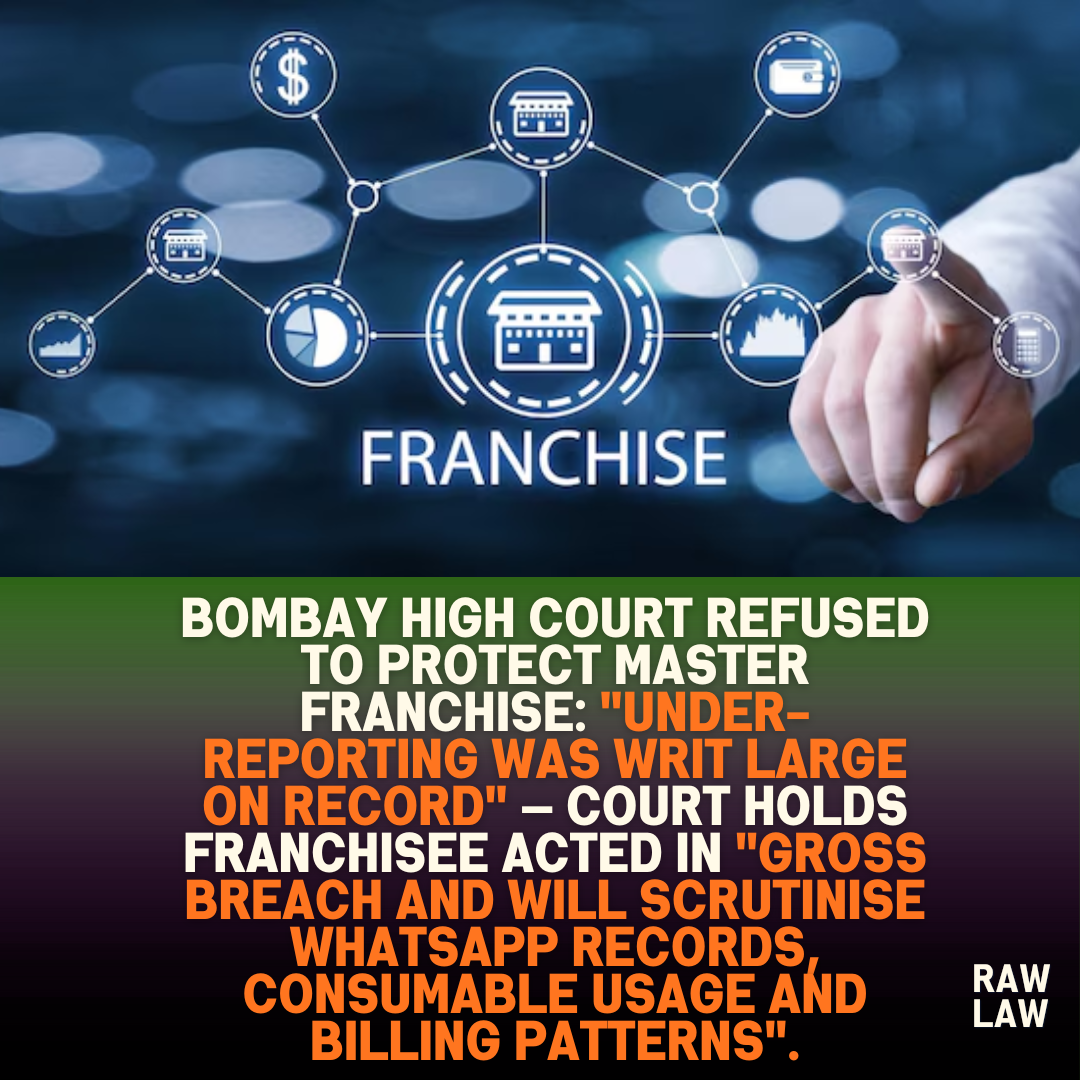
Bombay High Court Refused to Protect Master Franchise: “Under-Reporting Was Writ Large On Record” — Court Holds Franchisee Acted In “Gross Breach and will scrutinise WhatsApp records, consumable usage and billing patterns”.

Court’s Decision
The Bombay High Court dismissed the franchisee’s plea seeking to stay the termination of a long-standing master franchise agreement for hair restoration services, holding that the franchisee had been “deliberately, wilfully and fraudulently suppressing sales for years” to evade royalty payments.
The Court held that such conduct bars all equitable relief, including specific performance or interim injunction.
“A party in gross and continued breach cannot invoke equity. Fraud in reporting strikes at the root of the contract.”
The Court found that the franchisor had legitimately terminated the agreement after discovering that the franchisee had reported only 18–22% of actual sales, causing substantial royalty loss.
The plea that no “cure notice” was issued was rejected as “hyper-technical”, particularly since the franchisee was expressly warned through an email in April 2025 and still failed to correct the misreporting.
The Court concluded that the franchisee’s conduct amounted to fraud under Section 16 of the Specific Relief Act, making it ineligible for specific performance or injunction. The application was dismissed.
Facts
Under a 2018 master franchise arrangement, the franchisee obtained exclusive rights to operate hair restoration services in several territories. Royalty was fixed at 7% of billed and realised sales or 1800 euros per month, whichever was higher.
The parties had earlier separated their joint business through a settlement in 2017, after which the franchisee exclusively controlled the assigned territories. Several ancillary agreements—including territory assignment and novation documents—were executed to effectuate this restructuring.
In November 2024, an intellectual property assignment between a foreign entity and a competitor triggered tensions. Negotiations between the franchisee and competitor continued into 2025.
On 29 April 2025, an email was sent to the franchisee highlighting drastically low and suspicious sales figures and seeking corrected reports.
On 14 August 2025, the franchisor issued a termination notice, alleging:
- Massive under-reporting of actual sales
- Suppression of revenue across clinics
- Failure to pay royalty since January 2025
- Failure to report any sales after April 2025
The franchisee challenged the termination, claiming it was illegal and that the franchisor had no locus due to IP transfers. It sought a stay on termination and an injunction to continue operating the franchise.
The franchisor opposed the application, placing extensive material—including WhatsApp chats, invoices, and consumable usage data—demonstrating large-scale suppression of sales.
Issues
- Whether the franchise termination was valid.
- Whether absence of a formal 30-day cure notice rendered termination illegal.
- Whether the franchisee could seek specific performance despite allegations of fraud.
- Whether the intellectual property assignment violated contractual covenants.
- Whether interim protection could be granted in favour of a party accused of gross under-reporting.
Petitioner’s Arguments
The franchisee argued that, under the 2018 agreement, it had exclusive rights to operate in the assigned territories and that the franchisor could not terminate the arrangement without following the cure-notice mechanism.
It contended that the termination notice was invalid as no formal 30-day notice as required under Clause 10 was served. It also argued that the April 2025 email was not a cure notice, and further that it was issued by a third-party competitor rather than the franchisor.
To counter the allegations of under-reporting, the franchisee argued that patient packages included numerous non-franchise treatments such as plasma therapy, stem-cell procedures, bed charges, consumables and celebrity confidentiality preferences, which allegedly justified lower reported numbers. The incriminating WhatsApp chats, according to the franchisee, were leaked by a “disgruntled ex-employee” who had joined the competitor.
It also challenged the intellectual property transfer of November 2024 as being contrary to “negative covenants” in the franchise agreement.
Respondent’s Arguments
The franchisor submitted that the franchisee had been systematically concealing actual sales, backed by detailed documentary proof. WhatsApp chats reflected:
- Higher actual prices charged to patients
- Significantly lower invoice amounts
- Purchases of consumables sufficient for 1,585 hair transplant sessions, while reporting only 507 sessions
Historical data also showed that the franchisee’s reported average session price had dropped to ₹1.27 lakh, when historically it had been over ₹2.28 lakh.
The franchisor argued that, since fraud was established, the cure-notice requirement did not survive, as equity cannot aid a party in wilful breach. It relied on precedents holding that fraud nullifies contractual protections.
It was submitted that even if the cure notice was defective, the franchisee could only claim damages, not specific performance, due to Section 16 of the Specific Relief Act.
Analysis of the Law
The Court found the material on record “clinching”:
- The franchisee had purchased consumables for 1,585 sessions but reported only 507.
- Actual revenue for October 2024–March 2025 was over ₹3 crore, but reported sales were only ₹66 lakh.
- The franchisee’s own future earnings projection of ₹25 crore contradicted its past reporting of approximately ₹2 crore per year.
The defence that packages included non-franchise services was rejected because:
- WhatsApp chats showed separate charges for franchise treatments and ancillary procedures.
- No invoices for non-franchise services were produced.
The Court held that the attempt to explain away discrepancies was “afterthought and unconvincing.”
Regarding the cure notice, the Court held that the 29 April 2025 email expressly demanded corrected sales within 48 hours and therefore constituted adequate notice. The franchisee’s failure to reply was fatal.
Finally, applying Section 16 of the Specific Relief Act, the Court held that the franchisee’s conduct amounted to fraud and wilful variance from contractual obligations, barring it from seeking specific performance.
Precedent Analysis
- Maharashtra State Road Development Corporation v. Plus BKSP Toll
Cited for cure-notice interpretation; held inapplicable as it did not involve systematic fraud. - Bharat Petroleum v. Jethanand Karachiwala
Applied to affirm that fraud eliminates the need for cure notice and disentitles equitable relief. - Navyauga Machilipatnam Port Limited v. State of Andhra Pradesh
Reiterated that courts cannot grant relief to a party acting in fraud. - Gujarat Bottling Co. v. Coca Cola
Cited on negative covenants; held irrelevant because the IP assignment was not by the franchisor.
Court’s Reasoning
The Court expressly held:
“Plaintiffs have indulged in gross suppression of sales with the oblique motive of avoiding payment of royalty.”
It found that:
- Fraud was prima facie proved.
- The franchisee could not seek equity or injunction.
- Even assuming a defect in cure notice, the franchisee could only seek damages, not continuation of the franchise.
- The termination was valid and based on solid financial discrepancies.
The Court emphasised that forcing a franchisor to continue a franchise with a defaulting party would undermine commercial fairness.
Conclusion
The High Court:
- Dismissed the interim application,
- Upheld the termination,
- Rejected the plea for injunction, and
- Held that the franchisee is not entitled to specific performance due to fraud under Section 16.
The franchisee was left to seek only damages, if any, in the main suit.
“Equity cannot rescue a party who manipulates contractual reporting and evades financial obligations.”
Implications
This ruling reinforces critical principles for franchising:
- Accurate sales reporting is non-negotiable; royalty evasion amounts to fraud.
- Cure-notice arguments cannot shield fraudulent conduct.
- Courts will scrutinise WhatsApp records, consumable usage and billing patterns.
- Negative covenants cannot be invoked where the core breach is fraudulent misreporting.
- Specific performance is unavailable to parties acting in bad faith.