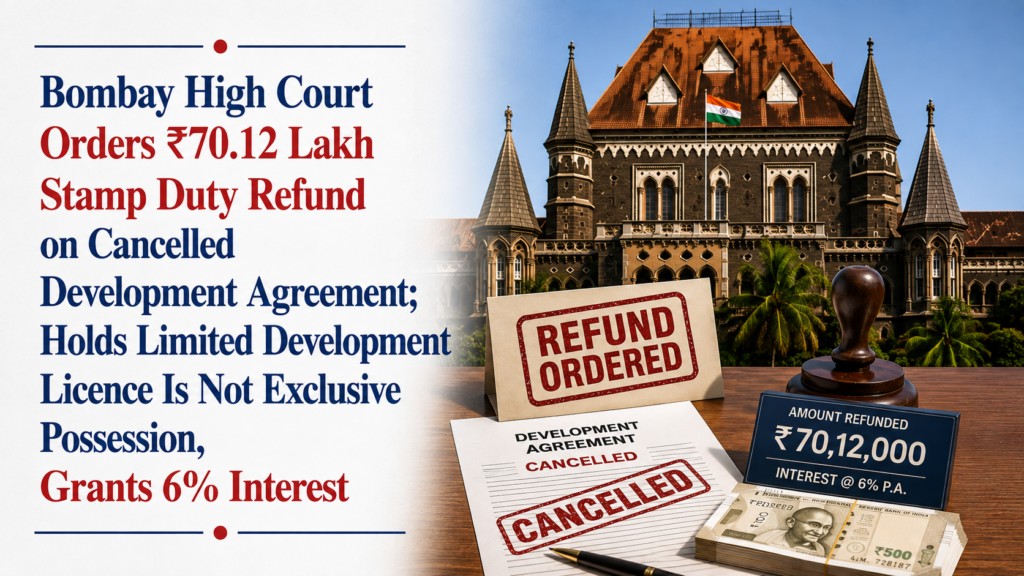
Bombay High Court Orders ₹70.12 Lakh Stamp Duty Refund on Cancelled Development Agreement; Holds Limited Development Licence Is Not Exclusive Possession, Grants 6% Interest

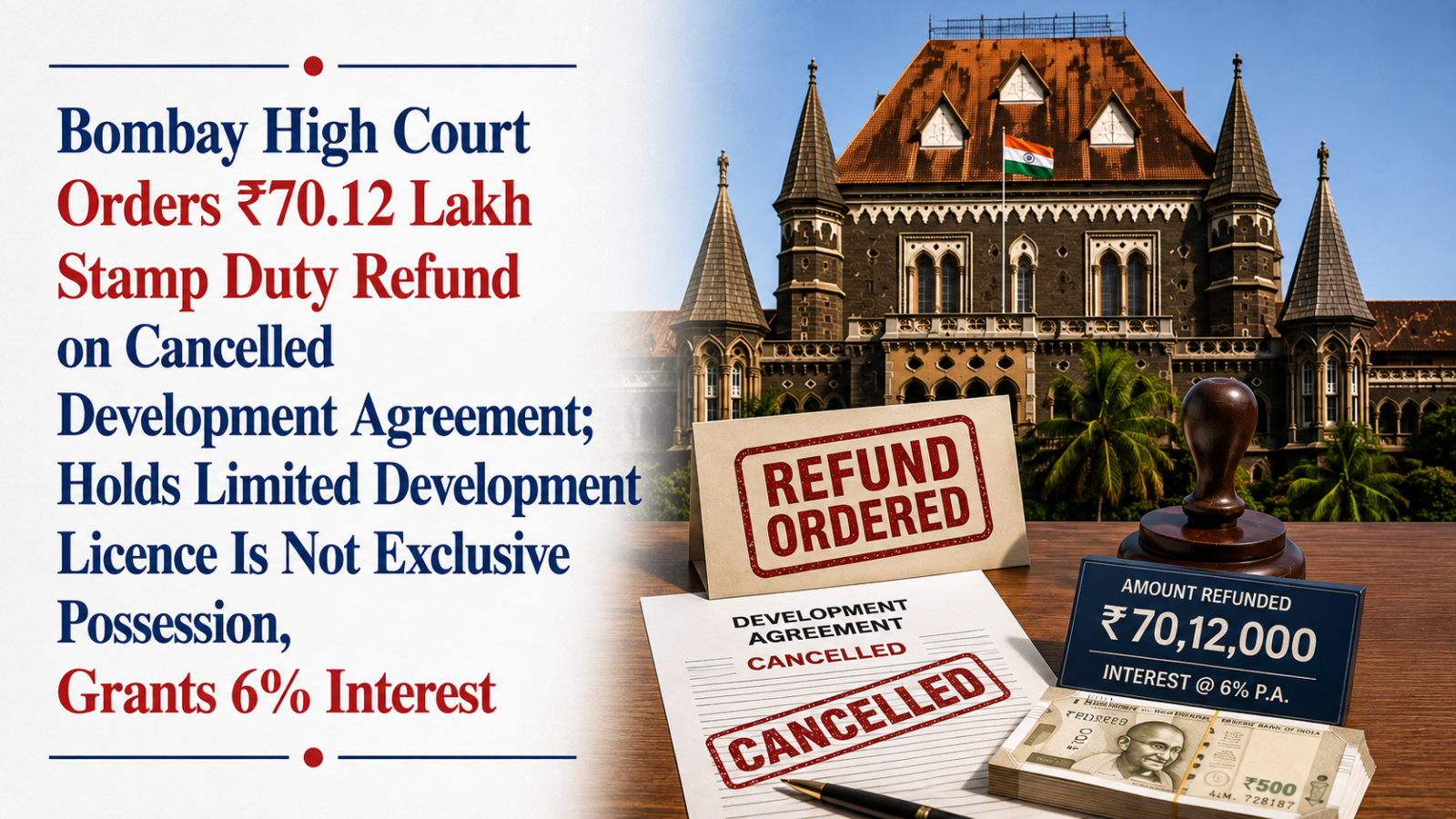
Bombay High Court Orders Stamp Duty Refund Within Six Weeks; Finds Development Agreement Failed, Possession Was Merely Licensed and Extended Limitation Proviso Applied
Facts
The petitioner, Sai Innovation, a partnership firm, challenged orders dated 11 August 2014 and 6 December 2014 passed by the stamp authorities refusing refund of ₹70,12,500 paid as stamp duty. It sought refund together with interest.
On 15 April 2013, the petitioner entered into a registered Development Agreement with the owners of approximately 8,000 sq. metres of land bearing Survey No. 29/4/2 at Balewadi, Pune. At registration, stamp duty of ₹70,12,500 was paid.
The proposed development did not proceed because building plans could not be sanctioned within a reasonable period and disputes arose between the parties. The consideration received by the owners was returned, and the parties mutually executed a Cancellation Deed dated 18 February 2014, which was registered on 24 February 2014.
The petitioner thereafter applied on 7 April 2014 for refund of the stamp duty. The Deputy Controller of Stamps declined to recommend the refund, and the Joint District Registrar and Collector of Stamps formally rejected it on 6 December 2014 on the ground that the application was not covered by the proviso to Section 48(1) of the Maharashtra Stamp Act, 1958.
During the writ proceedings, the State additionally argued that possession of the property had already been transferred to the developer under Clause 13 of the Development Agreement and that the refund claim was also barred by limitation.
Issues
The principal issues were:
- Whether the failed and subsequently cancelled Development Agreement entitled the petitioner to refund under Section 47(c)(5) of the Maharashtra Stamp Act, 1958.
- Whether a Development Agreement can fall within the proviso to Section 48(1) merely because it is not formally titled a “conveyance”.
- Whether the contractual right given to the developer under Clauses 11 and 13 amounted to legal and exclusive possession, thereby defeating the refund claim.
- Whether the refund application was barred by the ordinary six-month limitation period or benefited from the extended period under the proviso to Section 48(1).
- Whether the State could support the impugned order by introducing a fresh ground concerning possession through its affidavit, when that ground was absent from the original order.
- Whether the petitioner was entitled to interest on the refunded stamp duty.
Petitioner’s Arguments
The petitioner submitted that the stamp authorities had rejected the application solely because they considered the Development Agreement outside the scope of the proviso to Section 48(1).
It relied heavily upon the Bombay High Court’s later decision in M/s. Satyam Construction, arguing that a Development Agreement on which stamp duty is calculated with reference to Article 25 may be treated at par with a conveyance for the limited purpose of applying the proviso to Section 48(1).
The petitioner also opposed the State’s argument that possession had been handed over.
It relied upon Clause 11 of the Development Agreement, which described the developer’s entry and possession as being “as a licensee for development”. According to the petitioner, Clause 13 could not be read in isolation and had to be interpreted together with Clause 11.
The rights granted merely enabled the developer to enter the land, conduct surveys, carry out levelling, obtain sanctions, utilise FSI/TDR and perform development-related work. These were development rights rather than a transfer of exclusive juridical possession.
The petitioner further emphasised that:
- development never commenced;
- no construction was undertaken;
- no third-party rights were created; and
- the Development Agreement was cancelled before the intended transaction could be implemented.
It also relied upon Mohinder Singh Gill v. Chief Election Commissioner to contend that an administrative order must stand or fall on the reasons contained in it and cannot subsequently be improved through new reasons introduced in an affidavit.
Respondents’ Arguments
The State argued that the petitioner had not satisfied the statutory conditions for refund.
It contended that the Development Agreement was executed on 15 April 2013 and, under the ordinary portion of Section 48(1), the refund application had to be filed within six months. According to the State, the application was therefore belated.
The State further relied upon Clause 13 of the Development Agreement to argue that actual and open possession had been handed over to the developer, and therefore the transaction had progressed sufficiently to disentitle the petitioner from refund.
It also argued that a Development Agreement and Conveyance Deed are fundamentally different instruments and that merely calculating stamp duty with reference to Article 25 does not transform every Development Agreement into a conveyance.
For this proposition, the State relied upon Prasun Developers v. State of Maharashtra.
Analysis of the Law
Section 47 Creates the Right; Section 48 Governs Time
Justice Amit Borkar drew an important distinction between Sections 47 and 48 of the Maharashtra Stamp Act.
Section 47 is the substantive provision creating the entitlement to allowance or refund where circumstances specified by the statute exist.
Section 47(c)(5) specifically applies where an instrument fails to achieve its intended purpose because of refusal or non-performance contemplated by that provision.
Section 48, on the other hand, primarily prescribes the period within which the statutory right to refund must be exercised.
The Court held that the proviso to Section 48(1) does not independently create the right to refund; it merely provides an extended period of limitation where its requirements are satisfied.
Therefore, the stamp authority had approached the matter incorrectly by first asking whether the instrument fell within the Section 48 proviso and rejecting the substantive refund claim merely because it concluded that it did not.
Development Agreement Failed of Its Intended Purpose
The Development Agreement was entered into specifically to develop the Balewadi property.
The development never proceeded, the building plans were not sanctioned within the contemplated period, disputes arose, the consideration was returned and the parties mutually cancelled the agreement through a registered instrument.
There was also no evidence that construction had commenced or third-party rights had been created.
The Court therefore held that there was sufficient material to establish that the intended transaction never fructified, supporting the petitioner’s claim under Section 47(c)(5).
Development Licence Is Not Necessarily Legal Possession
A significant part of the dispute concerned the meaning of Clauses 11 and 13 of the Development Agreement.
Clause 13 contained language suggesting that “actual and open possession” had been given. However, Clause 11 expressly qualified the developer’s status as a licensee for the purpose of development.
The Court held that contractual provisions cannot be interpreted in isolation. The instrument must be read as a whole, and one clause may qualify or explain another.
Reading Clauses 11 and 13 together, the Court concluded that the developer had been given a contractual licence to enter upon the property and perform acts necessary for development, rather than complete and exclusive legal possession.
The factual conduct supported this interpretation: the developer never commenced construction, never created third-party rights and never asserted exclusive possession against the owners.
Accordingly, the alleged handing over of possession did not defeat the refund claim.
Development Agreement Can Receive Benefit of Section 48 Proviso
The Court applied M/s. Satyam Construction.
It noted that even though a Development Agreement may technically fall under Article 5(g-a)(i), the stamp duty payable upon it can be calculated with reference to the duty payable on a conveyance under Article 25.
Satyam Construction had consequently held that:
a Development Agreement may be treated at par with a conveyance for the limited purpose of the proviso to Section 48(1) where its stamp duty is calculated under Article 25.
The Court carefully clarified that this does not mean every Development Agreement becomes a Conveyance Deed for all purposes.
The question is narrower: whether such an instrument qualifies for the extended statutory period for seeking refund. Its title or nomenclature alone cannot decide that question.
Refund Claim Was Within Limitation
The Development Agreement was executed on 15 April 2013.
The registered Cancellation Deed was executed on 18 February 2014 and registered on 24 February 2014.
The Court accepted 7 April 2014 as the date of the refund application.
Once the transaction was held capable of falling under the proviso to Section 48(1), the State could not mechanically apply the ordinary six-month period calculated from execution of the original Development Agreement.
The registered cancellation and refund application were within the period contemplated by the proviso, and therefore the limitation objection failed.
Precedent Analysis
1. M/s. Satyam Construction, Writ Petition No. 241 of 2015, decided on 3 September 2025
This was the principal precedent governing the case.
The Court followed Satyam Construction for two important propositions:
First, the substantive right to refund flows from Section 47, while the proviso to Section 48(1) concerns the extended period for exercising that right.
Second, a Development Agreement may be treated at par with a conveyance for the limited purpose of Section 48(1) where stamp duty is calculated with reference to Article 25.
2. Sandeep Dwellers Pvt. Ltd.
This decision was considered through Satyam Construction regarding the interrelationship between stamp duty payable on a Development Agreement under Article 5 and the duty calculated by reference to Article 25.
3. Shweta Infrastructure and Housing (I) Pvt. Ltd.
This authority was also discussed through Satyam Construction concerning refund of stamp duty and applicability of the extended period under the proviso to Section 48(1).
4. Prasun Developers v. State of Maharashtra
The State relied upon Prasun Developers for the general proposition that a Development Agreement and Conveyance Deed are distinct instruments.
The Court accepted that proposition but held that it did not answer the narrower question before it: whether, for purposes of the Section 48 proviso, a Development Agreement whose duty is calculated by reference to Article 25 may receive the extended limitation benefit.
5. Mohinder Singh Gill v. Chief Election Commissioner, (1978) 1 SCC 405
The Court reaffirmed the principle that an administrative order ordinarily must be judged on the reasons stated in the order itself and cannot later be improved through additional grounds in an affidavit.
Therefore, the State could not ordinarily sustain the original rejection by introducing a fresh possession-based ground that did not appear in the impugned order.
The Court nevertheless examined the possession objection independently on merits and rejected it as well.
6. Ravindra C. Khirsara v. State, (2020) 14 SCC 774 and Darshana Anand Damle v. Deputy Commissioner of Income Tax, 2023 SCC OnLine Bom 1909
These authorities were relied upon by the petitioner in support of its contractual interpretation concerning possession and the distinction between a limited developmental licence and legal possession.
Court’s Reasoning
The Court identified three principal errors in the State’s rejection.
First, the stamp authority misunderstood the statutory structure by treating the proviso to Section 48(1) as though it created the substantive refund right. The correct inquiry begins under Section 47.
Second, the authority rejected the claim simply because the instrument was described as a Development Agreement rather than a conveyance. In light of Satyam Construction, that nomenclature-based approach was legally unsustainable where stamp duty had been calculated with reference to Article 25.
Third, the State’s possession objection rested upon reading Clause 13 in isolation. When Clauses 11 and 13 were read harmoniously, the developer’s rights amounted only to a limited licence for development, not unconditional or exclusive legal possession.
Most importantly, the intended transaction never materialised. There was no construction, no completed development and no third-party rights before the agreement was mutually cancelled.
The Court therefore held that the petitioner was entitled to refund under Section 47 read with the applicable proviso to Section 48(1).
Conclusion
The Bombay High Court allowed the writ petition and quashed both the order dated 6 December 2014 passed by the Joint District Registrar and Collector of Stamps and the earlier decision dated 11 August 2014 refusing to recommend the refund.
The petitioner’s refund application dated 7 April 2014 was allowed.
The State authorities were directed to refund ₹70,12,500 paid as stamp duty on the Development Agreement dated 15 April 2013.
The Court additionally awarded simple interest at 6% per annum from 7 April 2014 until actual payment.
The entire refund together with accrued interest was directed to be paid within six weeks from uploading of the judgment.
The judgment therefore establishes that where a stamped Development Agreement fails before the intended development is implemented, is mutually cancelled through a registered deed, and merely grants the developer a limited developmental licence rather than exclusive legal possession, refund may be claimed under Section 47 with the benefit of the applicable proviso to Section 48(1).
Case Details
Case: Sai Innovation v. Joint District Registrar and Collector of Stamps, Pune City & Others
Court: High Court of Judicature at Bombay, Civil Appellate Jurisdiction
Case Number: Writ Petition No. 7566 of 2016
Judge: Justice Amit Borkar
Date: 20 August 2026; Reserved on 18 August 2026
Result: Writ petition allowed; refusal orders quashed; ₹70,12,500 stamp duty directed to be refunded with 6% simple interest from 7 April 2014 until payment, within six weeks.