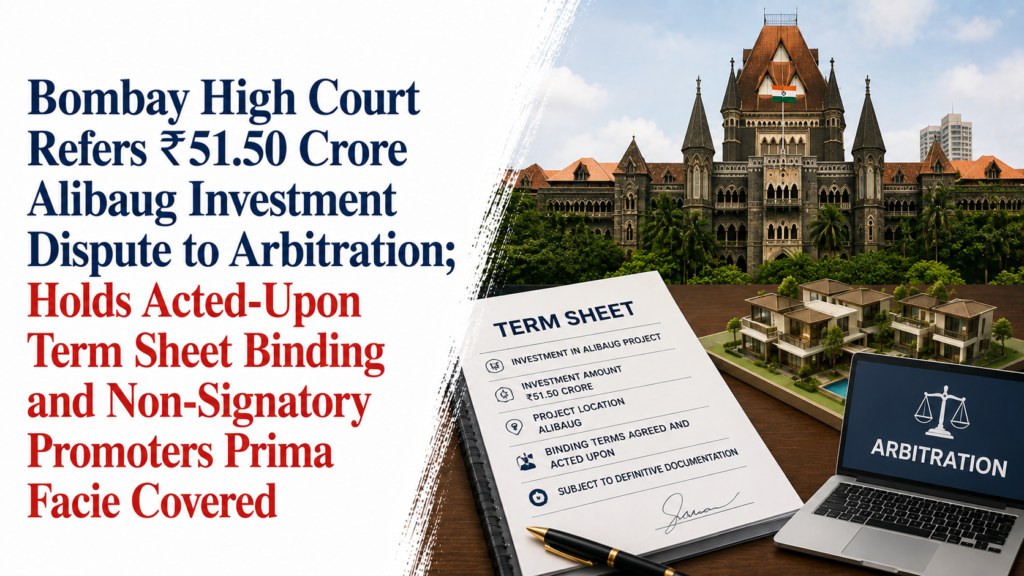
Bombay High Court Refers ₹51.50 Crore Alibaug Investment Dispute to Arbitration; Holds Acted-Upon Term Sheet Binding and Non-Signatory Promoters Prima Facie Covered

Bombay High Court Appoints Former Judge as Arbitrator in ₹51.50 Crore Dispute; Holds Trustee Prima Facie Entitled to Invoke Wound-Up Fund Scheme’s Arbitration Clause
Facts
Urban Infrastructure Trustees Limited, acting as trustee of Urban Infrastructure Venture Capital Fund (UIVCF), filed an application under Section 11 of the Arbitration and Conciliation Act, 1996, seeking appointment of an arbitral tribunal under Clause 41 of a Term Sheet dated 21 February 2007.
The dispute arose from an investment in Neelkanth Township and Construction Pvt. Ltd., a company engaged in real estate development. According to the Applicant, Respondent Nos. 1 to 4 promoted Neelkanth and approached it in 2007 to finance a bungalow project at Kihim, Alibaug.
A Term Sheet was executed on 21 February 2007 recording the key terms governing the proposed investment. Respondent No. 1, Bhavik Bhimjiyani, signed the Term Sheet, including in the capacity of promoter.
Following due diligence and representations made by the promoters, the Applicant invested approximately ₹51.50 crore in Neelkanth. Approximately 82 acres of land were purchased for the project, but according to the Applicant, no effective development thereafter took place.
The parties exchanged several communications regarding the investment, promoters’ contribution, refund and settlement. Mediation/settlement discussions ultimately failed.
On 27 February 2016, the Applicant invoked Clause 41 of the Term Sheet and sought arbitration. The Respondents denied the maintainability of arbitration, following which the Section 11 application was filed on 14 June 2016.
The Respondents raised several objections: the Term Sheet was merely preliminary and not a concluded contract; some respondents had never signed it; the Applicant lacked locus because UIOF had subsequently been wound up; and the underlying monetary claims were hopelessly barred by limitation.
Issues
The Bombay High Court framed four principal issues:
- Whether the Term Sheet dated 21 February 2007 constituted a concluded arrangement containing an enforceable arbitration clause, or merely contemplated a future contract without binding effect;
- Whether Urban Infrastructure Trustees Limited had locus standi to invoke arbitration and represent the party to the Term Sheet;
- Whether a Section 11 referral court could examine limitation of the underlying arbitral claims, and whether those claims were time-barred; and
- Whether the Respondents could be referred to arbitration as signatory and non-signatory parties to the Term Sheet.
Petitioner’s Arguments
The Applicant argued that at the Section 11 stage the Referral Court was primarily required to determine whether a prima facie arbitration agreement existed.
Clause 41 expressly required disputes and differences to be referred to arbitration and designated Mumbai as the place of arbitration.
The Applicant emphasised that the Term Sheet was not merely an unimplemented proposal. It had actually been acted upon, most importantly through the investment of approximately ₹51.50 crore.
The subsequent communications between the parties acknowledged the investment and, according to the Applicant, demonstrated that Respondent Nos. 1 to 4 functioned collectively as the Bhimjiyani promoter group.
On the non-signatory issue, the Applicant relied on the conduct and participation of the Respondents in the transaction, their correspondence concerning the investment, their involvement in settlement negotiations and their treatment as promoters.
The Applicant also contended that the underlying claim was not necessarily barred by limitation because there were alleged acknowledgments of liability extending up to 2014. In any event, whether the substantive claims were time-barred was a matter for the arbitral tribunal rather than the Section 11 Court.
Respondent’s Arguments
Respondent No. 1 contended that he had not signed the Term Sheet in his personal capacity, but only on behalf of Neelkanth.
The Respondents argued that the Term Sheet contemplated subsequent definitive agreements, including a Share Subscription Agreement, Shareholders’ Agreement and Debenture Subscription Agreement. Since these definitive agreements were never executed, the Term Sheet was said to be merely preliminary and to have expired by efflux of time.
They further argued that UIOF, the entity identified in the Term Sheet, was no longer in existence and that Urban Infrastructure Trustees Limited therefore lacked locus to invoke the arbitration agreement.
A substantial objection was also raised on limitation. The Term Sheet dated back to 2007 and was said to have expired by 30 April 2008, whereas arbitration was invoked only on 27 February 2016. According to the Respondents, the substantive claims were therefore ex facie and hopelessly time-barred.
Respondent Nos. 3 and 4 separately contended that they were neither parties nor signatories to the Term Sheet, had never authorised anyone to execute it on their behalf and therefore could not be compelled to arbitrate without consent.
Analysis of the Law
1. Applicant Had Prima Facie Locus to Invoke Arbitration
The Court noted that Urban Infrastructure Trustees Limited was acting as the sole trustee of UIVCF, while UIOF was a scheme of UIVCF.
Although UIOF was wound up with effect from 31 January 2023, UIVCF continued as a private trust.
The Court therefore found, prima facie and for the limited purpose of Section 11, that the Applicant as sole trustee had the right to invoke the arbitration agreement and institute the application.
Importantly, the Court expressly left the issue open for further contest before the arbitrator.
2. Term Sheet Was Acted Upon and Arbitration Clause Survived
The Court rejected the argument that the Term Sheet was merely a loose collection of terms dependent entirely upon execution of future definitive agreements.
The Applicant had invested approximately ₹51.50 crore, and the Respondents’ communications acknowledged that investment.
Thus, the parties had acted upon the Term Sheet.
The fact that subsequent comprehensive agreements were never executed did not erase the parties’ intention, expressed through Clause 41, that disputes arising under the Term Sheet would be resolved through arbitration.
The Court distinguished PSA Mumbai Investments Pte. Ltd. v. Board of Trustees of Jawaharlal Nehru Port Trust, where no concluded contract arose because essential contractual steps had never occurred.
Here, by contrast, the parties had actually acted upon the Term Sheet, and the Term Sheet itself contained the arbitration clause.
Accordingly, the Court held prima facie that disputes arising from the Term Sheet were referable to arbitration.
3. Referral Court Cannot Decide Limitation of Underlying Claims
A significant portion of the judgment concerned the scope of a Section 11 Court when an objection is raised that the substantive arbitral claims are time-barred.
The Court followed the seven-Judge Bench ruling in In Re: Interplay Between Arbitration Agreements under the Arbitration Act and the Stamp Act and subsequent three-Judge Bench decisions.
It held that the Referral Court’s limitation inquiry is restricted to determining whether the Section 11 application itself was filed within the applicable three-year limitation period.
The Court should not undertake an intricate evidentiary inquiry into whether the underlying substantive claims are barred by limitation; that issue belongs to the arbitrator.
The Court went further and clarified that the expression prohibiting an “intricate evidentiary inquiry” should not be understood as preserving a general power to reject an underlying claim merely because it appears prima facie time-barred.
It held that the earlier limited inquiry recognised in Arif Azim had been foreclosed by the subsequent larger-bench jurisprudence in Interplay, Krish Spinning and Asap Fluids.
Accordingly, factual questions concerning acknowledgments of liability and the precise limitation period governing the ₹51.50 crore claim were left to the arbitral tribunal.
4. Non-Signatories Can Be Bound Through Conduct and Participation
The Court then addressed whether Respondent Nos. 2 to 4, despite not signing the Term Sheet, could nevertheless be referred to arbitration.
The Court applied the Supreme Court’s jurisprudence in Cox and Kings Ltd. v. SAP India Pvt. Ltd. and KKH Finvest Pvt. Ltd. v. Ashiesh Shukla.
The governing principle is that the absence of a signature does not automatically exclude a person from an arbitration agreement.
Consent may be inferred from the person’s legal relationship with signatories and participation in negotiation, performance or termination of the underlying transaction. Conduct can therefore demonstrate an intention to be bound.
The Court also recognised that factors such as the composite nature of the transaction, commonality of subject matter and interconnectedness of claims are relevant when assessing non-signatories.
Precedent Analysis
In Re: Interplay Between Arbitration Agreement under the Arbitration and Conciliation Act, 1996 and the Indian Stamp Act, 1899
The seven-Judge Bench decision was treated as foundational for defining the narrow scope of judicial scrutiny at the referral stage.
The Section 11 Court principally examines the prima facie existence of an arbitration agreement, rather than deciding substantive disputes that properly belong to the tribunal.
SBI General Insurance Co. Ltd. v. Krish Spinning
This decision clarified that while the Referral Court can determine whether the Section 11 petition itself is within limitation, it should not conduct an intricate inquiry into limitation governing the underlying claims.
The Bombay High Court applied that distinction directly.
Aslam Ismail Khan Deshmukh v. ASAP Fluids Pvt. Ltd.
The Court relied upon this three-Judge Bench authority to reinforce the position that limitation concerning substantive claims is for the Arbitral Tribunal.
State of West Bengal v. BBM Enterprises
The Respondents relied upon this judgment because the Supreme Court had refused reference where the claimant had slept over its claim for approximately 21 years.
The Bombay High Court, however, held that BBM Enterprises did not disturb the larger-bench principles in Interplay and subsequent three-Judge Bench decisions restricting the Referral Court’s inquiry.
Cox and Kings Ltd. v. SAP India Pvt. Ltd.
This was central to the non-signatory question.
The Supreme Court recognised that consent to an arbitration agreement can be manifested through acts and conduct, and that a legal relationship arising from conduct can potentially bring a non-signatory within an arbitration agreement.
KKH Finvest Pvt. Ltd. v. Ashiesh Shukla
This recent Supreme Court authority applied the concept of “veritable parties.”
It emphasised that participation by a non-signatory in the performance of the underlying transaction is particularly important in determining whether that person intended to be bound.
The Court also referred to the factors recognised in ONGC v. Discovery Enterprises, including participation, composite nature of the transaction and commonality of subject matter.
Court’s Reasoning
The Court found several circumstances sufficient to justify reference to arbitration.
First, the Term Sheet contained an express arbitration agreement under Clause 41.
Second, the transaction had moved substantially beyond preliminary negotiations: the Applicant had invested approximately ₹51.50 crore pursuant to the arrangement, and the investment was acknowledged in subsequent communications.
Third, Respondent No. 1’s argument that he had signed only as a director was prima facie rejected because the Court found that he had also independently signed as a promoter.
Fourth, the documentary record showed dealings with Respondent Nos. 1 to 4 collectively as the Bhimjiyani Group/promoters in connection with the investment and Alibaug project.
Applying Cox and Kings and KKH Finvest, the Court held that intrinsic and extrinsic material could be examined to determine whether non-signatories were nevertheless parties to the arbitration arrangement.
The Court therefore found Respondent No. 1 to be a signatory and the remaining Respondents prima facie non-signatory parties connected with the Term Sheet.
Since the dispute arose from implementation of that Term Sheet, Clause 41 applied and the parties were referred to arbitration.
Conclusion
The Bombay High Court disposed of the Section 11 application by referring the parties to arbitration.
Mr. S. C. Gupte, former Judge of the Bombay High Court, was appointed as the sole arbitrator to adjudicate disputes and differences arising out of and in connection with the agreement.
The Court further directed that arbitral fees and costs would initially be borne equally by the parties, subject to the final award on costs.
Crucially, all contentions of the parties were expressly kept open before the arbitrator, meaning the prima facie findings at the Section 11 stage did not finally determine the substantive rights, limitation objections or liability of the parties.
The Arbitration Application was accordingly disposed of.
Case Details
Case: Urban Infrastructure Trustees Limited v. Bhavik Bhimjiyani & Ors.
Court: High Court of Judicature at Bombay, Ordinary Original Civil Jurisdiction
Case Number: Commercial Arbitration Application No. 14 of 2016
Judge: Justice Arun R. Pedneker
Date: 12 August 2026
Result: Section 11 application disposed of by referring the parties, including prima facie non-signatory promoters, to arbitration; former Bombay High Court Judge S. C. Gupte appointed sole arbitrator; all substantive contentions kept open.