Supreme Court Bars Arrest Protection After Anticipatory Bail Dismissal; Holds GST Commissioner Must Communicate Section 69 Arrest Order Before Arrest, Enabling Accused to Seek Bail

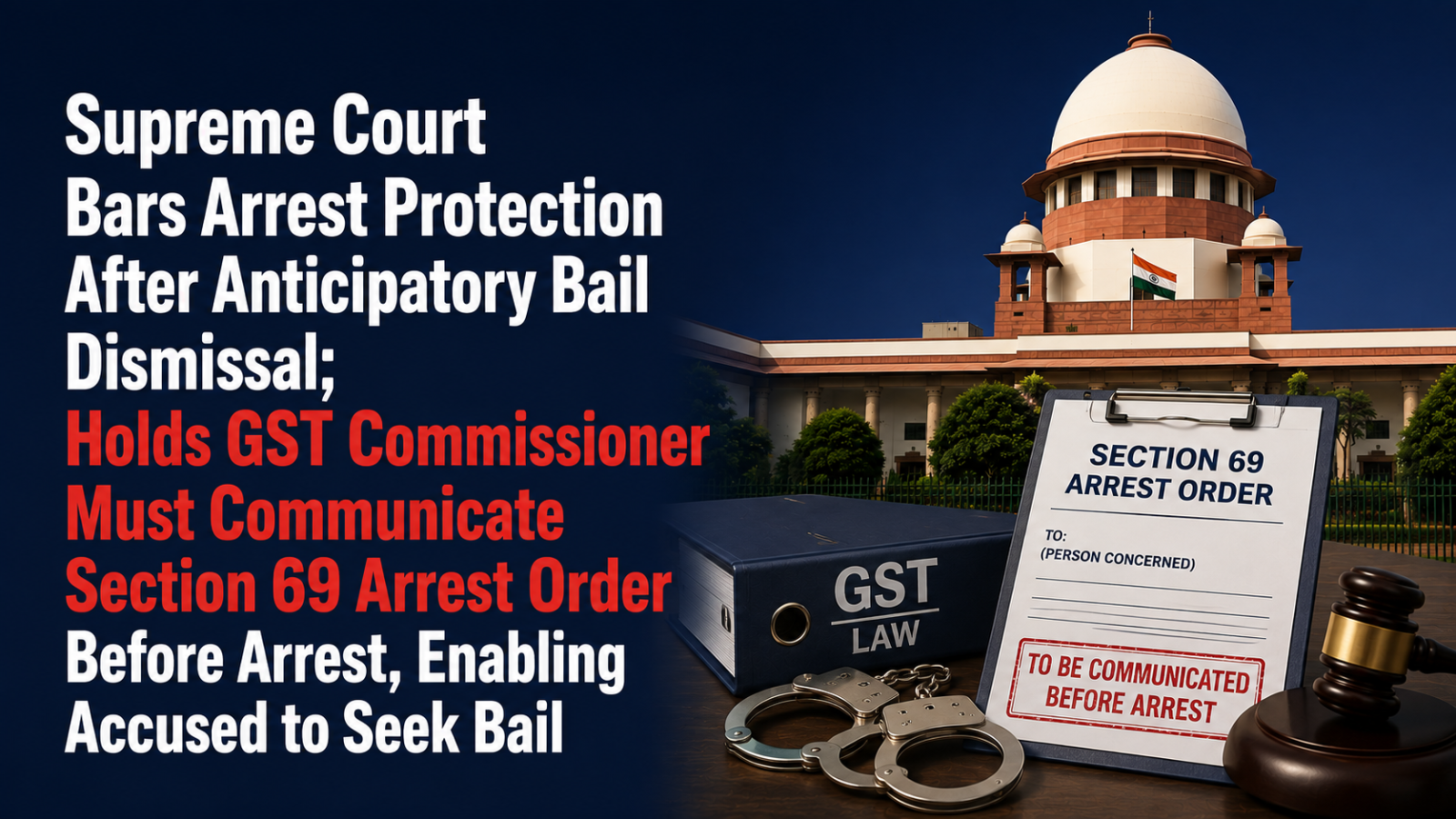
Supreme Court Clarifies GST Arrest and Anticipatory Bail Law; Sets Aside One-Week Protection but Makes Communication of Section 69 Arrest Order Mandatory
Facts
The case arose from an investigation by the Directorate General of GST Intelligence (DGGI), Mumbai Zonal Unit into M/s Alphaneon Techsolutions Pvt. Ltd. and its group entities for alleged wrongful availment and passing of Input Tax Credit without actual supply of goods or services, circular invoicing, and non-payment of GST on import of services.
During an inspection of the registered premises, Sunil Biyani was found present and acknowledged the inspection. The Department subsequently issued three summonses to him under Section 70 of the Central Goods and Services Tax Act, 2017. He sought adjournments instead of initially appearing and thereafter applied for anticipatory bail before the Sessions Court, Mumbai, which rejected his application on 14 October 2025.
Biyani then approached the Bombay High Court seeking pre-arrest bail. Pursuant to interim directions of the High Court, he appeared before the Department and his statement was recorded.
The Department informed the High Court that no arrest order under Section 69 of the CGST Act had yet been passed, since the investigation was still at a nascent stage and material facts were being verified.
The Bombay High Court rejected the anticipatory bail application on 13 February 2026. It held that in the absence of an order under Section 69, there was no apprehension of arrest and consequently no maintainable basis for anticipatory bail.
Despite dismissing the application, however, the High Court directed that if a Section 69 arrest order was subsequently passed, Biyani should not be arrested for one week from the date on which that order was communicated to him.
The Union of India challenged only this one-week protection before the Supreme Court. Importantly, Biyani did not challenge the rejection of his anticipatory bail application.
Issues
The Supreme Court considered two principal questions:
- Whether the High Court, after dismissing an anticipatory bail application as unmaintainable, could nevertheless grant one week’s protection from arrest if a future Section 69 CGST Act arrest order was passed; and
- Whether an order passed by the Commissioner under Section 69 of the CGST Act authorising arrest must be communicated to the person sought to be arrested before the arrest is effected.
The Court also considered when a person merely summoned under Section 70 acquires sufficient apprehension of arrest to maintain an anticipatory bail application.
Petitioner’s Arguments
The Union of India challenged the Bombay High Court’s direction granting one week’s protection from arrest despite dismissing Biyani’s anticipatory bail application.
Its essential case was that once the High Court concluded that the application itself was not maintainable because no Section 69 arrest order existed, it could not simultaneously grant an interim protection of the kind that could have operated only during the pendency of a maintainable anticipatory bail proceeding.
The Union therefore sought setting aside of paragraph 6 of the High Court’s order, which granted the respondent protection from arrest for one week after communication of any future Section 69 order.
Respondent’s Arguments
Sunil Biyani did not challenge the High Court’s rejection of his anticipatory bail application.
His principal submission before the Supreme Court concerned the practical consequences of a future arrest order under Section 69.
He argued that an order under Section 69 recording the Commissioner’s “reasons to believe” that an offence under Section 132 had been committed was a prerequisite for a maintainable anticipatory bail application.
Therefore, unless the Section 69 order was communicated to the proposed accused before arrest, an anomalous catch-22 situation would arise: he could not seek anticipatory bail before the Section 69 order existed, yet he would not know that such an order had been passed until he was actually arrested.
He submitted that principles of fairness and natural justice therefore required communication of the Section 69 order before arrest, even though the statute did not expressly spell out such a requirement.
Analysis of the Law
Section 70 Summons Does Not Make a Person an Accused
The Supreme Court first reaffirmed the principle laid down in Radhika Agarwal v. Union of India, (2025) 6 SCC 545.
Merely because a person has been summoned under Section 70 of the CGST Act does not make that person an accused.
The investigation must be allowed to proceed according to law, although investigative powers cannot be misused.
Since Biyani had only been summoned when he sought anticipatory bail, the Supreme Court affirmed the rejection of his anticipatory bail application.
Interim Relief Cannot Survive Rejection of the Main Proceeding
The Supreme Court then addressed the legality of the High Court’s one-week protection.
The Court reiterated the settled principle that interim relief is ancillary to the main relief. It cannot exist independently after the main proceeding itself has been dismissed or held not maintainable.
The Court traced this principle to the Constitution Bench judgment in State of Orissa v. Madan Gopal Rungta, which held that Article 226 cannot be used solely for granting interim relief where the main proceeding itself cannot be entertained.
The Supreme Court extended the same principle specifically to anticipatory bail proceedings.
It categorically held that where an application seeking pre-arrest bail is dismissed as not maintainable, whatever the reason, the High Court or Sessions Court cannot thereafter grant or extend protection from arrest of the nature that could have been granted while the application remained pending.
Accordingly, the Bombay High Court’s one-week protection was set aside.
Section 69 Order Is a Prerequisite for Anticipatory Bail in These Circumstances
The Court next considered when the apprehension of arrest crystallises.
Under Section 69(1), the Commissioner may authorise arrest where he has “reasons to believe” that the person has committed one of the specified offences under Section 132.
The Court stressed that these reasons must be founded upon material and evidence and must demonstrate application of mind, consistently with Radhika Agarwal.
The judgment explains that once the Commissioner forms the requisite reasons to believe and passes an order authorising arrest, the person becomes exposed to arrest and acquires the right to seek pre-arrest bail.
The Court therefore treated the Section 69 order as a sine qua non for maintaining an anticipatory bail application in the circumstances under consideration.
Section 69 Arrest Order Must Be Communicated Before Arrest
This is the most significant additional holding of the judgment.
The Supreme Court accepted the respondent’s contention that if the Section 69 order is what activates the right to seek anticipatory bail, it would be anomalous to hold that the order need not be communicated until after arrest.
Communication of the order does not obstruct the investigation. Rather, it gives practical meaning to the accused’s right to seek anticipatory bail and enables him to challenge the legality of the arrest authorisation.
The Court therefore read the requirement of communication into the statutory framework in furtherance of personal liberty and procedural fairness.
“Reasons to Believe” Are Open to Judicial Review
The Supreme Court further held that the Section 69 order and the Commissioner’s underlying “reasons to believe” are amenable to judicial review by constitutional courts.
Withholding the reasons could have serious consequences for personal liberty because it would impair the affected person’s ability to challenge the arrest authorisation on settled grounds of judicial review.
Thus, the decision does not merely require mechanical notice that an arrest has been authorised; it links communication with the accused’s ability to effectively exercise legal remedies against the order.
Electronic Communication Is Permissible
The Court also addressed the practical mode of communication.
Since Rule 8 of the CGST Rules requires GST registrants to furnish an email address and mobile number, the Court held that the Section 69 order may be communicated electronically, apart from the modes permissible under the BNSS and other legally permissible modes.
The Court ultimately directed the Commissioner to communicate any Section 69 order to Biyani, following which he would be free to pursue remedies available in law.
Most importantly, the Supreme Court expressly reiterated:
“without such communication, question of arrest would not arise.”
Precedent Analysis
Radhika Agarwal v. Union of India, (2025) 6 SCC 545
This was the central GST precedent.
The Supreme Court reiterated that a person summoned under Section 70 of the CGST Act does not, merely by reason of the summons, become an accused. The judgment also supplied the framework requiring the Commissioner’s “reasons to believe” under Section 69 to be supported by material and evidence and demonstrate application of mind.
State of Orissa v. Madan Gopal Rungta, 1951 SCC 1024
The Constitution Bench established that interim relief can only be granted in aid of and ancillary to substantive relief.
Where the main proceeding is dismissed or held not maintainable, interim relief cannot independently survive as the final relief.
Hema Mishra v. State of U.P., (2014) 4 SCC 453
The Court relied heavily on Hema Mishra, which applied the Madan Gopal Rungta principle in criminal proceedings.
Where a High Court dismisses a petition seeking quashing of an FIR or charge-sheet, it cannot nevertheless grant further protection against arrest for a specified period. Once the main proceeding fails, ancillary interim protection must also fall.
The present judgment extends that reasoning directly to anticipatory bail applications.
Sushila Aggarwal v. State (NCT of Delhi), (2020) 5 SCC 1
The Court relied upon Sushila Aggarwal while recognising that communication of a Section 69 order reinforces the accused’s meaningful right to seek anticipatory bail.
Gurbaksh Singh Sibbia v. State of Punjab, (1980) 2 SCC 565
The Constitution Bench’s seminal anticipatory bail judgment was relied upon for the close connection between personal liberty and the remedy of anticipatory bail.
The Supreme Court emphasised that unnecessary restrictions should not be read into anticipatory bail provisions where the legislature itself has imposed none, particularly because deprivation of bail directly affects personal liberty.
Maneka Gandhi v. Union of India, (1978) 1 SCC 248
The judgment invokes Maneka Gandhi to reinforce the constitutional requirement that any procedure resulting in deprivation of personal liberty under Article 21 must be fair, just and reasonable.
Court’s Reasoning
The Supreme Court drew a careful distinction between judicially granting advance protection from arrest and requiring the executive to communicate the statutory arrest order before exercising the power of arrest.
The Bombay High Court could not grant Biyani one week’s arrest protection after simultaneously concluding that his anticipatory bail application was unmaintainable. Once the main application failed, there was no proceeding capable of supporting ancillary interim protection.
The Court therefore set aside that part of the High Court’s order.
However, the Court recognised the practical difficulty arising under the CGST arrest regime.
Before the Commissioner passes a Section 69 order, a person who has merely received Section 70 summons is not necessarily an accused and cannot claim anticipatory bail merely on that basis. But once the Section 69 order is passed, the risk of arrest crystallises.
If the Department could keep that order secret until the moment of arrest, the right to seek anticipatory bail could become practically meaningless.
Accordingly, the Court held that the arrest order must be communicated before arrest, thereby allowing the affected person to pursue anticipatory bail or challenge the Section 69 order and the Commissioner’s reasons to believe.
The Court nevertheless made clear that these protections should not impede the substantive GST investigation, which was directed to proceed uninfluenced by the observations in the judgment.
Conclusion
The Supreme Court disposed of the Union of India’s appeal by setting aside the one-week protection from arrest granted by the Bombay High Court.
It held that once an anticipatory bail application is dismissed as unmaintainable, the High Court or Sessions Court cannot grant or continue interim protection from arrest.
At the same time, the Supreme Court laid down an important safeguard concerning arrests under the CGST Act:
An order passed by the Commissioner under Section 69 authorising arrest must be communicated to the person concerned before arrest. Without such communication, arrest cannot take place.
The order may be communicated electronically or through other legally permissible modes. After communication, the person may avail the remedies provided by law, including seeking anticipatory bail or judicial review.
The pending DGGI investigation was permitted to continue independently and uninfluenced by the Supreme Court’s observations.
Case Details
Case: Union of India v. Sunil Biyani
Court: Supreme Court of India
Case Number: Criminal Appeal arising out of SLP (Crl.) No. 12535 of 2026; 2026 INSC 849
Judge: Justice Dipankar Datta and Justice Sheel Nagu
Date: 12 August 2026
Result: Appeal disposed of; Bombay High Court’s one-week protection from arrest set aside; Supreme Court held that any Section 69 CGST arrest order must be communicated before arrest, after which the person may pursue remedies available in law.