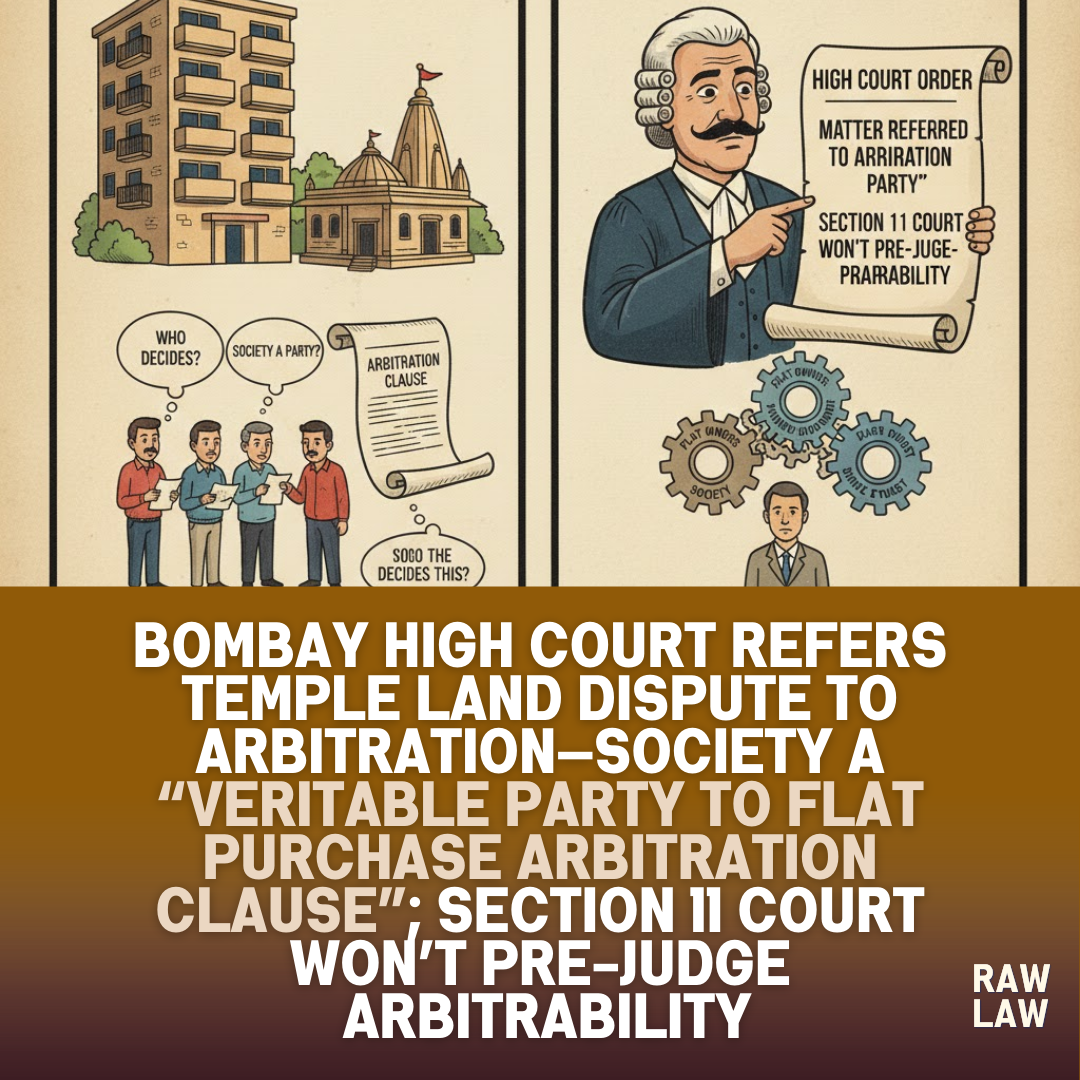
Bombay High Court refers temple land dispute to arbitration—Society a “Veritable party to flat purchase arbitration clause”; Section 11 court won’t pre-judge arbitrability

1. Court’s decision
The Bombay High Court allowed two Section 11 applications and appointed a sole arbitrator to adjudicate disputes between a developer, a Jain temple trust, and a cooperative housing society. The Court held that although the Society was not a signatory to the individual flat purchase agreements, it was a “veritable party” to the arbitration agreement contained in each such agreement.
Relying on the Constitution Bench ruling in Cox and Kings, the Court ruled that issues of non-signatory joinder and subject-matter arbitrability fall within the arbitral tribunal’s domain. The Court confined itself to the limited examination of “existence” of an arbitration agreement and constituted the tribunal.
2. Facts
A developer constructed a building known as Veer Tower pursuant to a development agreement. Before execution of conveyance to flat purchasers, portions of land along with development rights were gifted through registered deeds in 2014 and 2022 to a Jain temple trust for construction and functioning of a temple.
Each flat purchase agreement expressly disclosed the gift in favour of the temple trust and acknowledged its development rights. Each agreement contained an identical arbitration clause naming two alternative arbitrators.
The flat purchasers later formed a cooperative housing society. Disputes arose when the Society filed a civil suit challenging the validity of the gift deeds and claiming development rights. The City Civil Court referred the matter to arbitration under Section 8. Thereafter, the developer and the temple trust invoked arbitration. Since the named arbitrators recused, Section 11 applications were filed seeking constitution of a tribunal.
3. Issues
The principal issue was whether the arbitration agreement between the developer and individual flat purchasers extended to bind the Society, a body corporate formed by those purchasers.
A secondary issue was whether the temple trust, a non-signatory claiming through the developer, could be treated as a party to the arbitration agreement.
The Court also considered whether objections relating to cancellation of gift deeds and deemed conveyance affected arbitrability at the Section 11 stage.
4. Petitioners’ arguments
The developer contended that each member of the Society had executed an identical arbitration agreement. The formation of the Society was expressly contemplated in those agreements. Therefore, the Society’s existence was a product of the very contracts containing the arbitration clause.
The temple trust argued that it claimed rights through the developer, whose agreements acknowledged the temple trust’s entitlements. Since the Society sought to invalidate the gift deeds expressly recited in the flat purchase agreements, the dispute fell squarely within the arbitration clause.
The petitioners further argued that the Section 8 order had already affirmed the existence of the arbitration agreement, and that pendency of a writ petition did not bar commencement of arbitration under Section 8(3).
5. Respondent’s arguments
The Society argued that it was not a signatory to any arbitration agreement and could not be compelled to arbitrate. It contended that privity existed only between individual flat purchasers and the developer.
It further submitted that disputes relating to cancellation of registered gift deeds and entitlement to development rights were non-arbitrable. The Society relied on its deemed conveyance order and pending writ petitions to argue that arbitration should not proceed.
The Society maintained that there was no mutual intention between the Society as a corporate entity and the developer to arbitrate disputes.
6. Analysis of the law
The Court emphasized the limited scope of Section 11 jurisdiction: it must examine only the prima facie existence of an arbitration agreement.
Referring to Cox and Kings Ltd. v. SAP India Pvt. Ltd., the Court noted that when non-signatories are involved, the referral court must determine prima facie whether they are “veritable parties” or persons “claiming through or under” a signatory. Deeper factual inquiries are reserved for the arbitral tribunal under Section 16.
The Court observed that Sections 8, 35, and 45 of the Act recognise that persons claiming through or under a party may invoke or be bound by arbitration. Commercial efficacy requires that derivative claimants not escape the arbitral process.
7. Precedent analysis
The Court relied primarily on the Constitution Bench judgment in Cox and Kings (2024) 4 SCC 1, which clarified the “group of companies” doctrine and the concept of a “veritable party.” It emphasized that referral courts must avoid detailed adjudication of jurisdictional facts and leave such issues to the tribunal.
The Court also referred to statutory recognition under Sections 8, 35 and 45 that persons claiming through or under a signatory may be referred to arbitration. This reinforced the temple trust’s status as a derivative claimant through the developer.
8. Court’s reasoning
The Court held that the Society’s very formation was contemplated in the flat purchase agreements containing arbitration clauses. Every constituent member was individually bound. The Society, being an amalgam of those members on the same subject matter, could not disclaim the arbitration agreement.
The Court termed the Society a “veritable party” to the arbitration agreement. Its attempt to deny privity was described as lacking substance.
Regarding the temple trust, the Court held that it claimed through the developer, whose agreements acknowledged the gift deeds. Therefore, the trust fell within the expression “persons claiming through or under” a party to the arbitration agreement.
Subject-matter arbitrability and jurisdictional objections were left open for the tribunal under Section 16.
9. Conclusion
The High Court concluded that an arbitration agreement prima facie existed between the developer and the Society, and that the temple trust could participate as a derivative claimant.
Justice (Retd.) Akil Kureshi was appointed as the Sole Arbitrator to adjudicate all disputes and differences between the parties. The Court clarified that all issues on merits and arbitrability remain open before the tribunal.
10. Implications
This judgment significantly strengthens arbitration enforcement in real estate disputes involving cooperative housing societies. It clarifies that societies formed pursuant to agreements containing arbitration clauses cannot evade arbitration by invoking separate corporate personality.
It also reinforces the Supreme Court’s Cox and Kings framework, confirming that Section 11 courts must conduct only a prima facie examination and leave non-signatory and arbitrability issues to the arbitral tribunal.
For developers and derivative right-holders such as trusts, the ruling affirms that rights acknowledged in sale agreements can be enforced through arbitration even against subsequently formed societies.
Case Law References
Cox and Kings Ltd. v. SAP India Pvt. Ltd. (2024) 4 SCC 1 – Constitution Bench clarified referral court’s limited role under Section 11 and laid down principles for joinder of non-signatories and “veritable party” doctrine.
FAQs
1. Can a housing society be bound by arbitration clauses signed by its members?
Yes. If the society’s formation was contemplated in agreements containing arbitration clauses, courts may treat it as a “veritable party” bound by those clauses.
2. Can a non-signatory like a trust invoke arbitration?
Yes, if it claims “through or under” a signatory and its rights arise from the same contractual framework.
3. Can Section 11 courts decide arbitrability finally?
No. Section 11 courts conduct only a prima facie examination of existence of the arbitration agreement. Arbitrability and jurisdictional objections are for the tribunal under Section 16.