Bombay High Court refuses to stay 30-foot height covenant in Altamount Road redevelopment dispute—“Plaintiff cannot approbate and reprobate its own title”; interim relief denied

1. Court’s decision
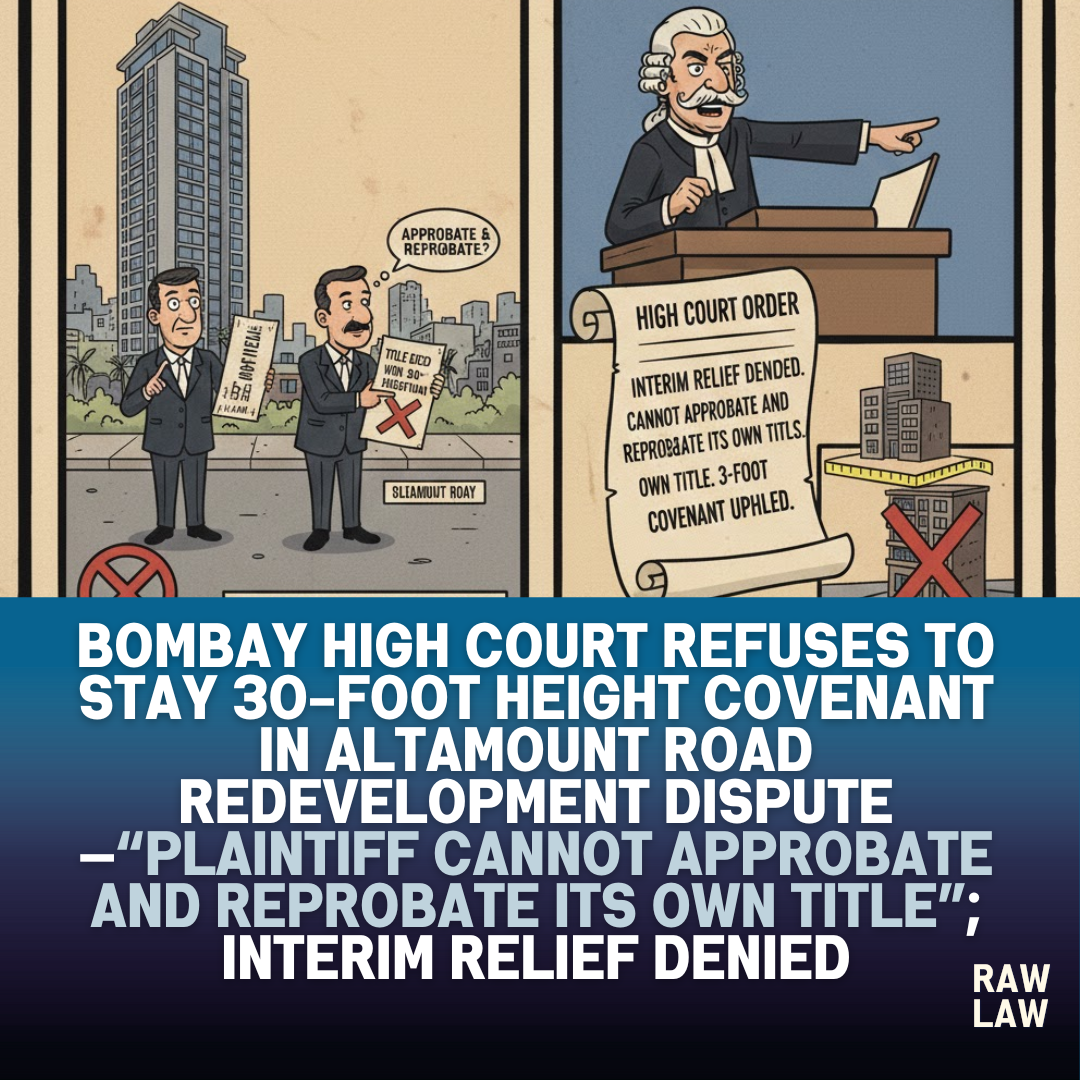
The Bombay High Court dismissed an interim application filed by a cooperative housing society seeking permission to proceed with redevelopment beyond a 30-foot height restriction contained in historical title documents. The Court held that the restrictive covenant prima facie runs with the land and is reflected in the Plaintiff’s own chain of title. It refused to restrain the adjoining society from asserting the covenant and declined to permit redevelopment beyond 30 feet at the interim stage. The Court observed that granting such relief would amount to granting final relief and irreversibly alter the status of the property before trial.
2. Facts
The Plaintiff, a cooperative housing society registered under the Maharashtra Co-operative Societies Act, owns land at Altamount Road, Mumbai, acquired under a registered Indenture dated 5 April 1963. The conveyance expressly recorded that the transfer was subject to stipulations, agreements, covenants and restrictions contained in an earlier Indenture dated 25 July 1944, which in turn incorporated a 30-foot height restriction originating from an Indenture dated 15 October 1943.
The building on the suit property is over 60 years old and the Plaintiff resolved to undertake redevelopment. Public notices were issued inviting objections. The Defendant, an adjoining cooperative housing society, asserted through legal notice and public notice that a restrictive covenant prohibited construction beyond 30 feet and claimed entitlement to enforce it. Developers expressed reluctance to proceed without a no-objection certificate from the Defendant. The Plaintiff then filed the suit seeking declaration that the restrictive covenant was void, invalid and unenforceable, along with interim relief to proceed with redevelopment.
3. Issues
The primary issue before the Court was whether, at the interim stage, the Plaintiff had established a strong prima facie case to restrain the Defendant from asserting the 30-foot height restriction.
Closely connected issues included: whether the restrictive covenant runs with the land; whether the Defendant has locus to enforce it despite absence of verbatim reproduction in later deeds; whether the Plaintiff suppressed material facts regarding its own title; whether the suit was barred by limitation under Article 58 of the Limitation Act; and whether the doctrine of obsolescence rendered the covenant unenforceable due to changed neighbourhood conditions.
4. Petitioner’s arguments
The Plaintiff contended that the restrictive covenant was either non-existent or unenforceable. It argued that the original 1943 covenant lacked certainty, particularly as the annexed plan identifying the “Plot for Cottages” was not produced. It submitted that the covenant was personal to the original parties and did not bind successors. Even if it subsisted, the Defendant had no locus as the benefit was never specifically assigned in the Defendant’s title deeds. The Plaintiff relied on authorities holding that negative covenants must be strictly construed and cannot be extended by implication.
The Plaintiff also invoked the doctrine of obsolescence, arguing that Altamount Road had undergone irreversible transformation into a high-rise locality, including the Defendant’s own extension from three to seven storeys. It maintained that cause of action arose only in 2024 when the Defendant first asserted the covenant, and therefore the suit was within limitation. It stressed that redevelopment was essential as most members were senior citizens residing in a dilapidated building.
5. Respondent’s arguments
The Defendant argued that the restrictive covenant was clearly reflected in the Plaintiff’s own chain of title. The 1963 conveyance under which the Plaintiff derived title expressly subjected the property to stipulations in the 1944 Indenture, which incorporated the 30-foot height restriction. Therefore, the covenant had travelled through successive conveyances.
The Defendant submitted that restrictive covenants running with the land do not require specific reiteration in each subsequent deed. Conveyances of the adjoining land in 1945 and 1972 transferred property together with all rights, liberties, easements and advantages, which included the benefit of the covenant. It relied on precedents holding that covenants annexed to land pass with the land without express assignment.
It further alleged suppression of material facts, pointing out that the Plaintiff initially pleaded that no restrictive covenant existed, only to amend its case after the Defendant produced the title documents. It invoked the doctrine of approbate and reprobate, contending that the Plaintiff could not accept title under the 1963 deed while challenging its conditions.
6. Analysis of the law
The Court examined the doctrine of covenants running with the land. It noted that where conveyances expressly incorporate earlier stipulations and transfer property together with rights, liberties and appurtenances, a prima facie inference arises that restrictions were intended to bind successors. An express reiteration of the covenant in every deed is not mandatory if earlier documents are incorporated by reference.
Relying on authorities such as Princy v. Jose and English precedents cited therein, the Court observed that where a covenant is annexed to land at inception, it passes to assignees without specific assignment. It constitutes an equitable interest inhering in the land itself.
On the doctrine of approbate and reprobate, the Court invoked Supreme Court precedent holding that a party who accepts benefits under a document cannot later deny its binding effect. Since the Plaintiff derived title under a deed expressly incorporating the restrictive covenant, it could not, at the interim stage, avoid the condition while retaining title.
Regarding limitation, the Court accepted prima facie that cause of action arose only when the Defendant asserted the covenant in 2024. Thus, the suit could not be rejected at threshold on limitation grounds, though the issue remained open for trial.
7. Precedent analysis
The Court relied on Rajasthan State Industrial Development and Investment Corporation Ltd. v. Diamond and Gem Development Corporation Ltd. to apply the doctrine of election and estoppel. It cited Princy v. Jose to support the proposition that a covenant annexed to land passes with it without specific assignment.
The Plaintiff’s reliance on Administrator of the Specified Undertaking of UTI v. Garware Polyester Ltd. for strict construction of negative covenants was noted, but the Court held that the covenant’s existence in the chain of title could not be ignored at the interim stage.
On limitation, the Court referred to Daya Singh v. Gurdev Singh and Geeta Patkar v. Chandrakant Shah to hold that cause of action accrues upon clear threat to infringe the asserted right.
8. Court’s reasoning
The Court found that the restrictive covenant had consistently appeared in the Plaintiff’s own title chain. The Plaintiff’s initial categorical denial of the covenant, followed by acceptance after confrontation with documents, undermined its equity at the interim stage. Suppression of material facts and shifting stands weighed against grant of discretionary relief.
The Court held that change in neighbourhood and high-rise development did not automatically render the covenant obsolete. Whether the doctrine of obsolescence applied required evidence and could only be determined at trial.
Granting interim relief permitting construction beyond 30 feet would effectively grant final relief and irreversibly alter the property’s character before adjudication. The balance of convenience did not favour the Plaintiff. However, the Court clarified that redevelopment up to 30 feet was permissible.
9. Conclusion
The High Court concluded that the Plaintiff failed to establish a strong prima facie case. The restrictive covenant prima facie runs with the land and binds the Plaintiff’s property. The balance of convenience lay in maintaining status quo. Interim Application No. 731 of 2025 was dismissed, with all observations being prima facie and issues left open for trial.
10. Implications
This ruling underscores the enduring enforceability of restrictive covenants in Mumbai’s prime real estate corridors. Cooperative housing societies undertaking redevelopment must carefully examine historical title documents. Courts are reluctant to dilute covenants at the interim stage, especially where redevelopment would cause irreversible consequences. The judgment also reiterates that parties cannot selectively accept favourable parts of title deeds while challenging burdensome conditions.
Case Law References
- Princy & Another v. Jose – Covenants annexed to land pass with assignment without specific reiteration; equitable interest inheres in land.
- Rajasthan State Industrial Development and Investment Corporation Ltd. v. Diamond and Gem Development Corporation Ltd. – Doctrine of approbate and reprobate; estoppel by election.
- Administrator of the Specified Undertaking of UTI v. Garware Polyester Ltd. – Strict construction of negative covenants.
- Daya Singh v. Gurdev Singh; Geeta Patkar v. Chandrakant Shah – Cause of action under Article 58 arises upon clear threat to infringe rights.
FAQs
1. Can a cooperative housing society ignore an old height restriction during redevelopment?
Not at the interim stage. If the restrictive covenant appears in the society’s own chain of title, courts may treat it as prima facie binding until finally adjudicated.
2. Does a restrictive covenant need to be repeated in every conveyance to remain enforceable?
No. If earlier deeds are incorporated by reference and the covenant was annexed to the land at inception, it can run with the land without verbatim repetition.
3. Does change in neighbourhood make a restrictive covenant obsolete?
Not automatically. Courts require evidence to determine whether the doctrine of obsolescence applies; mere surrounding high-rise development is insufficient at the interim stage.