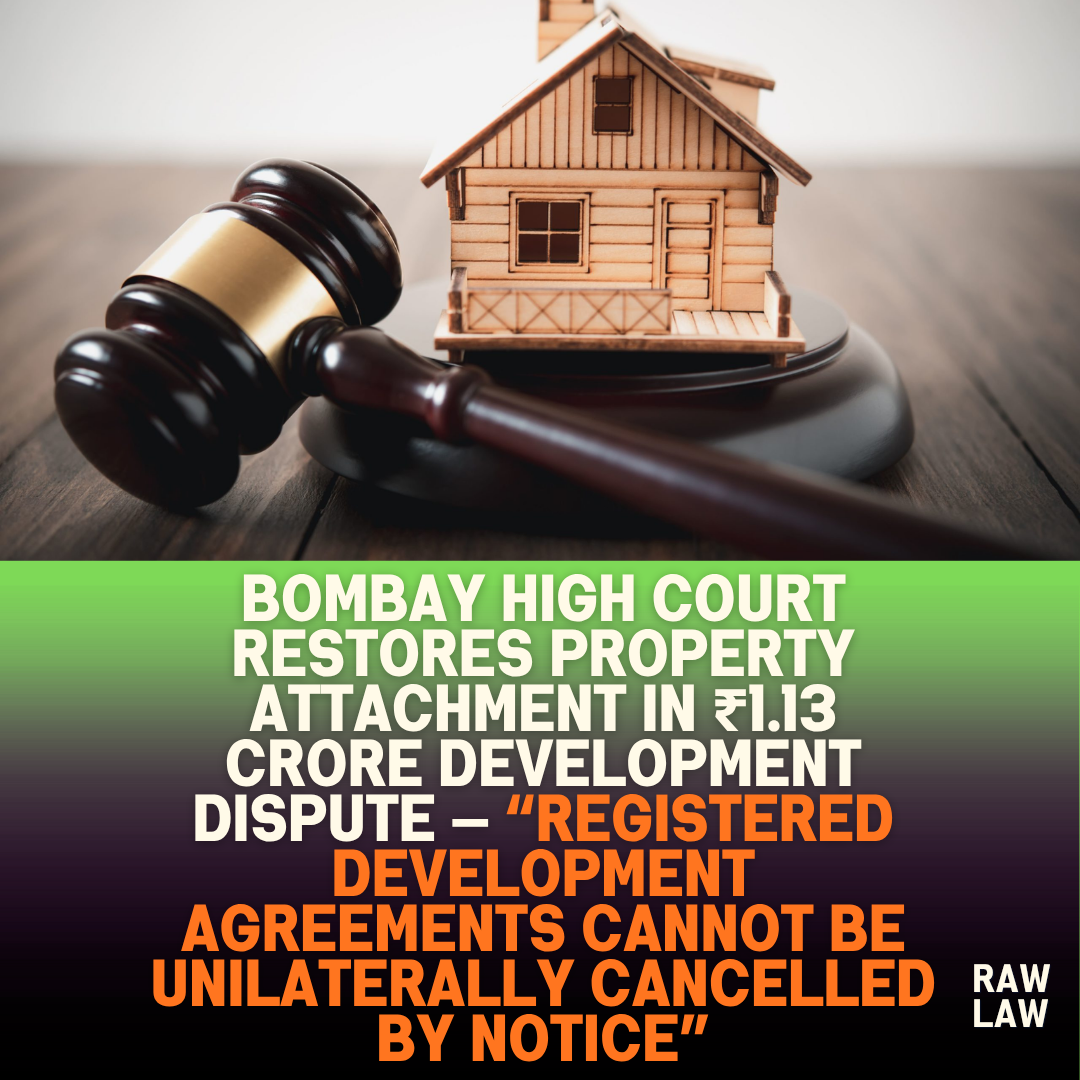
Bombay High Court Restores Property Attachment in ₹1.13 Crore Development Dispute — “Registered Development Agreements Cannot Be Unilaterally Cancelled by Notice”

Court’s Decision
The Bombay High Court, in a detailed judgment authored by Justice Amit Borkar, quashed the order of the Divisional Joint Registrar, Cooperative Societies, and restored the attachment order issued by the Special Recovery Officer against a developer’s rights in a prime Matunga property.
The Court held that once a registered Development Agreement creates an interest in property, it cannot be unilaterally cancelled through a notice or private communication. The Revisional Authority, by accepting such cancellation as valid, had exceeded its jurisdiction, and its findings were declared legally unsustainable.
Justice Borkar emphatically stated:
“A registered agreement creating an interest in immovable property cannot be nullified by a unilateral notice from an Advocate. The rights so created subsist until annulled by a competent Civil Court.”
Accordingly, the Court allowed the writ petition filed by the cooperative bank, restoring the Special Recovery Officer’s order under Rule 107(19) of the Maharashtra Cooperative Societies Rules, 1961, and rejecting the landowners’ objections.
Facts
A cooperative bank had granted cash credit facilities to a developer firm, APT Infratech Solutions LLP, whose partners also stood as guarantors. Upon default, the account was classified as a Non-Performing Asset, leading to recovery proceedings under Section 101 of the Maharashtra Cooperative Societies Act, 1960.
On 8 July 2022, a recovery certificate was issued, and on 7 September 2022, the Special Recovery Officer attached the rights and interests of the developer and guarantors in a property located at Plot No. 209-D, Dadar-Matunga Estate, based on a registered Development Agreement dated 18 October 2011.
The agreement between the property owners and the developer conferred upon the developer the right to sell, transfer, and dispose of units in the redeveloped property and to retain sale proceeds as its own. The total consideration payable was ₹1.13 crore.
In April 2023, the property owners filed objections under Rule 107(19), claiming that they had cancelled the Development Agreement through a notice dated 2 May 2023, rendering the attachment invalid. The Special Recovery Officer rejected the objection, but on revision, the Divisional Joint Registrar set aside the attachment order on 21 January 2025, prompting the present writ petition.
Issues
- Whether the Revisional Authority had jurisdiction to set aside the attachment on the basis of an alleged unilateral cancellation of the registered Development Agreement.
- Whether the Special Recovery Officer acted within his powers under Rule 107(19) by attaching only the rights and interests of the developer without affecting ownership rights.
- Whether the development agreement created a substantive proprietary interest or only an “inchoate right.”
- Whether the bank was required to first proceed against mortgaged property before attaching guarantors’ property under Rule 107(2).
Petitioner’s Arguments
The cooperative bank, represented by Senior Advocate Atul Damle, contended that the Development Agreement of 18 October 2011 had created a valuable and enforceable interest in favour of the developer. Such interest could not be cancelled unilaterally, as it was a registered instrument supported by consideration.
Mr. Damle argued that the attachment was limited to the “rights and interests” of the developer and guarantors, not the ownership of the landowners. Hence, their claim of wrongful attachment was misconceived.
He further asserted that the Revisional Authority had no jurisdiction to adjudicate on the validity or termination of a registered development agreement, as such matters fell within the exclusive domain of Civil Courts. The Revisional Authority’s reliance on a private cancellation notice was legally unsound.
Respondents’ Arguments
Senior Advocate Girish Godbole, appearing for the property owners, argued that the bank violated Rule 107(2) by proceeding directly against guarantors’ property without first exhausting remedies against the mortgaged property.
He further contended that the developer held only an inchoate right—a non-transferable, incomplete interest that did not create proprietary rights. Citing B. Jeejeebhoy Vakharia & Associates v. Sahara India Commercial Corporation Ltd. (2008 SCC OnLine Bom 536) and Suhas Damodar Sathe v. State of Maharashtra (2025 SCC OnLine Bom 576), he maintained that such agreements confer only developmental rights, not ownership.
Relying on Bhartiya Seva Samaj Trust v. Yogeshbhai Ambalal Patel (2012) 9 SCC 310, he urged that the High Court should not quash one illegal order if doing so revived another. He also sought permission to file additional affidavits to bring subsequent events to the Court’s notice, arguing that even under Mohinder Singh Gill v. Chief Election Commissioner (1978) 1 SCC 405, courts may mould reliefs based on later developments.
Analysis of the Law
The Court began by examining Rule 107 of the Maharashtra Cooperative Societies Rules, 1961, emphasizing that it permits objections only where the attached property does not belong to the judgment-debtor. The Special Recovery Officer’s attachment was confined strictly to the developer’s interest, not the owners’ title, and thus was lawful.
Justice Borkar rejected the owners’ interpretation of Rule 107(2), observing that the provision uses the expression “may indicate,” conferring discretion on the creditor rather than mandating an order of priority between mortgaged and guarantor properties.
The Court observed that the Revisional Authority had exceeded its jurisdiction by adjudicating upon the validity and cancellation of a registered document—a domain strictly reserved for Civil Courts. The Revisional Authority’s decision was thus void for jurisdictional overreach.
Precedent Analysis
- State of West Bengal v. Baisakhi Bhattacharya (AIR 2025 SC 1882) – Applied by analogy to emphasize that statutory authorities must not exceed their jurisdiction; only competent forums can decide civil rights.
- B. Jeejeebhoy Vakharia & Associates v. Sahara India (2008 SCC OnLine Bom 536) – Distinguished; held inapplicable since the agreement here transferred sale rights, consideration, and control, creating a proprietary interest.
- Bhartiya Seva Samaj Trust v. Yogeshbhai Ambalal Patel (2012) 9 SCC 310) – Clarified that the doctrine against reviving illegal orders does not apply, as the Special Recovery Officer’s order was legally valid.
- Mohinder Singh Gill v. Chief Election Commissioner (1978) 1 SCC 405) – Reiterated that an order’s validity must be judged only on the reasons recorded in it; new justifications through affidavits are impermissible.
Court’s Reasoning
The Court held that the 2011 Development Agreement was a registered and valid legal instrument, containing clear clauses for payment of consideration and conferring on the developer the right to sell, transfer, and retain proceeds. These rights were not mere permissions but constituted valuable commercial interests in the property.
“The developer’s rights were not temporary or revocable. Once acted upon, they created a legal interest in the property which cannot be extinguished without a civil court’s decree.”
The Court concluded that the cancellation notice dated 2 May 2023 issued by the owners’ advocate had no legal force. It was a private communication that could not override a registered document.
Further, the Revisional Authority’s finding that the agreement had lapsed due to breach was beyond its jurisdiction and violated the statutory limits of Section 154 of the MCS Act.
The High Court also rejected the plea to consider subsequent events or affidavits, reaffirming Mohinder Singh Gill, that orders must stand or fall on their original reasoning.
Conclusion
The Bombay High Court allowed the writ petition, holding that the Special Recovery Officer’s attachment order was lawful and confined only to the developer’s rights and interests, not ownership of the property. The Revisional Authority’s order dated 21 January 2025 was quashed and set aside.
The Court declared:
“A unilateral notice cannot nullify a registered development agreement supported by consideration. The Revisional Authority’s interference with a lawful attachment amounts to jurisdictional error.”
The request for stay was also rejected.
Implications
This judgment significantly clarifies the legal position on rights created under development agreements, especially in the context of cooperative bank recoveries. It establishes that:
- Registered agreements confer proprietary interest, not mere developmental permissions.
- Unilateral cancellations are legally ineffective without a civil court’s declaration.
- Recovery Officers’ jurisdiction is limited to determining judgment-debtors’ interests, not civil title disputes.
It strengthens creditor rights under the Maharashtra Cooperative Societies Act, ensuring that banks can enforce recovery against beneficial interests created by registered development contracts.