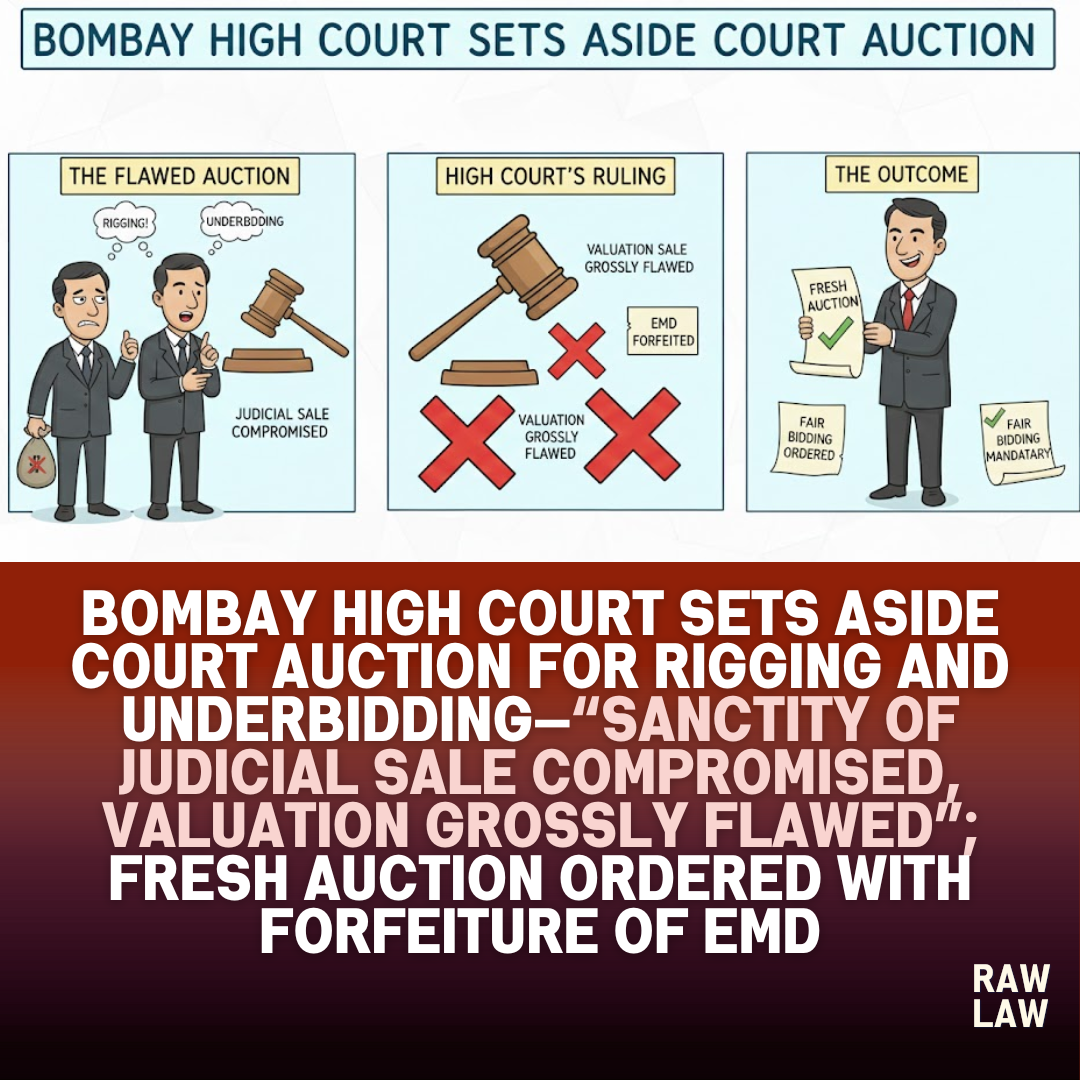
Bombay High Court sets aside court auction for rigging and underbidding—“Sanctity of judicial sale compromised, valuation grossly flawed”; fresh auction ordered with forfeiture of EMD

Court’s decision
The Bombay High Court, exercising its execution jurisdiction, quashed an entire court auction process after finding that the bidding was tainted by syndication, underbidding, and conduct that destroyed the sanctity of a judicial sale. The Court held that meaningful judicial control is essential to ensure that court auctions fetch the best possible price and that any process suggestive of collusion or manipulation cannot be permitted to stand. All bids were rejected, the earnest money deposits (EMDs) of all bidders were forfeited, and a fresh auction was directed to be conducted after obtaining a new valuation.
Facts
The proceedings arose in an execution application concerning sale of a valuable leasehold property situated in a prime residential locality of Juhu-Vile Parle Development Scheme, Mumbai. The Sheriff of Mumbai conducted the auction pursuant to directions of the Court. Terms and conditions of sale were finalised in a meeting, followed by publication of auction notices in leading newspapers. Site inspections were provided to interested bidders.
Five bidders participated in the auction after depositing EMDs of ₹10 lakh each. The initial bids ranged from ₹85 lakh to ₹1 crore, except for one bidder who quoted ₹6.03 crore. During open bidding in Court, only two bidders meaningfully increased their offers. Ultimately, the highest offer stood at ₹9.75 crore. The Sheriff’s Report was placed before the Court for confirmation of sale.
Issues
The central issue before the Court was whether the auction process had been conducted fairly and transparently so as to inspire confidence that the best possible price had been fetched. The Court also examined whether the conduct of bidders indicated formation of a syndicate or underbidding, whether the valuation report relied upon was credible, and whether judicial intervention was required to protect the integrity of the court auction.
Applicant’s arguments
The decree-holder supported scrutiny of the auction process, highlighting that the property was located in one of Mumbai’s most premium residential areas and that the bids appeared disproportionately low when compared to market realities. Serious reservations were expressed regarding the conduct of certain bidders, who appeared to act in coordination rather than genuine competition. It was urged that confirmation of such an auction would cause grave prejudice and result in sale of valuable property at an inadequate price.
Respondents’ arguments
Certain bidders contended that the auction had been conducted in accordance with prescribed procedure and that the highest bid represented fair market interest. They sought confirmation of sale on the ground that competitive bidding had taken place in open court. It was argued that mere suspicion of collusion could not justify setting aside an auction once bidding had concluded.
Analysis of the law
The High Court reiterated that a court auction is not a mere contractual transaction but a judicial process requiring strict supervision to ensure transparency, fairness, and maximisation of value. The Court emphasised that the objective of a judicial sale is to secure the most remunerative price, particularly where the property belongs to a judgment-debtor and the sale is conducted under the authority of law.
The Court underscored that meaningful judicial intervention is necessary to prevent formation of syndicates, underbidding, and manipulation. Where circumstances indicate that the auction process has been compromised, the Court is duty-bound to intervene rather than mechanically confirm the highest bid.
Precedent analysis
The Court relied on authoritative Supreme Court precedent holding that courts conducting auctions must actively supervise the process to prevent collusive practices. The apex court has consistently held that judicial sales must not only be fair but must also appear to be fair, and that any process resulting in sale at an inadequate price due to manipulation defeats the purpose of court-supervised auctions.
Court’s reasoning
On facts, the Court found multiple disturbing features. First, the conduct of two principal bidders, who repeatedly left the courtroom during live bidding and then returned with incremental offers, raised serious doubts about collusion. One bidder exited the courtroom without permission, undermining the transparency of the process. The Court found this conduct wholly impermissible in a court auction.
Secondly, the valuation report placed before the Court assessed the property at approximately ₹64 lakh—an amount the Court described as grossly undervaluing a prime plot in a highly sought-after Mumbai locality. The Court noted that even the initial bid of ₹6.03 crore starkly contradicted the valuer’s assessment, exposing the valuation report as fundamentally flawed.
Thirdly, the Court observed that most bidders had quoted abnormally low amounts and did not meaningfully participate in competitive bidding. One bidder even stated that he was willing to bid as high as ₹15 crore but had been asked to remain silent, reinforcing the Court’s conclusion that the auction process had been rigged.
In these circumstances, the Court held that the sanctity of the judicial auction stood completely eroded. Allowing confirmation of sale would legitimise a compromised process and cause serious injustice.
Conclusion
The Bombay High Court quashed and set aside the entire auction process, rejected all bids, and forfeited the EMDs deposited by all bidders. The Court directed that the forfeited amounts be invested in a nationalised bank pending further orders. It further ordered the Deputy Sheriff to obtain a fresh valuation report and conduct a new auction strictly in accordance with law, ensuring transparency and fair competition.
Implications
This judgment sends a strong message that court auctions are not a forum for manipulation or cartelisation. The ruling reinforces the judiciary’s duty to actively supervise auction proceedings and intervene where underbidding or collusion is suspected. It also highlights the critical importance of accurate and realistic valuation reports in judicial sales. For bidders, the decision serves as a caution that any conduct undermining the integrity of a court auction can result in severe consequences, including forfeiture of EMDs.
Case law references
- LICA (P) Ltd. (No. 2) v. Official Liquidator: Held that courts must exercise meaningful control over auction proceedings to prevent syndication, underbidding, and sale of property at inadequate prices.
FAQs
1. Can a court auction be cancelled after bidding is completed?
Yes. If the court finds that the auction process was tainted by collusion, underbidding, or lack of transparency, it can set aside the entire auction even after bids are opened.
2. What happens to the earnest money deposit if an auction is found to be rigged?
The court has the power to forfeit EMDs of bidders whose conduct undermines the integrity of the auction process.
3. Why is valuation important in court auctions?
A credible valuation ensures that the reserve price reflects market realities. A grossly flawed valuation can facilitate underbidding and defeat the purpose of a judicial sale.