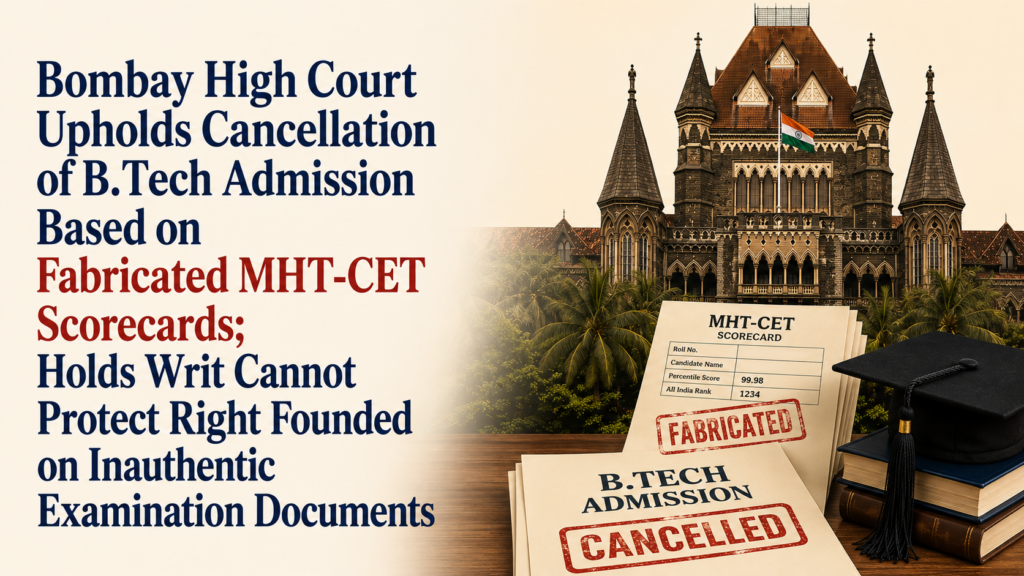
Bombay High Court Upholds Cancellation of B.Tech Admission Based on Fabricated MHT-CET Scorecards; Holds Writ Cannot Protect Right Founded on Inauthentic Examination Documents

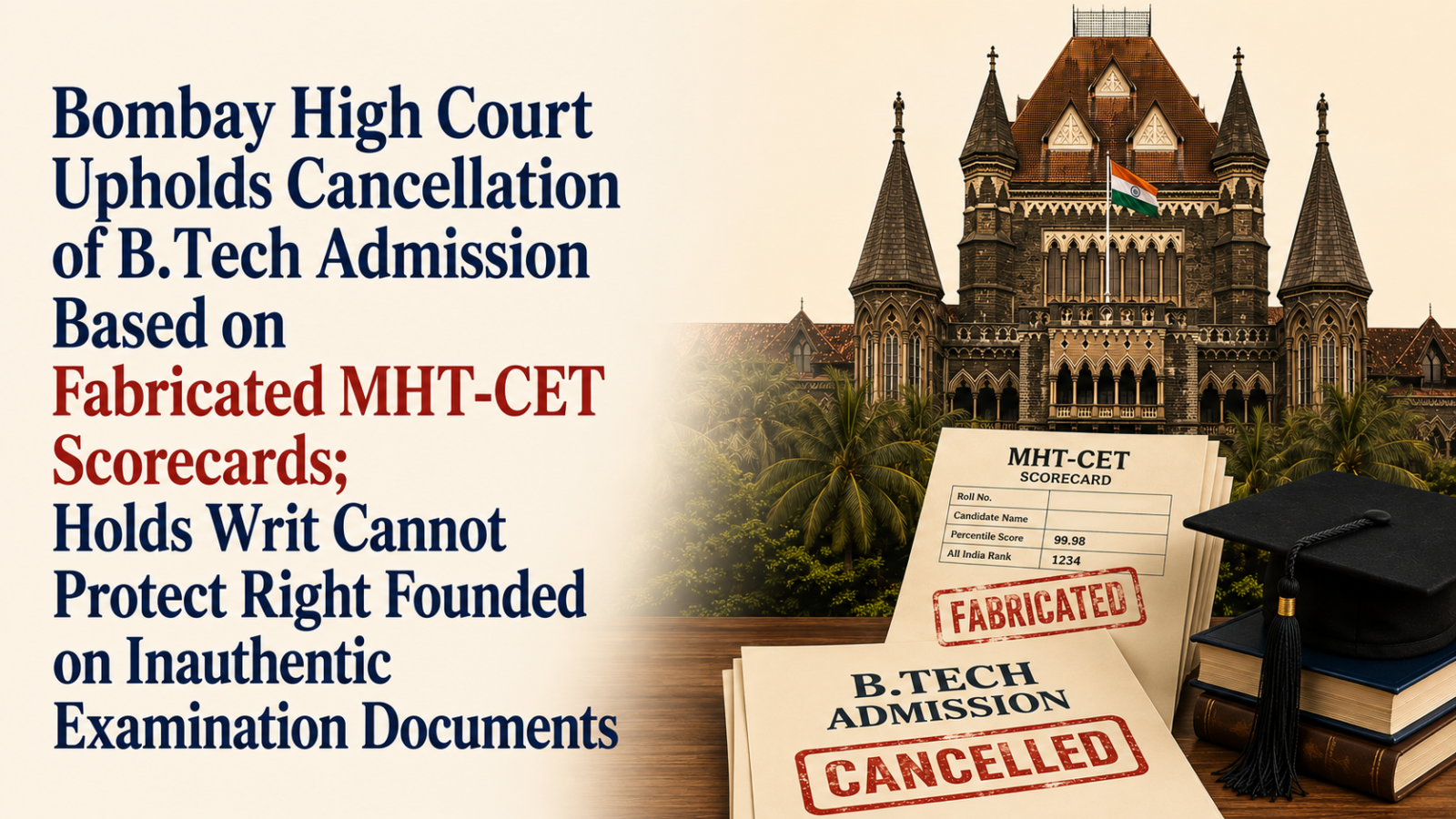
Bombay High Court Dismisses Writ Seeking Restoration of Engineering Admission; Leaves Inquiry Into Fabrication of MHT-CET Scorecards Open to Authorities
Facts
The Bombay High Court considered a writ petition filed by Shubham Vijay Mangire seeking, among other reliefs, an inquiry by the State Common Entrance Test Cell into discrepancies between two sets of MAH-MHT-CET 2026 (PCM Group) scorecards and quashing of the University’s 14 July 2026 communication cancelling his provisional admission.
The petitioner had appeared for MHT-CET on 16 April 2026 and again on 19 May 2026. According to the scorecards initially relied upon by him, he had secured overall percentiles of 78.874707 in the first attempt and 73.5482364 in the second attempt. On that basis, he was provisionally admitted on 23 June 2026 to the first year of the B.Tech. Renewable Energy Engineering programme, Batch 2026–2030.
However, after the University noticed a discrepancy and informed him that his admission would be cancelled, the petitioner downloaded fresh scorecards from the CET portal. Those reflected drastically lower scores: 7.8474707 in the first attempt and 13.5482364 in the second attempt. The comparison between both sets of scorecards is reproduced in the table on page 2 of the judgment.
The University cancelled his provisional admission on 14 July 2026 and referred the matter to its Legal Department. The petitioner approached the High Court three days later.
The Court immediately directed the State CET Cell to investigate which scorecards were authentic and how two different sets came to exist. An initial report confirmed the lower scores but did not adequately explain the discrepancy, leading the Court to call for a supplementary report.
Issues
The principal questions before the Court were:
- Which of the two sets of MHT-CET scorecards were authentic.
- Whether the scorecards showing the higher percentiles had actually been generated by the State CET Cell.
- Whether the petitioner had any enforceable right to retain his provisional engineering admission if the scorecards submitted by him were found to be inauthentic.
- Whether restoration of admission depended upon proving that the petitioner himself had fabricated or manipulated the scorecards.
- Whether the High Court, in writ jurisdiction, could itself determine criminal responsibility for fabrication.
- Whether further disciplinary, administrative or criminal action should be left open to the competent authorities.
Petitioner’s Arguments
The petitioner’s case was essentially that the discrepancy had occurred through no fault of his own.
He maintained that he had downloaded the higher scorecards from the official CET portal and had relied upon them while obtaining admission.
After the supplementary report was filed, his principal objection was that the report did not specifically establish that he personally fabricated or manipulated the scorecards.
He therefore sought restoration of his admission on the footing that, in the absence of proof connecting him personally with the fabrication, he should not lose the seat.
Respondents’ Position
The State CET Cell relied on its official raw-score and percentile data.
The supplementary report concluded that the actual percentiles were:
- First attempt: 7.8474707
- Second attempt: 13.5482364
and not the substantially higher figures appearing in the documents initially relied upon by the petitioner.
The University defended cancellation of the provisional admission on the basis that the petitioner had obtained admission using a scorecard which did not correspond with the official examination records.
Analysis of the Law
Official Data Established the Authentic Scores
The High Court found the supplementary report detailed and reliable.
It was based upon:
- official raw-score records;
- subject-wise percentile data;
- comparison with other candidates in the same examination sessions; and
- analysis of the scorecards submitted by the petitioner.
The report demonstrated that the disputed higher scores could not be explained as mere clerical or typographical mistakes.
For example, the first-attempt Mathematics percentile of 56.7177098 shown on the petitioner’s scorecard did not correspond with the percentile awarded to any candidate in the relevant session.
Second Attempt Also Contained Objective Discrepancies
The same pattern emerged from the second attempt.
The petitioner’s actual overall percentile was 13.5482364, not 73.5482364.
In Mathematics, the scorecard showed 68.1095149, whereas the petitioner’s raw score actually corresponded to a percentile of approximately 4.6095146.
In Chemistry, the submitted scorecard showed 71.5043214, while the official data showed 11.5043214.
These were therefore not marginal or innocent discrepancies.
Decimal Format Was Also Inconsistent
The Court noted another objective indicator.
The State CET Cell publishes percentiles up to seven decimal places.
The figure of 78.874707 appearing in the petitioner’s higher scorecard contained only six decimal places, further supporting the conclusion that the document had not been generated in the ordinary CET process.
Scorecards Held Tampered/Fabricated
After reviewing the underlying data, the supplementary report concluded that the scorecards annexed by the petitioner as Exhibits “B” and “C” were not generated by the State CET Cell and had been tampered with/fabricated.
The only genuine scorecards were the lower-scoring documents annexed as Exhibits “F” and “G”.
The High Court found no cogent reason to reject those findings.
The petitioner was unable to point out any substantive flaw in the methodology or produce material showing that the higher percentiles could legitimately have been generated from the official examination data.
Identity of the Fabricator Was Not the Writ Issue
This was the key legal distinction in the judgment.
The Court held that it was not required to decide whether the petitioner himself fabricated the scorecards, procured somebody else to fabricate them, or knowingly relied on documents fabricated by another person.
Those were matters for any competent investigative authority, if separate proceedings were considered warranted.
The writ petition raised a narrower question:
Were the scorecards relied upon to claim the higher percentile and retain admission authentic?
The answer was clearly no.
Therefore, even absence of proof that the petitioner himself fabricated the document could not create a legal right to retain an admission obtained on its basis.
Alleged Download From Official Portal Did Not Prove Authenticity
The petitioner argued that he had personally downloaded the disputed scorecards from the official portal.
The Court held that, even assuming this assertion were true, it did not establish authenticity of the contents.
The question of how the document came to be available or came into the petitioner’s possession was separate from the question of whether the scorecard accurately represented the percentile actually awarded by the examination authority.
Official examination records conclusively showed that it did not.
Writ Cannot Protect a Right Founded on Inauthentic Document
The Court then stated the central public-law principle.
A petitioner invoking Article 226 must demonstrate a legally enforceable right.
Here, restoration of admission would amount to protecting a seat obtained on the basis of a scorecard which the competent examination authority had established was not authentic.
The Court held:
“A writ of mandamus cannot issue to protect an asserted right founded upon an inauthentic document.”
The extraordinary jurisdiction exists to advance justice and prevent illegality, not to preserve an advantage flowing from a document demonstrably inconsistent with official records.
No Finding of Criminal Guilt
The High Court carefully limited its findings.
It clarified that the writ proceedings were not criminal proceedings and that its observations were confined to:
- authenticity of the scorecards; and
- the petitioner’s entitlement to admission.
The Court expressly refrained from holding that the petitioner had personally committed any criminal offence.
This distinction preserves the petitioner’s procedural rights if any criminal or disciplinary inquiry is initiated separately.
Integrity of Competitive Examinations
The Court also made broader observations about examination integrity.
Professional-course admissions allocate scarce educational opportunities on the basis of merit.
Manipulation of marks, percentiles or scorecards therefore affects not merely one candidate but every student who competed honestly on the basis of actual performance.
The Court observed that academic anxiety or disappointment over a lower score cannot justify adoption of impermissible means to obtain admission.
Precedent Analysis
The judgment does not materially rely upon or analyse any named judicial precedent.
Its reasoning rests predominantly upon:
- the official investigation and supplementary report of the State CET Cell;
- the evidentiary comparison between official examination records and disputed scorecards;
- the basic principles governing issuance of mandamus under Article 226; and
- the distinction between adjudicating an admission entitlement and determining criminal responsibility for fabrication.
Accordingly, no broader precedent-based ratio beyond these principles should be attributed to the judgment.
Court’s Reasoning
The Court’s reasoning proceeded in a clear sequence.
First, the State CET Cell’s official examination data conclusively established the petitioner’s true scores.
Second, the higher-scoring documents were objectively inconsistent with the official raw scores, percentile mapping and even the CET Cell’s formatting practice.
Third, the documents used to obtain provisional admission were therefore not authentic.
Fourth, a student cannot establish a legal entitlement to an admission based on an inauthentic scorecard merely because there is no finding in the writ proceeding as to who fabricated it.
Fifth, any question of criminal, disciplinary or administrative liability must be investigated separately by competent authorities.
On this basis, the Court found no legal right requiring protection under Article 226.
Conclusion
The Bombay High Court found no reason to interfere with the University’s decision cancelling the petitioner’s provisional admission.
It held that the petitioner had failed to establish any legal right to continue in the B.Tech course on the basis of the scorecards relied upon by him.
The Court left it open to the University, State CET Cell or any other competent authority to independently consider whether disciplinary, administrative or criminal proceedings should be initiated concerning the creation or use of the disputed scorecards. Any such proceedings would have to comply with applicable procedural safeguards.
Accordingly, the challenge to the cancellation communication failed and the writ petition was dismissed with no order as to costs.
Case Details
Case: Shubham Vijay Mangire v. State of Maharashtra & Ors.
Court: Bombay High Court, Civil Appellate Jurisdiction
Case Number: Writ Petition No. 9144 of 2026
Judges: Justice R.I. Chagla and Justice Farhan P. Dubash
Date: 14 August 2026
Result: Writ petition dismissed; cancellation of provisional B.Tech admission upheld after CET investigation found the higher-score scorecards were not authentic and had been tampered with/fabricated.