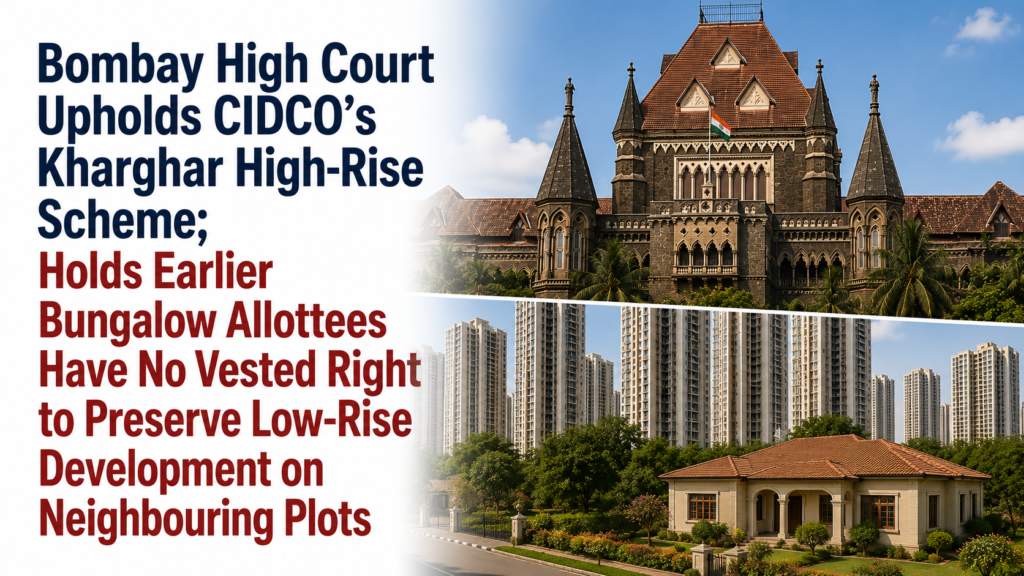
Bombay High Court Upholds CIDCO’s Kharghar High-Rise Scheme; Holds Earlier Bungalow Allottees Have No Vested Right to Preserve Low-Rise Development on Neighbouring Plots

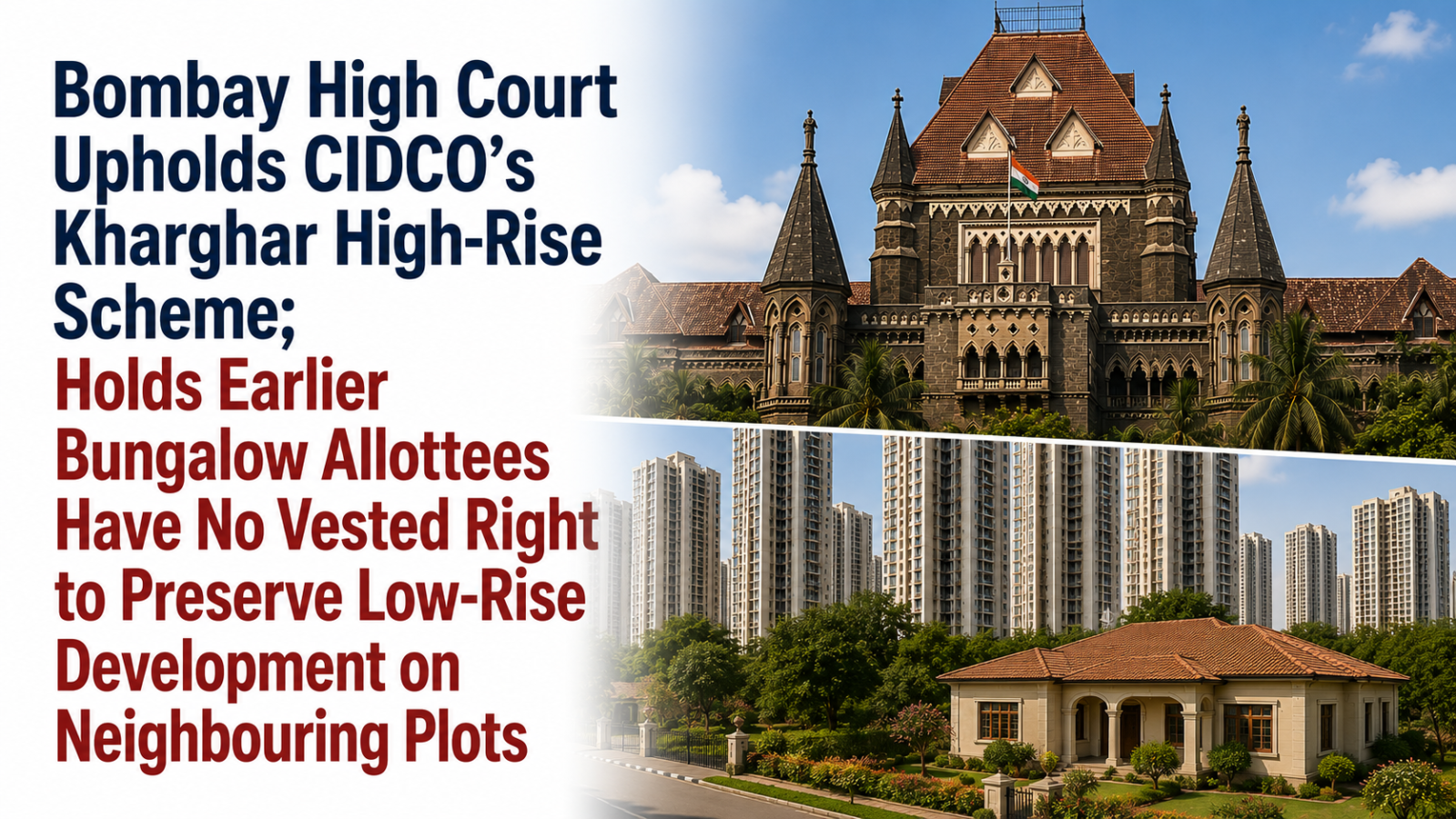
Bombay High Court Dismisses Challenge to High-Rise Construction in Kharghar; Finds 2020–21 CIDCO Scheme Independent of 2002 and 2011 Bungalow Schemes
Facts
The writ petition was filed by 17 plot holders in Sector 21, Kharghar, principally challenging CIDCO’s 2020–2021 scheme for leasing 106 residential plots across New Panvel, Kharghar, Nerul, Airoli and Ghansoli. The petitioners were allottees under earlier CIDCO schemes of 2002–2003 and 2011–2012.
The earlier 2002–2003 scheme contemplated bungalow plots and prescribed an FSI of 1, with a maximum height of G+2 or 10 metres. The 2011–2012 scheme dealt with semi-detached bungalow plots and similarly restricted FSI to 1, limited construction to stilt plus three floors, prohibited amalgamation and ordinarily allowed one dwelling unit per plot.
The petitioners objected to CIDCO’s later 2020–2021 scheme insofar as it concerned 14 plots in Sector 21, Kharghar. They contended that CIDCO was permitting construction of multi-storeyed or high-rise residential buildings and amalgamation of plots in an area originally envisaged as a bungalow and semi-detached bungalow neighbourhood.
Their case was that this altered development pattern affected their light, air and ventilation and fundamentally changed the character of the locality in which they had purchased residential bungalow plots.
The 2020–2021 scheme, however, had been formulated after the Unified Development Control and Promotion Regulations, 2020 (UDCPR) came into force. Under the new regulatory regime, increased FSI, plot amalgamation and multi-dwelling residential development were permissible subject to applicable planning restrictions.
Issues
The principal questions before the Bombay High Court were:
- Whether the development restrictions contained in CIDCO’s 2002–2003 and 2011–2012 bungalow schemes continued to bind plots subsequently offered under the independent 2020–2021 scheme.
- Whether earlier bungalow allottees possessed a vested or enforceable right to insist that neighbouring or remaining CIDCO plots continue to be developed only as low-rise bungalow plots.
- Whether CIDCO could permit higher FSI, multiple dwelling units, high-rise construction and amalgamation under the UDCPR.
- Whether CIDCO’s nodal layouts constituted statutory development plans incapable of alteration without following the modification procedure under the MRTP Act.
- Whether the doctrine of legitimate expectation protected the petitioners’ expectation that Sector 21 would permanently retain a bungalow character.
- Whether alleged impairment of light and air entitled the petitioners to challenge development on neighbouring plots through Article 226.
- Whether the Court could interfere with CIDCO’s planning policy on the ground that a bungalow-only or lower-density policy would be preferable.
Petitioners’ Arguments
The petitioners contended that plots in Sector 21 had originally been earmarked and offered as part of a planned bungalow and semi-detached bungalow layout.
They relied strongly upon the special conditions of the 2011–2012 scheme, under which:
- FSI was restricted to 1;
- height was restricted;
- amalgamation was expressly prohibited;
- only one dwelling unit per plot was generally permissible; and
- the prescribed land use and FSI were to prevail irrespective of otherwise permissible development-control FSI.
They argued that CIDCO could not subsequently permit amalgamation of plots such as Nos. 164–165, 170–171 and 174–175 or allow those lands to be utilised for multi-storeyed/high-rise construction contrary to the original planning concept.
The petitioners also invoked legitimate expectation, contending that having acquired bungalow plots under earlier schemes they reasonably expected that the surrounding area would continue to maintain the same development character.
They asserted that permitting skyscrapers or large residential buildings would adversely affect:
- light and ventilation;
- road capacity;
- parking;
- sewage infrastructure;
- water supply; and
- the overall planned character of Sector 21.
They further argued that the 2020–2021 scheme was contrary to the MRTP Act and the Navi Mumbai Disposal of Lands Regulations and had been introduced without adequate environmental and infrastructure studies.
Respondents’ Arguments
CIDCO opposed the petition and maintained that the earlier schemes governed only the plots actually offered and allotted under those schemes.
The remaining or subsequently auctioned plots continued to vest in CIDCO. No assurance had ever been made that all land in Sector 21 would permanently remain subject to the restrictions applicable to the 2002–2003 or 2011–2012 allotments.
CIDCO contended that it was empowered under Section 118 of the MRTP Act to dispose of land on such terms and conditions as it considered expedient for development of Navi Mumbai.
It further argued that after the UDCPR came into force in December 2020, development potential—including permissible FSI, height and plot amalgamation—was governed by that regulatory framework.
The private allottees and developers under the 2020–2021 scheme supported CIDCO and argued that the petitioners could not use restrictions contained in their own lease transactions to control separate CIDCO properties.
Analysis of the Law
1. Earlier Scheme Conditions Bind the Concerned Plots, Not the Entire Sector
This was the core of the judgment.
The Court held that the conditions in the 2002–2003 and 2011–2012 schemes were specific contractual and development restrictions applicable to plots offered under those schemes.
CIDCO had never represented that all other land in Sector 21 would forever remain subject to those restrictions.
Consequently, a person who purchased a bungalow plot could enforce the conditions governing his own allotment but could not convert those conditions into a perpetual planning restriction over neighbouring land owned by CIDCO.
2. The 2020–2021 Scheme Was an Independent Scheme
The Court expressly rejected the contention that the 2020–2021 scheme was merely a continuation of the earlier bungalow schemes.
It was a separate and independent scheme, governed by the UDCPR rather than the Development Control Regulations, 1975 applicable to the earlier schemes.
Under the applicable regulations, development potential could include a total FSI of up to 2.0, consisting of base FSI of 1.1, premium FSI of 0.5 and TDR of 0.4, subject to regulatory requirements.
The Court found nothing erroneous in CIDCO’s position that after December 2020, questions such as amalgamation, permissible FSI and permissible height were governed by the UDCPR.
No Vested Right to a Permanent Development Pattern
The petitioners were allottees of their individual properties under earlier schemes. Their rights arose from their allotment documents, lease agreements and applicable development regulations.
They had no proprietary or contractual right over CIDCO’s remaining unsold or subsequently disposed plots.
The Court therefore held that nothing on record demonstrated any vested or enforceable legal right enabling the petitioners to insist that the same development typology must continue in future schemes.
Section 118 of the MRTP Act gives CIDCO discretion to determine how land is disposed of in furtherance of planned development. Planning requirements can legitimately change with social, demographic and regulatory developments.
Nodal Plans Are Not Statutory Development Plans
Another significant holding concerned CIDCO’s nodal layouts.
The Court held that the planning and layout of individual CIDCO plots in nodal plans does not constitute the statutory Development Plan under the MRTP Act.
CIDCO therefore enjoys flexibility to modify its nodal planning and utilise plots for permissible uses without undertaking the formal statutory procedure applicable to modification of a Development Plan, provided its actions remain consistent with governing rules and regulations.
The Court reiterated that CIDCO’s plot layouts are not development plans and that CIDCO possesses substantial flexibility to utilise its plots for all legally permissible uses.
Legitimate Expectation
The petitioners argued that they had a legitimate expectation that Sector 21 would retain its bungalow character.
The Court rejected this contention because legitimate expectation ordinarily requires some representation, promise or consistent past practice capable of giving rise to an expectation of particular treatment.
Here, there was no representation or assurance from CIDCO that all plots in Sector 21 would permanently be subjected to the earlier bungalow-scheme conditions.
Relying upon Bannari Amman Sugars Ltd. v. Commercial Tax Officer, the Court reiterated that legitimate expectation does not itself create a crystallised substantive right. Policy may legitimately change provided the change is not irrational, perverse or unreasonable in the Wednesbury sense.
Thus, an expectation that the neighbourhood would remain unchanged could not override CIDCO’s lawful planning powers.
Judicial Review of Planning and Policy Decisions
The High Court emphasised the limits of judicial review over urban planning.
It was not for the Court to decide what CIDCO’s planning policy ought to be or whether a bungalow-only development pattern would be aesthetically, environmentally or socially preferable.
Judicial intervention would be justified if the policy were shown to be:
- contrary to statute;
- patently arbitrary;
- capricious;
- illegal; or
- uninformed in a legally relevant sense.
No such case was established.
Relying upon BALCO Employees’ Union v. Union of India, the Court reiterated that judicial review does not permit courts to strike down public policy merely because another policy might appear fairer, wiser, more scientific or more logical.
Precedent Analysis
Bannari Amman Sugars Ltd. v. Commercial Tax Officer
This judgment governed the doctrine of legitimate expectation.
The Court applied the principle that a legitimate expectation ordinarily arises from a representation, promise or consistent practice. Even then, policy changes may defeat that expectation where they satisfy standards of reasonableness and public interest.
Since CIDCO had never promised a permanently low-rise Sector 21, the petitioners could not establish a substantive legitimate expectation.
Dilip K. Mandal v. State of Maharashtra, Rajvansh Co-operative Housing Society Ltd. v. CIDCO and Nishant Karsan Bhagat v. CIDCO
These authorities supported CIDCO’s proposition that plot layouts and nodal planning are not themselves statutory Development Plans and that CIDCO possesses flexibility regarding permissible utilisation of plots.
The Division Bench accepted this proposition.
BALCO Employees’ Union v. Union of India
The judgment was relied upon for judicial restraint in policy matters.
Courts do not determine whether government policy is ideal, wise or scientifically optimal. Unless illegality, arbitrariness or constitutional infirmity is demonstrated, policy choices remain within the executive or specialised authority’s domain.
Bangalore Medical Trust v. B.S. Muddappa
The petitioners relied upon this authority for the proposition that governmental action contrary to statute cannot be validated merely because it is taken by the State.
The High Court distinguished it because the present case involved no established statutory violation by CIDCO.
Residents Welfare Association v. Union Territory of Chandigarh
The petitioners relied upon the Supreme Court’s intervention concerning apartmentalisation and redensification in heritage Chandigarh.
The Bombay High Court distinguished the case because Chandigarh involved its unique Corbusian heritage character and specific planning restrictions, including the Supreme Court’s exercise of Article 142 jurisdiction. No comparable statutory or heritage restriction applied to Sector 21, Kharghar.
Indian Institute of Architects Navi Mumbai Centre v. CIDCO
This authority concerned shifting of a designated sports facility and was distinguished as turning upon its particular facts and the need to preserve an earmarked public sports facility. The Court held that it did not govern the present dispute over residential development potential.
Court’s Reasoning
The Division Bench found the petitioners’ basic premise flawed.
The restrictions attached to their own bungalow plots did not translate into restrictions over every neighbouring CIDCO plot. The Court proceeded on the basis that plots not actually forming part of the 2002–2003 and 2011–2012 schemes remained CIDCO property capable of lawful disposal under the prevailing UDCPR.
It further held that the plots offered in the 2020–2021 scheme were not governed by the earlier auction brochures and that the contention that all plots in Sector 21 must remain subject to those earlier restrictions was “fallacious and misconceived.”
The Court found no representation by CIDCO that:
- Sector 21 would permanently remain bungalow-only;
- neighbouring land would never be amalgamated;
- FSI would remain frozen at 1;
- buildings would permanently remain low-rise; or
- future regulatory changes would not apply.
The petitioners therefore could not use legitimate expectation to freeze the development potential of third-party plots.
Most importantly, the Court refused to substitute its own urban-planning assessment for CIDCO’s statutory judgment. Population growth, increased housing demand and amended development regulations legitimately permitted a different development model from that prevailing two decades earlier.
Conclusion
The Bombay High Court found no merit in the petitioners’ challenge to CIDCO’s 2020–2021 scheme.
It held that:
- restrictions in earlier bungalow schemes applied only to the plots governed by those schemes;
- the 2020–2021 scheme was independent and governed by the UDCPR;
- CIDCO could utilise remaining plots for legally permissible residential development;
- its nodal layouts were not statutory Development Plans;
- earlier allottees had no vested right to preserve the surrounding area as permanently low-rise;
- no legitimate expectation arose in the absence of any promise or representation by CIDCO; and
- no arbitrariness or statutory violation warranting Article 226 interference had been demonstrated.
The writ petition was consequently dismissed with no order as to costs, and the interim applications were disposed of.
After pronouncement, however, the Court continued the existing interim protection for four weeks. It permitted the respondents to apply for Occupancy Certificates and allowed those applications to be processed, but directed that no final decision on the OC applications be taken for four weeks.
Case Details
Case: Mandar Shashikant Jadhav & Ors. v. City and Industrial Development Corporation of Maharashtra Ltd. & Ors.
Court: Bombay High Court, Civil Appellate Jurisdiction
Case Number: Writ Petition No. 15332 of 2023 with Interim Application Nos. 11377 and 11376 of 2025; 2026:BHC-AS:33455-DB
Judge: Justice M. S. Karnik and Justice S. M. Modak
Date: 13 August 2026
Result: Writ petition dismissed; CIDCO’s 2020–2021 scheme upheld; interim protection continued for four weeks and final decision on OC applications deferred for that period.