Bombay High Court upholds option rule for Anganwadi Sevikas elected to Panchayat—“No dual holding of posts”; termination quashed after resignation from elected office

1. Court’s decision
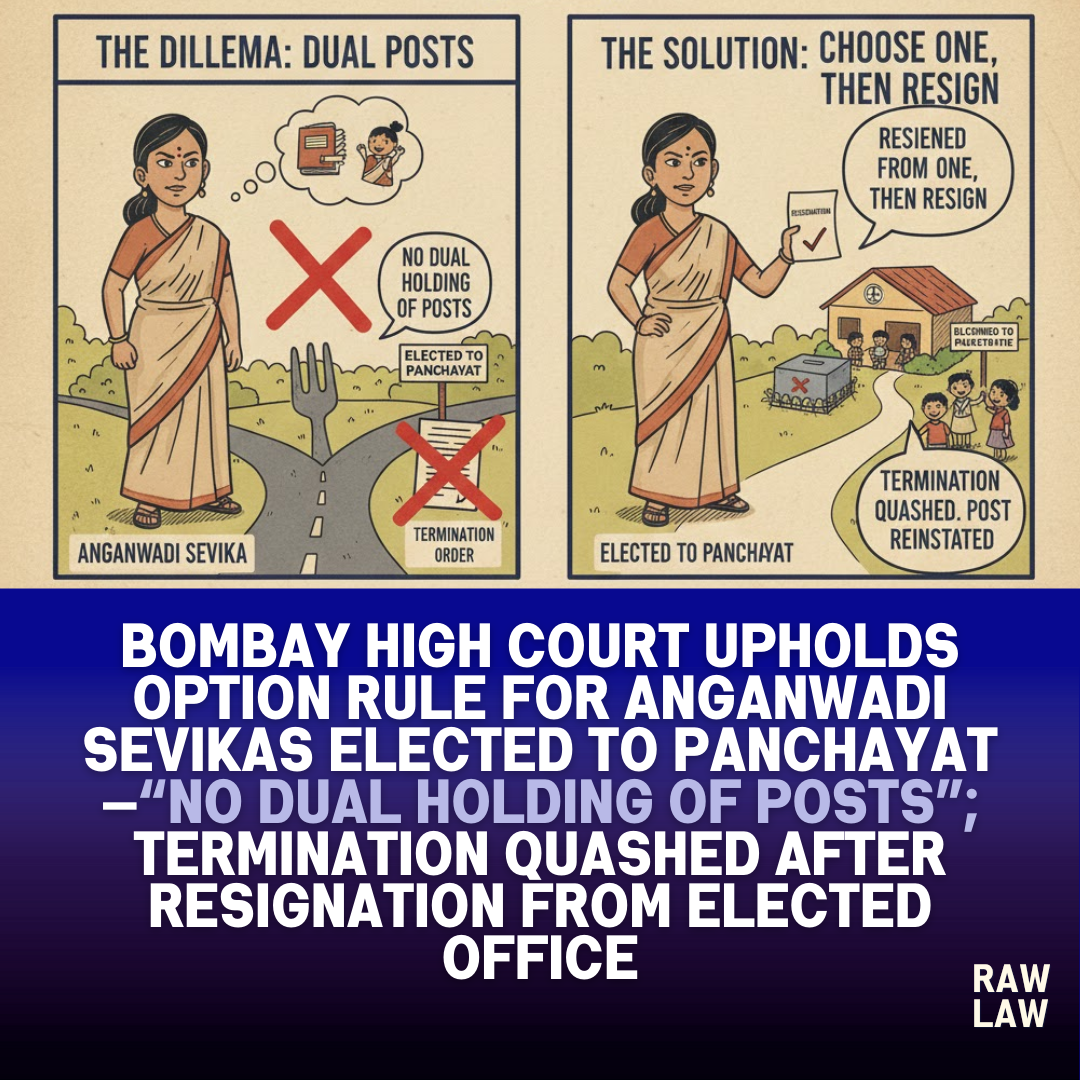
The Bombay High Court (Aurangabad Bench) upheld the validity of the Government Resolution dated 05 August 2010 requiring an Anganwadi Sevika elected as a Village Panchayat member to choose between the two posts. The Court rejected the constitutional challenge to the Resolution and held that simultaneous holding of both posts is impermissible.
However, since the petitioner resigned from her elected post during the pendency of proceedings and the Anganwadi post remained vacant, the Court quashed the termination order dated 23 March 2021 and directed reinstatement, without arrears, subject to acceptance of her resignation by the Panchayat.
2. Facts
The petitioner was appointed as an Anganwadi Sevika in 1996 at village Bondar, District Nanded. In the 2020 Panchayat elections, she was elected as a Member of Village Panchayat of Nasaratpur-Hassapur, about 16 km from her Anganwadi centre.
Pursuant to Government Resolution dated 05 August 2010, she was issued a show-cause notice directing her to resign either from the elected post or from her Anganwadi post. Having failed to exercise the option within the stipulated time, her services were terminated by order dated 23 March 2021.
She challenged both the Government Resolution and the termination order under Article 226 of the Constitution.
3. Issues
The Court considered three central issues:
• Whether an Anganwadi Sevika holds an “office of profit” disqualifying her from contesting elections.
• Whether the Government Resolution mandating resignation from one of the two posts is arbitrary or unconstitutional under Articles 14 and 19.
• Whether the termination order was sustainable in law.
4. Petitioner’s arguments
The petitioner contended that both posts are honorary in nature and do not constitute permanent civil posts. She argued that the Government Resolution violated democratic principles by restricting her right to contest elections.
Relying on Supreme Court jurisprudence, she submitted that an Anganwadi Sevika does not hold a civil post nor an office of profit. Therefore, there was no statutory bar under the Maharashtra Village Panchayat Act, 1955 preventing her from holding both posts simultaneously.
She urged that the termination order was unconstitutional and liable to be set aside.
5. Respondents’ arguments
The State defended the Government Resolution as being issued pursuant to Central Government communication dated 04 June 2010. It was argued that the object was to prevent lapses in duty when Anganwadi Sevikas simultaneously held elected office.
Respondents emphasized the nature of duties under the Integrated Child Development Services Scheme, which require full-time engagement in child nutrition monitoring, vaccination drives, home visits, reporting, and public health campaigns.
The State contended that dual responsibilities would adversely affect service delivery under the welfare scheme.
6. Analysis of the law
The Court first examined whether an Anganwadi Sevika holds a civil post or office of profit. Relying on the Supreme Court decision in State of Karnataka v. Ameerbi (2007) 11 SCC 681, it held that Anganwadi Sevikas do not hold civil posts and are free to contest elections.
However, the Court clarified that the Government Resolution does not prohibit contesting elections. It merely requires the Sevika to choose one post upon being elected.
The Resolution was evaluated in light of the Integrated Child Development Services Scheme. The Court noted that Anganwadi Sevikas are responsible for nutrition assessment, health monitoring, vaccination coordination, pre-primary education, and reporting. Simultaneous holding of an elected office could compromise these essential welfare duties.
The condition was therefore held to be reasonable and based on public interest.
7. Precedent analysis
The Court relied primarily on State of Karnataka v. Ameerbi (2007) 11 SCC 681, which held that Anganwadi workers do not hold civil posts and are not barred from contesting elections.
It also referred to Supreme Court observations in Satrucharla Chandrasekhar Raju v. Vyricherla Pradeep Kumar Dev, reiterating that holding a post under a scheme does not automatically disqualify a person from elections unless statutory provisions so mandate.
The Court distinguished between eligibility to contest elections and eligibility to simultaneously discharge two roles affecting public welfare.
8. Court’s reasoning
The Court held that the Resolution strikes a balance between democratic participation and effective delivery of welfare services. The petitioner’s right to contest elections was not curtailed. However, continuing both roles would undermine the scheme’s object.
The Court found no arbitrariness or unreasonableness in the Government Resolution. It held that societal interest and uninterrupted functioning of Anganwadi services justified the condition requiring election of one post.
When informed that the petitioner had resigned from her elected post on 23 January 2026 and that the Anganwadi post had not been permanently filled, the Court adopted a pragmatic approach. It directed reinstatement subject to acceptance of resignation, but denied arrears.
9. Conclusion
The Government Resolution dated 05 August 2010 was upheld. The termination order dated 23 March 2021 was quashed and set aside in view of the petitioner’s resignation from elected office.
The petitioner shall continue as Anganwadi Sevika subject to acceptance of her resignation by the Village Panchayat, but without entitlement to back wages. The Rule was made absolute accordingly.
10. Implications
This ruling clarifies that:
• Anganwadi Sevikas do not hold civil posts or offices of profit.
• They may contest elections.
• However, simultaneous holding of elected Panchayat office and Anganwadi post is impermissible.
• Government can impose reasonable service conditions in public interest.
The judgment balances participatory democracy with functional efficiency of welfare schemes and may influence similar disputes across Maharashtra.
Case Law References
State of Karnataka v. Ameerbi (2007) 11 SCC 681 – Anganwadi Sevika does not hold civil post; free to contest elections.
Satrucharla Chandrasekhar Raju v. Vyricherla Pradeep Kumar Dev – Office under State does not automatically amount to office of profit.
FAQs
1. Can an Anganwadi Sevika contest Panchayat elections?
Yes. The Supreme Court has held that Anganwadi Sevikas do not hold civil posts and may contest elections.
2. Can she continue as Anganwadi Sevika after being elected?
No. As per Maharashtra’s Government Resolution dated 05 August 2010, she must choose one of the two posts.
3. Is the Government Resolution unconstitutional?
No. The High Court held it to be reasonable and in public interest to ensure effective delivery of ICDS services.