

1. Court’s decision
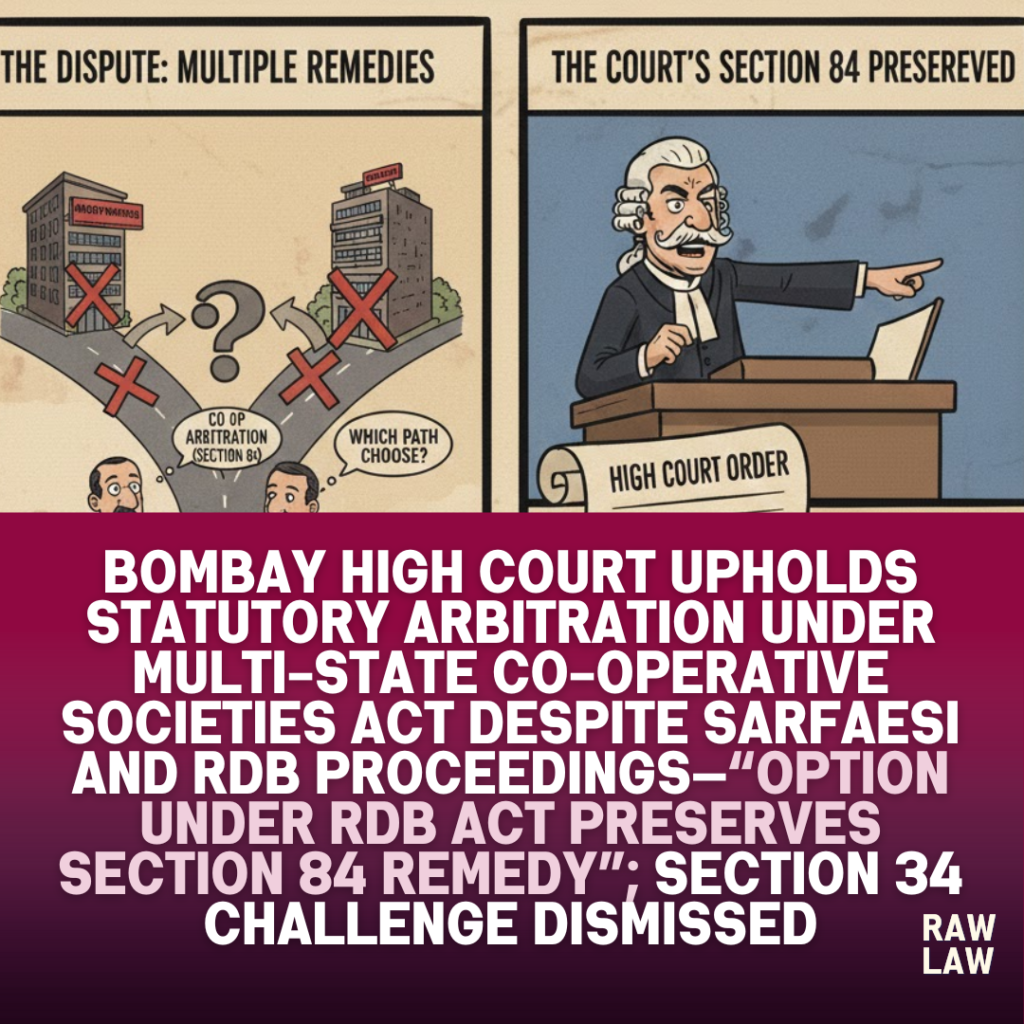
The Bombay High Court dismissed two petitions filed under Section 34 of the Arbitration and Conciliation Act, 1996 challenging arbitral awards passed under Section 84 of the Multi-State Co-operative Societies Act, 2002. The core challenge was jurisdictional: whether a multi-state co-operative bank could invoke statutory arbitration under Section 84 for recovery of dues when remedies under the Recovery of Debts and Bankruptcy Act, 1993 and the Sarfaesi Act were also available. The Court held that the statutory framework itself preserves the bank’s option to proceed under the MSCS Act and that no exclusive jurisdiction vests in the Debt Recovery Tribunal to the exclusion of Section 84 arbitration. The petitions were accordingly dismissed.
2. Facts
The petitioners had availed financial assistance from a multi-state co-operative bank and defaulted in repayment. The bank invoked Section 84 of the MSCS Act and referred the dispute to arbitration. The learned arbitrator passed awards dated 5 December 2022 and 3 July 2023 directing recovery of the outstanding dues.
Simultaneously, the bank also initiated measures under the Sarfaesi Act for enforcement of security interest in mortgaged property. The petitioners contended that the bank had also invoked other statutory mechanisms, including insolvency proceedings. In the Section 34 challenge before the High Court, the petitioners did not assail factual findings but confined their arguments to legal objections concerning jurisdiction and legislative competence.
3. Issues
The principal issue was whether recovery of debts by a multi-state co-operative bank falls exclusively within the domain of the RDB Act and Sarfaesi Act, thereby excluding recourse to arbitration under Section 84 of the MSCS Act.
A related issue concerned legislative competence: whether banking, being referable to Entry 45 of List I of the Seventh Schedule, rendered the MSCS Act mechanism inapplicable when the dispute concerns recovery of loan amounts.
The Court also examined whether an arbitrator appointed under Section 84 could rule on his own jurisdiction, and whether parallel invocation of Sarfaesi proceedings barred arbitration.
4. Petitioners’ arguments
The petitioners argued that recovery of bank debts is governed by central legislations enacted under Entry 45 of List I, namely the RDB Act and Sarfaesi Act. They contended that the MSCS Act is primarily concerned with governance of co-operative societies and not recovery of debts, and therefore could not override specialized debt recovery statutes.
They further submitted that since the bank had invoked Sarfaesi measures and other proceedings, it could not simultaneously pursue arbitration under Section 84. According to them, recovery should proceed before a single forum to avoid multiplicity. It was also contended that the arbitrator, being appointed under statute, could not decide a challenge to his own jurisdiction.
5. Respondents’ arguments
The bank submitted that Section 84(2) expressly covers disputes touching the business of the society, including recovery of loans from members. The petitioners had admittedly become members of the bank, and therefore the dispute squarely fell within the statutory arbitration framework.
The bank relied upon amendments to Section 19 of the RDB Act, particularly sub-sections (1A) and (1B), which expressly confer an option upon a multi-state co-operative bank to initiate proceedings under the MSCS Act instead of approaching the Debt Recovery Tribunal. This statutory option, it was argued, negated any plea of exclusive jurisdiction under the RDB Act.
It was further submitted that Sarfaesi proceedings are enforcement mechanisms for secured assets and do not bar adjudicatory arbitration proceedings.
6. Analysis of the law
The Court undertook a detailed statutory analysis. It first noted that the MSCS Act provides a self-contained dispute resolution mechanism under Section 84 for disputes touching the constitution, management or business of a multi-state co-operative society. A claim by the society for recovery of debt from a member is expressly deemed to be such a dispute.
The Court then examined the constitutional scheme under Entries 45 of List I (Banking) and 32 of List II (Co-operative Societies), and referred to authoritative precedent clarifying that recovery of debt forms an essential part of banking activity. However, the existence of parliamentary competence to enact debt recovery laws does not automatically exclude the operation of the MSCS Act.
Crucially, the Court relied on Section 19(1A) and (1B) of the RDB Act, introduced by amendment, which expressly permits a multi-state co-operative bank to opt for recovery under the MSCS Act instead of filing an application before the Tribunal. This statutory option is explicit and unequivocal. Therefore, the argument of exclusive jurisdiction under the RDB Act was rejected.
The Court also emphasized the non obstante clause in Section 84 of the MSCS Act, which gives it overriding effect in case of inconsistency. No direct conflict between the statutes was demonstrated.
7. Precedent analysis
The Court relied on the Constitution Bench decision in Pandurang Ganpati Chaugule v. Vishwasrao Patil Murgud Sahakari Bank Ltd., which upheld the applicability of the Sarfaesi Act to co-operative banks and recognized Parliament’s competence under Entry 45. The decision clarified that recovery of debts is integral to banking and that additional statutory remedies can coexist.
The Court further referred to Indiabulls Housing Finance Ltd. v. Deccan Chronicle Holdings Ltd., Transcore v. Union of India, and M.D. Frozen Foods Exports Pvt. Ltd. v. Hero Fincorp Ltd., which collectively establish that remedies under Sarfaesi, RDB Act, and arbitration can proceed simultaneously, as they are complementary rather than mutually exclusive.
The reliance on Vidya Drolia concerning non-arbitrability was held to be misplaced, as the dispute was statutorily arbitrable under Section 84.
8. Court’s reasoning
The Court reasoned that once the petitioners admitted membership in the bank, the dispute regarding recovery of loan squarely fell within Section 84(2)(a). Recovery of loan is part of the “business” of the society.
The amendment to Section 19 of the RDB Act makes it clear that a multi-state co-operative bank has an express statutory option to initiate proceedings under the MSCS Act. Since the bank chose that route from the outset, there was no requirement to seek permission from the Tribunal.
On the competence of the arbitrator to rule on jurisdiction, the Court invoked Section 16 of the Arbitration and Conciliation Act, 1996, which embodies the principle of kompetenz-kompetenz. The arbitrator was therefore competent to decide jurisdictional objections.
As regards simultaneous Sarfaesi proceedings, the Court held that enforcement of security interest under Section 13 of Sarfaesi is distinct from adjudicatory determination of debt under arbitration. Section 37 of Sarfaesi preserves the applicability of other laws, and no statutory bar against parallel proceedings was demonstrated.
9. Conclusion
The High Court concluded that there was no jurisdictional infirmity in the arbitral awards. The statutory scheme itself authorizes a multi-state co-operative bank to recover debts through arbitration under Section 84 of the MSCS Act, even when Sarfaesi or RDB remedies are available. The Section 34 petitions were dismissed and the interim applications disposed of.
10. Implications
This ruling clarifies that multi-state co-operative banks retain a statutory option to pursue recovery under the MSCS Act despite the existence of specialized debt recovery mechanisms under the RDB Act and Sarfaesi Act. It reinforces the complementary operation of multiple recovery statutes and rejects the argument of exclusive forum jurisdiction.
For borrowers, the judgment signals that invoking Sarfaesi or other proceedings does not automatically invalidate arbitration under Section 84. For banks, it confirms flexibility in choosing the recovery mechanism best suited to the circumstances.
Case Law References
Pandurang Ganpati Chaugule v. Vishwasrao Patil Murgud Sahakari Bank Ltd. (2020) 9 SCC 215 – Upheld Parliament’s competence under Entry 45; clarified applicability of Sarfaesi to co-operative banks.
Indiabulls Housing Finance Ltd. v. Deccan Chronicle Holdings Ltd. (2018) 14 SCC 783 – Held Sarfaesi and arbitration remedies can coexist.
Transcore v. Union of India (2008) 1 SCC 125 – Rejected doctrine of election; remedies under RDB and Sarfaesi are complementary.
M.D. Frozen Foods Exports Pvt. Ltd. v. Hero Fincorp Ltd. (2017) 16 SCC 741 – Arbitration and Sarfaesi proceedings can proceed simultaneously.
Vidya Drolia v. Durga Trading Corporation (2019) 20 SCC 406 – On arbitrability; distinguished in present context.
FAQs
1. Can a multi-state co-operative bank choose arbitration under Section 84 instead of filing before the Debt Recovery Tribunal?
Yes. Section 19(1A) of the RDB Act expressly grants such an option to multi-state co-operative banks.
2. Does initiating Sarfaesi proceedings bar arbitration under the MSCS Act?
No. Courts have held that Sarfaesi enforcement and arbitration are complementary remedies and can proceed simultaneously.
3. Can a statutory arbitrator decide jurisdictional objections?
Yes. Section 16 of the Arbitration Act empowers an arbitral tribunal to rule on its own jurisdiction.


