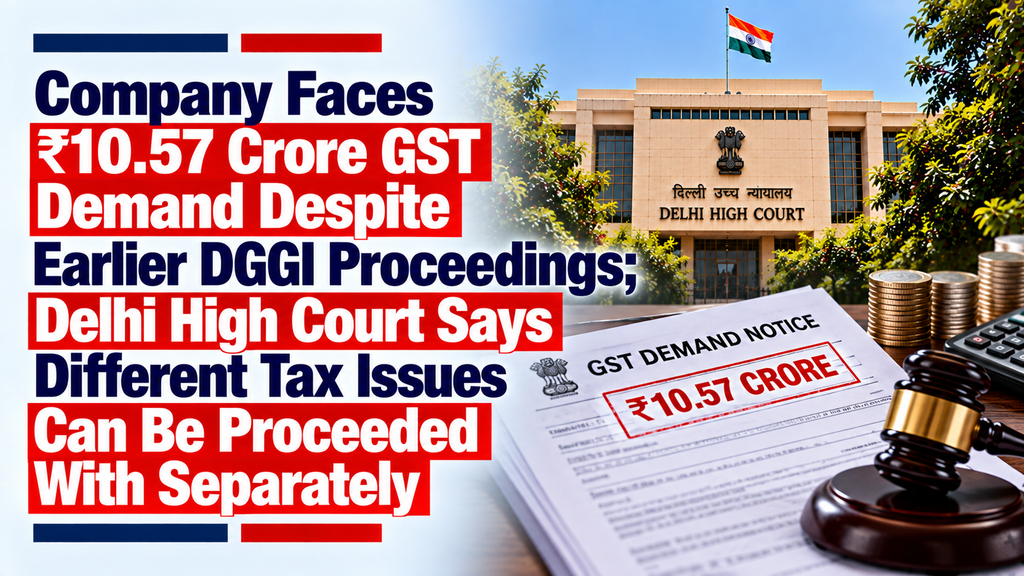
Company Faces ₹10.57 Crore GST Demand Despite Earlier DGGI Proceedings; Delhi High Court Says Different Tax Issues Can Be Proceeded With Separately

Same Taxpayer and Overlapping Period Not Enough to Bar Second GST Proceeding; Delhi High Court Explains Meaning of “Same Subject Matter”
Facts
M/s Vertilink Media Solutions Private Limited, which provides script services to Zee Entertainment Enterprises Ltd., challenged a GST show-cause notice dated 29 May 2024 and a consequential order dated 29 August 2024, creating a demand of ₹10,57,75,250. VERTILINK MEDIA
The dispute arose because the petitioner had already been subjected to an investigation that was eventually handled by the Directorate General of GST Intelligence (DGGI), Mumbai Zonal Unit. On 31 March 2023, DGGI issued a common show-cause notice to 45 noticees, including Vertilink and its former director, concerning alleged fraudulent availment of Input Tax Credit involving suppression, fraud or wilful misstatement. VERTILINK MEDIA
While those proceedings were pending, the Delhi GST authority issued a separate notice under Section 73 of the CGST Act for April 2019–March 2020, alleging incorrect declaration of tax liability.
The Delhi authority subsequently denied Input Tax Credit under Section 16(2)(c) and created the ₹10.57 crore liability. VERTILINK MEDIA
Meanwhile, the DGGI proceedings eventually concluded after the principal noticee, Zee Entertainment Enterprises Ltd., paid the entire ITC demanded along with interest and 25% penalty. Consequently, proceedings against the remaining co-noticees, including Vertilink, were treated as concluded. VERTILINK MEDIA
Issues
The principal issues were whether:
- Section 6(2)(b) of the CGST Act barred the Delhi GST authority from commencing separate proceedings after DGGI had already proceeded against the petitioner;
- the two proceedings concerned the “same subject matter”;
- conclusion of the DGGI proceedings following payment by Zee Entertainment extinguished the separate ₹10.57 crore liability;
- Section 75(13) prohibited further penalty for the same act or omission; and
- the High Court should exercise Article 226 jurisdiction when the petitioner had not pursued the statutory appeal and approached the Court after substantial delay.
Petitioner’s Arguments
Vertilink argued that once the Anti-Evasion Branch initiated investigation and the matter was transferred to DGGI, another GST authority could not independently commence proceedings concerning the same transactions.
It relied heavily upon Section 6(2)(b) and Amit Gupta v. Union of India, arguing that GST law was designed to prevent multiple authorities from pursuing parallel proceedings over the same subject matter. VERTILINK MEDIA
It further contended that once the DGGI proceedings against it stood concluded because of payment by the principal noticee, it could not separately be subjected to another demand concerning those transactions.
Respondents’ Position
The Court accepted the fundamental distinction between the two sets of proceedings: the DGGI proceeding and the Delhi GST proceeding did not determine the same liability on the same statutory basis.
The existence of common transactions, the same assessee, overlapping financial periods or common terminology such as “ITC” was insufficient to establish identity of subject matter.
Analysis of the Law
The key interpretation concerned Section 6(2)(b) of the CGST Act.
The Delhi High Court held that the provision is intended to prevent multiplicity of proceedings where another GST authority has already initiated proceedings “on the same subject matter.”
However, the Court emphasized:
Same taxpayer + overlapping period + common transactions ≠ necessarily the same subject matter.
The Court held that the nature, statutory basis, allegations and liability sought to be determined must be compared. VERTILINK MEDIA
Section 73 Proceeding
The Delhi proceeding concerned:
- incorrect declaration of tax liability for April 2019–March 2020; and
- inadmissible ITC under Section 16(2)(c), because suppliers allegedly had not paid corresponding tax on outward supplies.
Section 74 DGGI Proceeding
The DGGI proceeding involved:
- 45 noticees;
- alleged fraudulent availment of ITC;
- alleged absence of actual supply of goods or services; and
- proceedings under Section 74.
The Court therefore found the statutory provisions, allegations and liabilities materially different. VERTILINK MEDIA
Section 6(2)(b), therefore, did not impose a blanket prohibition merely because another GST authority had previously proceeded against the same assessee. VERTILINK MEDIA
Precedent Analysis
Amit Gupta v. Union of India
The petitioner relied upon Amit Gupta to argue against parallel GST proceedings.
The High Court distinguished its application. It held that Amit Gupta recognizes the statutory protection against multiple proceedings concerning the same subject matter, but does not eliminate the requirement of first establishing that both proceedings actually concern the same subject matter. VERTILINK MEDIA
Thus, the precedent did not create a general “first authority takes exclusive jurisdiction” rule covering every subsequent GST issue concerning the taxpayer.
Court’s Reasoning
The Court rejected the writ challenge on four independent grounds.
First, Vertilink had an efficacious statutory appellate remedy against the 29 August 2024 assessment order but failed to use it within limitation.
Second, the assessment order was passed in August 2024, while the writ petition was instituted only in August 2026. Filing a rectification application in April 2025 did not erase or adequately explain that delay. VERTILINK MEDIA VERTILINK MEDIA
Third, Section 6(2)(b) did not apply because the two proceedings had not been shown to concern the same subject matter.
Fourth, Section 75(13) did not assist the petitioner. Although Vertilink was a co-noticee in the DGGI proceeding, no tax, interest or penalty had actually been imposed upon it in those proceedings. The proceedings against it were merely treated as concluded following payment by the principal noticee. VERTILINK MEDIA
The Court also clarified that transferring one investigation to DGGI does not create a blanket ouster of jurisdiction of every other proper GST officer regarding different allegations. VERTILINK MEDIA
Conclusion
The Delhi High Court dismissed Vertilink Media Solutions’ writ petition.
The Court summarized four reasons:
- failure to avail the statutory appeal;
- unexplained delay and laches;
- absence of identity of subject matter necessary for Section 6(2)(b); and
- Section 75(13) was inapplicable because no prior penalty for the same act or omission had been shown against Vertilink. VERTILINK MEDIA
The Court nevertheless clarified that Vertilink could pursue whatever remedy was legally available against an order eventually passed on its pending rectification application. VERTILINK MEDIA
Case Details
Case: M/s Vertilink Media Solutions Private Limited v. Anti Evasion Branch & Ors.
Court: Delhi High Court
Case No.: W.P.(C) 13077/2026
CNR: DLHC010423722026
Judges: Justice Anil Kshetrapal and Justice Rajneesh Kumar Gupta
Reserved: 9 September 2026
Pronounced: 25 September 2026 VERTILINK MEDIA
Result: Writ petition dismissed; ₹10.57 crore GST demand was not quashed.