Company Seeks Police Protection to Stop Alleged Construction on Its Thane Land; Bombay High Court Says Property Must First Be Precisely Identified

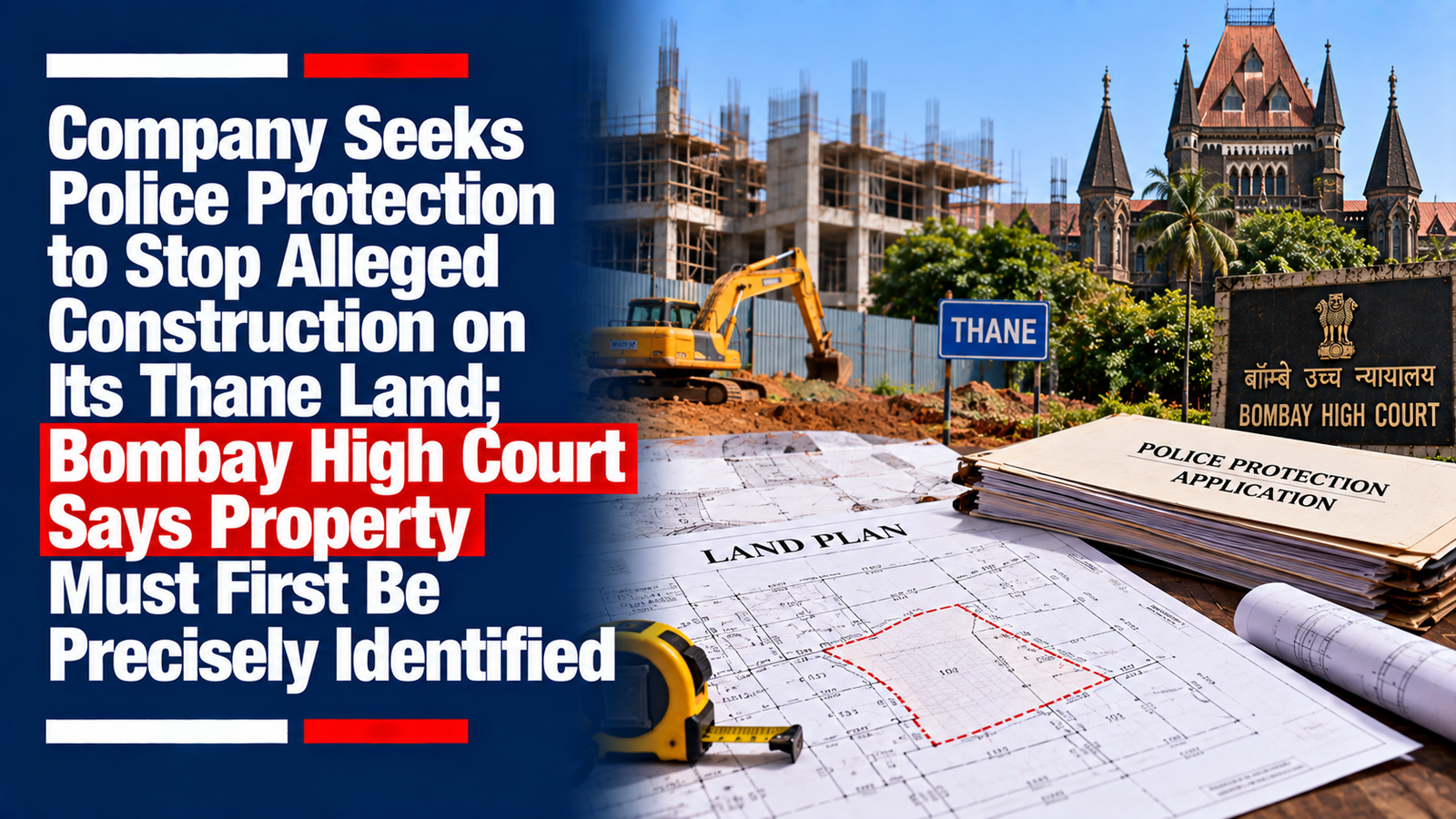
Police Refuses to Enforce Civil Court Injunction Saying Property Dispute Is Civil; Bombay High Court Orders Commissioner to Identify Disputed Land
Facts
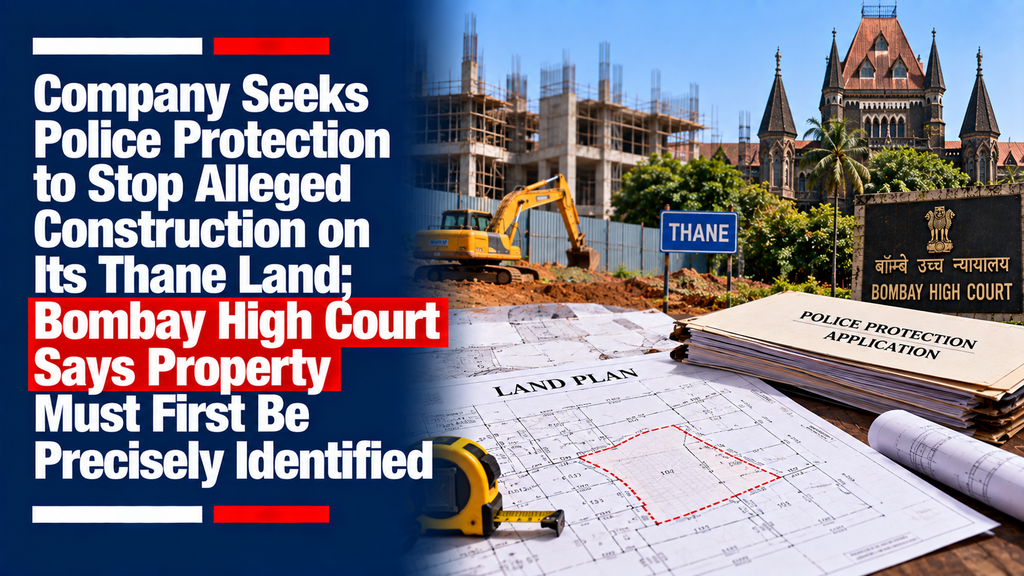
The petition was filed by Raptakos, Brett & Company Limited, a pharmaceutical company, and its Senior Vice President, Dinesh R. Mishra. The dispute concerned land forming part of Survey Nos. 217/1 and 217/2 at Thane. The company had already instituted Regular Civil Suit No. 272 of 2024 seeking declaration and injunction.
The company alleged that on 13 April 2024, unidentified persons forcibly entered its land, cut geo-tagged trees and claimed they were contractors of the Thane Municipal Corporation carrying out widening of a nalla. It further alleged that on 7 May 2024, Respondent No. 6 and his men broke the RCC compound wall, entered with a JCB, damaged trees and threatened the company’s personnel.
The company therefore instituted the civil suit. On 29 May 2024, the Civil Court directed maintenance of status quo after noticing photographs indicating day-to-day construction.
On 20 July 2024, the Civil Court restrained the defendants from entering the suit property or carrying out civil work using JCBs, earth movers, dumpers and other machinery, and specifically directed Vartak Nagar Police to provide police assistance for implementation.
The petitioners alleged that the police nevertheless refused to intervene, stating that the matter was a “civil dispute.” The Civil Court therefore again directed police assistance on 19 August 2024.
The Bombay High Court itself passed an interim order on 30 August 2024, directing the police to stop construction activities on the “suit property”, remove construction machinery and prevent the private respondents from entering or carrying out construction there.
The principal difficulty, however, was that the private respondents maintained that they were not constructing on the petitioners’ property at all; according to them, construction was occurring on their own land pursuant to statutory permissions.
Issues
The principal questions were:
Whether a writ of mandamus could be issued compelling the police to implement the Civil Court’s injunction when the identity and boundaries of the property itself were seriously disputed.
Whether the High Court could determine, in Article 226 proceedings, whether the ongoing construction was actually situated on the petitioners’ land.
Whether the petitioners should instead establish the precise location, possession and alleged encroachment through the pending civil proceedings.
Petitioners’ Arguments
The petitioners argued that once a competent Civil Court had passed categorical injunction orders and specifically directed police assistance, the police had no authority to simply disregard those directions by characterising the dispute as civil.
They relied upon Tayabbhai M. Bagasarwalla v. Hind Rubber Industries Pvt. Ltd. to contend that a judicial order must be obeyed while it remains operative, even if it is subsequently found to have been passed without jurisdiction.
They therefore sought continuation of the High Court’s 30 August 2024 order stopping construction until disposal of the civil suit.
Respondents’ Arguments
The contesting respondents questioned the maintainability of the writ petition because the civil suit was already pending and the CPC provided appropriate remedies to the plaintiff.
More importantly, they relied on Order VII Rule 3 CPC, arguing that the plaint did not sufficiently identify the exact suit property. Consequently, an injunction referring generically to the “suit property” could not effectively be implemented by the police.
They maintained that construction was occurring on their own land, pursuant to permissions granted by the Thane Municipal Corporation, and not on the petitioners’ land.
Analysis of the Law
The High Court emphasised Order VII Rule 3 CPC, which requires that where the subject matter of a suit is immovable property, the plaint must contain a description sufficient to identify that property. Where identification is possible through boundaries or survey numbers, those particulars must be supplied.
The Court explained that merely giving some description is insufficient—the description must permit the disputed property to be clearly and precisely identified, particularly where an injunction is expected to be implemented on the ground by police authorities.
The Court accepted the general proposition that an order passed by a competent court must be complied with. But where police assistance is sought to enforce an injunction relating to immovable property, the land affected by that injunction must first be identifiable with sufficient certainty.
Precedent Analysis
The petitioners relied upon Tayabbhai M. Bagasarwalla v. Hind Rubber Industries Pvt. Ltd., AIR 1997 SC 1240, for the proposition that judicial orders cannot simply be ignored while they remain operative.
The judgment also considered the principle governing writs seeking police protection in private property disputes: Article 226 should not become a substitute for adjudication by the competent Civil Court where the relief depends upon disputed questions of possession, title, boundaries or identity of land.
The High Court ultimately found that the case involved precisely such factual disputes.
Court’s Reasoning
The Court noticed an important defect in the underlying civil proceedings. When the suit was originally filed, the alleged construction had not yet commenced. The pleaded cause concerned alleged trespass, tree cutting and demolition of the compound wall. Although additional defendants were later brought in, the plaint was apparently not amended to incorporate the subsequent construction allegations.
More significantly, although the plaint referred to survey numbers and a sketch, the High Court found these insufficient to determine whether the construction shown in photographs was actually taking place on land belonging to the petitioners.
The photographs established that some construction was occurring, but did not conclusively establish that it was happening on the petitioners’ property.
Thus, the High Court declined to use a writ of mandamus to direct police action merely on the petitioners’ assertion, particularly when there were heavily disputed questions regarding the identity of the land.
The Court also found no breach of statutory duty by the police. There was sufficient ambiguity regarding where the construction was actually taking place, which explained the police reluctance to intervene.
Crucially, the Court held that the successive injunction orders did not themselves establish the petitioners’ title or possession over the precise land on which construction was allegedly occurring. That required further evidence.
The Court identified the appropriate procedural solution in Order XXVI Rule 9 CPC. A Civil Court can appoint a Commissioner to conduct a local investigation to determine the site, boundaries, possession and alleged encroachment. The Commissioner’s report can then form part of the evidence and the parties can examine the Commissioner.
Accordingly, rather than allowing the police to effectively determine a boundary dispute, the High Court directed that the factual position first be established through the Civil Court process.
Conclusion
The Bombay High Court disposed of the writ petition without granting the unconditional police mandamus sought by the petitioners.
Instead, it granted Raptakos liberty to apply in Civil Suit No. 272 of 2024 within four weeks for appointment of a Commissioner under Order XXVI Rule 9 CPC to investigate three specific matters:
encroachment, identity of the disputed land, and the actual site of construction.
If such an application is filed, the Civil Court was directed to decide it preferably within eight weeks. After the Commissioner’s report and examination of the Commissioner, the Civil Court may pass a fresh order on temporary injunction, including modification or alteration of its order dated 18 February 2025.
Importantly, the High Court did not immediately lift its earlier protection. Its interim order dated 30 August 2024 restraining construction on the suit property was directed to continue until completion of the above process and a fresh injunction order is passed by the Civil Court. No costs were awarded.
Case: Raptakos, Brett & Company Limited & Anr. v. Joint Commissioner of Police, Thane City & Ors.
Court: Bombay High Court, Civil Appellate Jurisdiction
Case No.: Writ Petition No. 12225 of 2024
Citation: 2026:BHC-AS:38752-DB
Coram: Justice Suman Shyam and Justice Advait M. Sethna
Date: 22 September 2026
Result: Writ petition disposed of; liberty granted to seek a local Commissioner; existing High Court restraint to continue until the Civil Court completes the directed process and passes a fresh injunction order.