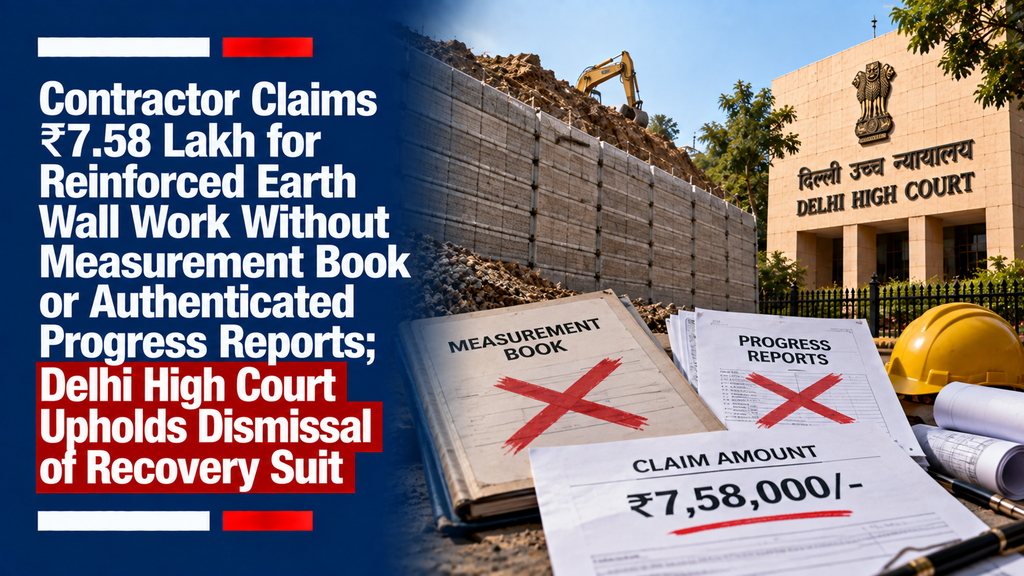
Contractor Claims ₹7.58 Lakh for Reinforced Earth Wall Work Without Measurement Book or Authenticated Progress Reports; Delhi High Court Upholds Dismissal of Recovery Suit

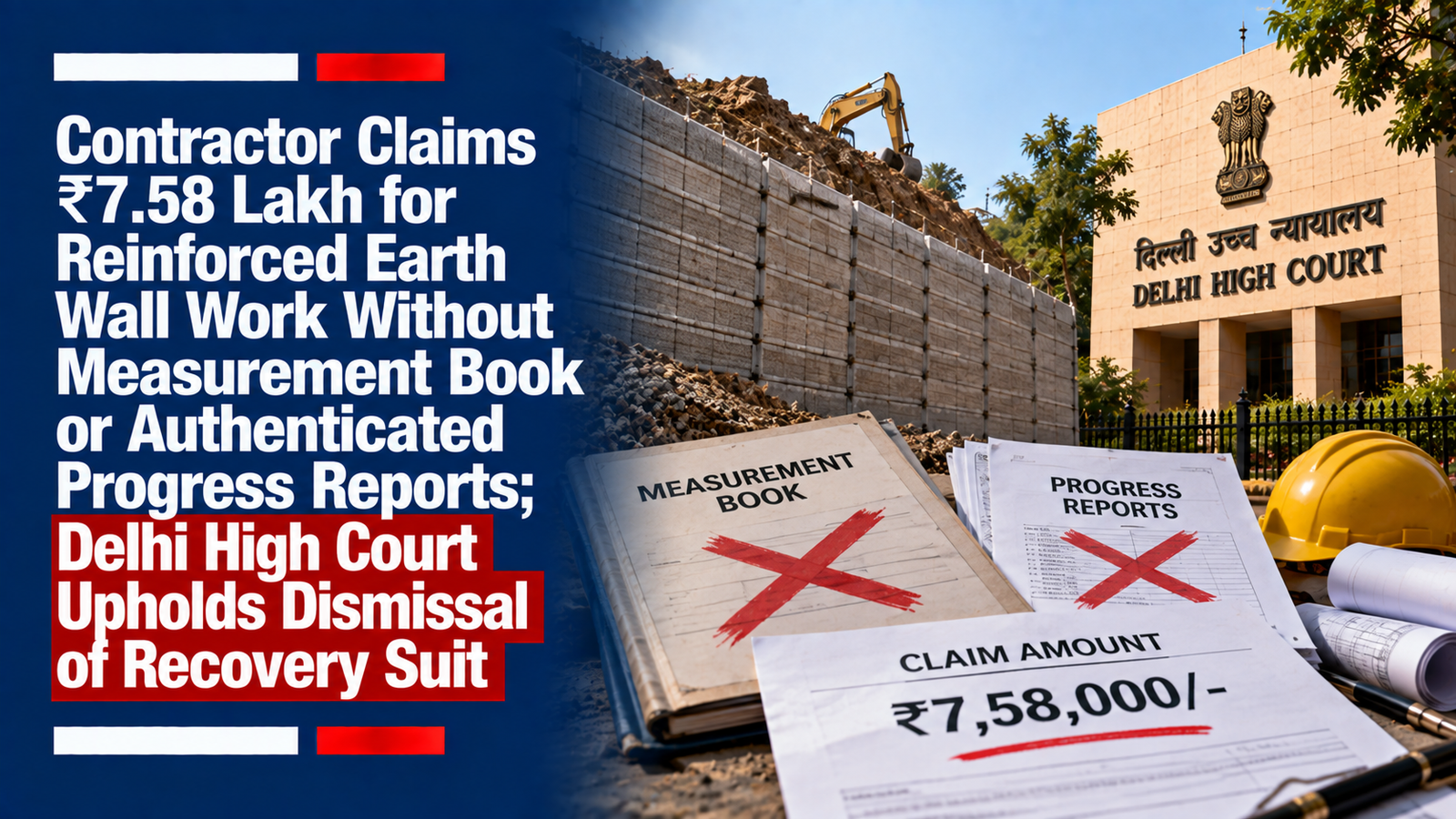
₹10 Lakh Already Paid Under ₹14.28 Lakh Contract; Delhi High Court Rejects Further ₹7.58 Lakh Claim for Lack of Supporting Documents
Facts
The appellant, M/s Hi-Tech Geosynthetics Pvt. Ltd., was engaged by M/s Shubh Construction Co. for execution of Reinforced Earth Wall work for a road-flyover at Bilhar-Sareni Road in Uttar Pradesh under a PWD project. The Work Order dated 5 May 2009 contemplated completion within 40 days.
The total contract value was ₹14,28,800, calculated for 752 sq. metres at ₹1,900 per sq. metre. The respondent admittedly paid ₹10 lakh to the appellant in three tranches.
The appellant claimed that the work was delayed because of several defaults by the respondent, including non-availability of the site due to canal water, failure to provide machinery and labour, failure to provide drainage/filter material and non-provision of Form-38/road permits.
After allegedly completing its work, the appellant raised a final invoice and claimed:
- ₹4,28,800 towards balance contractual consideration;
- ₹1,74,318 for anchor pins;
- ₹60,000 for idle labour; and
- ₹95,000 towards expenses arising from non-provision of Form-38.
The total amount claimed was ₹7,58,118, along with pendente lite and future interest at 24% per annum.
The suit was initially decreed ex parte in 2013. However, the ex parte decree was subsequently set aside and the matter proceeded on merits.
On 20 February 2026, the District Judge dismissed the recovery suit, finding that the appellant had failed to satisfactorily prove performance and, importantly, the extent and value of the work actually executed.
The contractor therefore approached the Delhi High Court in a Regular First Appeal.
Issues
The principal questions before the High Court were:
- Whether failure to complete the work within the stipulated 40 days defeated the appellant’s contractual claim;
- Whether the delay was attributable to the appellant or the respondent;
- Whether non-furnishing of the Corporate Performance Guarantee justified withholding payment;
- Whether the Daily Progress Reports and other correspondence sufficiently proved the quantity and value of work executed; and
- Whether the appellant had proved its entitlement to recover ₹7,58,118.
Appellant’s Arguments
The appellant argued that the District Judge had wrongly interpreted the Work Order and attributed to it contractual obligations that actually belonged to the respondent.
It maintained that its specialised RE Wall work had been completed and that the Corporate Performance Guarantee could not be furnished because the respondent had itself failed to complete or rectify portions falling within its scope, particularly the filter media and drainage arrangements.
The appellant also challenged the rejection of its Daily Progress Reports (DPRs) merely because the white original copies did not carry the respondent’s or PWD officials’ signatures. It claimed that the coloured carbon copies had been countersigned by the respondent’s representative.
It further relied on correspondence, invoices, reconciliation statements and legal notices allegedly demonstrating an outstanding amount of ₹7,58,118.
The appellant emphasised deficiencies in the respondent’s own evidence. The respondent had not produced records showing which substitute contractor allegedly completed the remaining work, proof of purchase of anchor pins, documentary proof of installation of drainage filter media or its statement of accounts.
Respondent’s Arguments
The respondent maintained that the appellant had itself failed to perform the contractual obligations within its scope.
It alleged that the appellant failed to supply the required geosynthetics, friction ties and anchor pins, did not provide the agreed labour and failed to complete the project within the stipulated period.
It further contended that the appellant had failed to provide the Corporate Performance Guarantee, despite having already received ₹10 lakh.
According to the respondent, the appellant’s incomplete performance compelled it to engage another agency to finish the remaining work.
Analysis of the Law
1. Expiry of the 40-Day Period Did Not Automatically End the Contract
This is an important part of the judgment.
The High Court disagreed with treating the mere delay beyond 40 days as determinative.
Although the Work Order required completion within 40 days, both parties continued performing and dealing with each other after that period expired. There was no evidence that the respondent terminated the contract or directed the appellant to stop work because the 40-day period had expired.
The Court consequently observed that neither was time treated as the essence of the contract nor was the arrangement repudiated on account of the delay.
Thus, the appellant’s claim could not be rejected merely because the project took almost a year instead of 40 days.
2. Allegations Against Respondent Required Evidence
The appellant alleged that the respondent had failed to provide machinery for two months and failed to execute work falling within its own contractual scope.
However, the High Court found no independent site records, PWD evidence or other corroborative material establishing these defaults or demonstrating that they actually caused the delay.
A unilateral letter written by the appellant recording its own grievance could not, without supporting evidence, establish either the respondent’s default or its causal relationship with the delay.
The Court put the principle succinctly:
“bald assertions” unsupported by material were insufficient where the alleged facts were capable of documentary verification.
3. Serious Bridge-Safety Allegation Was Also Unproved
The appellant alleged that the respondent had deliberately failed to install an inverted drainage filter to save approximately ₹2.5 lakh, thereby compromising the safety of the Reinforced Earth Wall and potentially endangering public property and persons using the bridge.
But there was no independent technical, site or PWD record proving:
- non-installation of the drainage filter;
- the alleged ₹2.5 lakh saving; or
- the alleged structural danger.
The Court therefore declined to accept the allegation merely on the appellant’s assertion.
4. Defendant’s Failure to Prove Its Defence Did Not Prove Plaintiff’s Claim
This is another useful proposition from the judgment.
The respondent claimed that another agency had completed the unfinished work. During cross-examination, however, its proprietor could not even remember the name of that agency and admitted that no supporting documents had been produced.
Nevertheless, the High Court held that this deficiency could not automatically benefit the appellant.
The appellant remained independently responsible for proving the quantity of work executed by it and its entitlement to the money claimed.
In other words, weakness in the defence cannot substitute for proof of the plaintiff’s monetary claim.
5. Performance Guarantee Was an Express Contractual Obligation
The Work Order expressly required the appellant to furnish a Corporate Performance Guarantee after satisfactory completion.
The appellant admitted that no such guarantee was furnished. It sought to justify this by claiming that defects in the respondent’s portion of the overall bridge works prevented it from providing the guarantee.
But the High Court found no independent evidence substantiating those alleged defects. The appellant’s own correspondence was insufficient to prove them.
6. Measurement Book Was Crucial but Not Produced
The decisive weakness in the appellant’s monetary claim concerned proof of the actual quantity of work performed.
PW-1 admitted that the work executed at the site had been recorded in a Measurement Book, but that Measurement Book was never produced before the Court.
This became particularly important because the contract price was calculated on a per-square-metre basis.
Therefore, without reliable measurements, the appellant could not satisfactorily establish the quantum of work for which payment was allegedly outstanding.
7. Daily Progress Reports Were Not Reliable Proof
The appellant attempted to rely upon its DPRs.
However:
- the original white DPR sheets did not contain the respondent’s countersignatures;
- no PWD official or engineer had authenticated them;
- the employee who allegedly maintained the DPRs was not examined; and
- the DPRs had been produced belatedly.
The Court therefore held that these DPRs could not, by themselves, reliably establish the extent and quantity of work performed.
Precedent Analysis
The judgment is essentially an evidence-and-contract based first appellate determination rather than a decision turning on a major line of cited precedent.
Its significance lies principally in the Court’s application of the burden of proof to a construction recovery claim: the contractor seeking payment must affirmatively prove the quantity/value of work for which recovery is sought.
The Court also distinguished between delay in contractual performance and proof of monetary entitlement. Even though it did not accept that crossing the 40-day deadline automatically defeated the contract, that finding did not relieve the appellant of its separate burden to prove the actual work executed.
Court’s Reasoning
The High Court’s reasoning can be reduced to a clear distinction:
The appellant may have performed work — but that did not establish that ₹7,58,118 was legally proved as outstanding.
The Court expressly acknowledged that the evidence indicated that the appellant “may have done the work.” Nevertheless, the appellant had received ₹10 lakh and bore the burden of proving, through cogent bills and supporting records, its assertion that another ₹7,58,118 was payable.
The contract value was ₹14,28,800, of which ₹10 lakh had already been paid. Yet there were no corresponding documents, bills or invoices reliably proving the appellant’s assertion regarding the additional amount claimed.
The missing Measurement Book, unauthenticated DPRs, failure to examine their author, absence of technical/PWD corroboration and lack of reliable documentary proof of the quantified claim ultimately proved fatal.
Conclusion
The Delhi High Court held that the appellant had failed to prove its entitlement to ₹7,58,118.
Importantly, the Court did not hold that the claim failed simply because the work exceeded the contractual 40-day period. Rather, the decisive failure was the appellant’s inability to establish through reliable documentary evidence the extent of work actually executed and the corresponding amount payable.
The Court therefore upheld the District Judge’s judgment dated 20 February 2026 and dismissed the Regular First Appeal as devoid of merit.
Case Details
Case: M/s Hi-Tech Geosynthetics Pvt. Ltd. v. M/s Shubh Construction Co.
Court: Delhi High Court
Case No.: RFA 912/2026 & CM APPL. 58024/2026
CNR: DLHC010403722026
Judge: Justice Neena Bansal Krishna
Reserved: 31 August 2026
Pronounced: 17 September 2026
Result: Appeal dismissed; dismissal of ₹7,58,118 recovery suit upheld