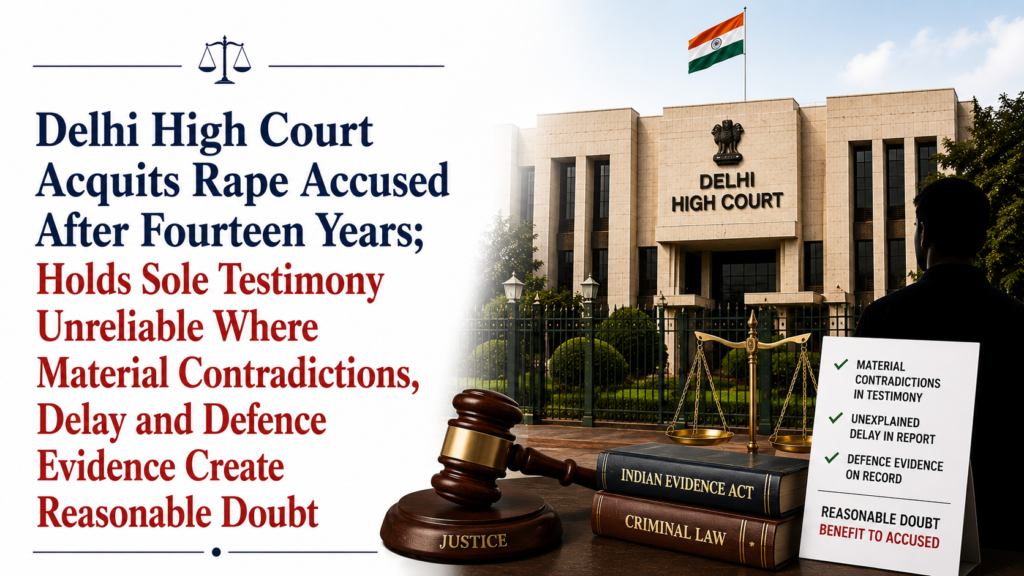
Delhi High Court Acquits Rape Accused After Fourteen Years; Holds Sole Testimony Unreliable Where Material Contradictions, Delay and Defence Evidence Create Reasonable Doubt

Delhi High Court Rules Plea of False Implication Became Probable in Light of Prior Complaints and Inconsistent Defence Narrative Assessment
Facts
The prosecutrix alleged that on 23 February 2012, while she was alone in her rented room and approximately one month pregnant, the accused, who lived in the adjacent room as a tenant, entered her room, threatened her with a knife, raped her and warned her not to disclose the incident. She claimed that she informed her husband when he returned home that night and that both of them immediately approached the police, but no FIR was registered. After repeated inaction by the police, she submitted complaints to senior police officers and eventually approached the Magistrate under Section 156(3) CrPC, pursuant to which an FIR was registered. The trial court convicted the accused under Sections 376 and 506 IPC and sentenced him to seven years’ imprisonment. The accused challenged the conviction before the Delhi High Court.
Issues
- Whether the prosecution proved beyond reasonable doubt that the accused committed rape and criminal intimidation.
- Whether the testimony of the prosecutrix was sufficiently reliable to sustain conviction without independent corroboration.
- Whether the surrounding circumstances, delay, inconsistencies and defence evidence created reasonable doubt entitling the accused to acquittal.
Appellant’s Arguments
The appellant contended that the prosecutrix’s testimony contained material improvements and inconsistencies, including introducing for the first time during trial that her child was present during the incident. It was argued that despite alleging that a knife was placed on her neck, no injury was found. The defence emphasised the delay of over five months in filing the first written complaint, absence of immediate medical examination and failure to produce reliable evidence supporting the prosecution version.
The appellant further relied upon call detail records to contend that he was elsewhere at the relevant time and asserted that the prosecution was motivated by a monetary dispute. According to him, complaints had been lodged by him against the prosecutrix’s husband even before the FIR, making the defence of false implication probable. It was also argued that the alleged occurrence was inherently improbable because the accused and his wife occupied an adjoining room in the same premises.
Respondent’s Arguments
The State argued that the prosecutrix consistently narrated the core allegation from the earliest complaint through her deposition before the Court. It submitted that minor omissions or improvements did not undermine her credibility. The prosecution further contended that the absence of injuries and delayed medical examination were attributable to police inaction rather than the prosecutrix, and that defective investigation could not benefit the accused.
The State also argued that the plea of alibi had not been proved in accordance with law, since the call detail records did not conclusively establish the appellant’s whereabouts and the alleged mobile number was not even registered in his name. It was submitted that the conviction based on the prosecutrix’s testimony deserved to be affirmed.
Analysis of the Law
The High Court reiterated that conviction for rape may lawfully rest upon the sole testimony of the prosecutrix if her evidence is wholly reliable and inspires confidence. At the same time, where material inconsistencies, improbabilities or surrounding circumstances create reasonable doubt, the Court is duty-bound to extend the benefit of doubt to the accused.
The Court also examined the law relating to delayed FIRs, defective investigation, evidentiary value of site plans prepared by investigating officers, the burden of proving a plea of alibi under Section 11 of the Evidence Act, and the limited relevance of medical evidence in sexual offence prosecutions. It observed that defects in investigation cannot by themselves result in acquittal, but the overall prosecution evidence must nevertheless satisfy the standard of proof beyond reasonable doubt.
Precedent Analysis
The Court relied upon several precedents, including:
- Jagdish Narain v. State of U.P. and Tori Singh v. State of U.P., explaining the limited evidentiary value of site plans prepared during investigation.
- Jayantibhai Bhenkarbhai v. State of Gujarat, governing the principles relating to the plea of alibi and the burden of proof.
- Karnel Singh v. State of M.P., holding that defective investigation alone does not justify acquittal.
- Ajay Kumar Garg v. Gaurav, concerning the limited scope of additional evidence under Section 391 CrPC.
The Court applied these principles while evaluating whether the prosecution had established guilt beyond reasonable doubt.
Court’s Reasoning
The High Court closely scrutinised the prosecution evidence and found that although certain individual circumstances—such as delayed FIR, absence of injuries or delayed medical examination—were not by themselves fatal, the cumulative effect of the evidence created substantial doubt.
The Court noted significant inconsistencies in the prosecution case, weaknesses in the surrounding circumstances and serious deficiencies regarding the alleged motive advanced by the defence. It also found that the defence had succeeded in creating a plausible alternative explanation through the prior complaints and surrounding circumstances, even though every aspect of the defence was not fully established. The Court held that the prosecution failed to eliminate these reasonable doubts to the standard required in criminal law.
Accordingly, it concluded that the trial court had failed to properly appreciate the cumulative effect of the inconsistencies and surrounding circumstances before recording conviction.
Conclusion
The Delhi High Court allowed the appeal and set aside the conviction and sentence under Sections 376 and 506 IPC. The Court held that although a conviction for rape may rest upon the sole testimony of the prosecutrix, such testimony must inspire complete confidence. In the present case, the cumulative effect of the inconsistencies, surrounding circumstances and defence evidence created reasonable doubt, entitling the appellant to acquittal.
Case Details
Case: Mahender Rathore v. State (Govt. of NCT of Delhi)
Court: High Court of Delhi
Case Number: CRL.A. 844/2017
Judge: Hon’ble Ms. Justice Chandrasekharan Sudha
Date: 05 August 2026
Result: Appeal allowed; conviction and sentence under Sections 376 and 506 IPC set aside; appellant acquitted