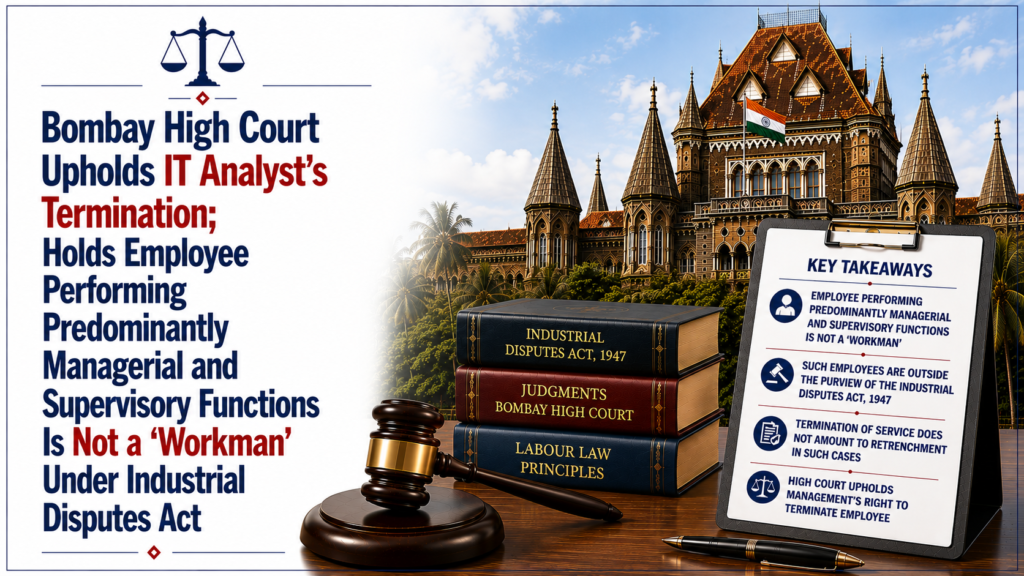
Bombay High Court Upholds IT Analyst’s Termination; Holds Employee Performing Predominantly Managerial and Supervisory Functions Is Not a ‘Workman’ Under Industrial Disputes Act

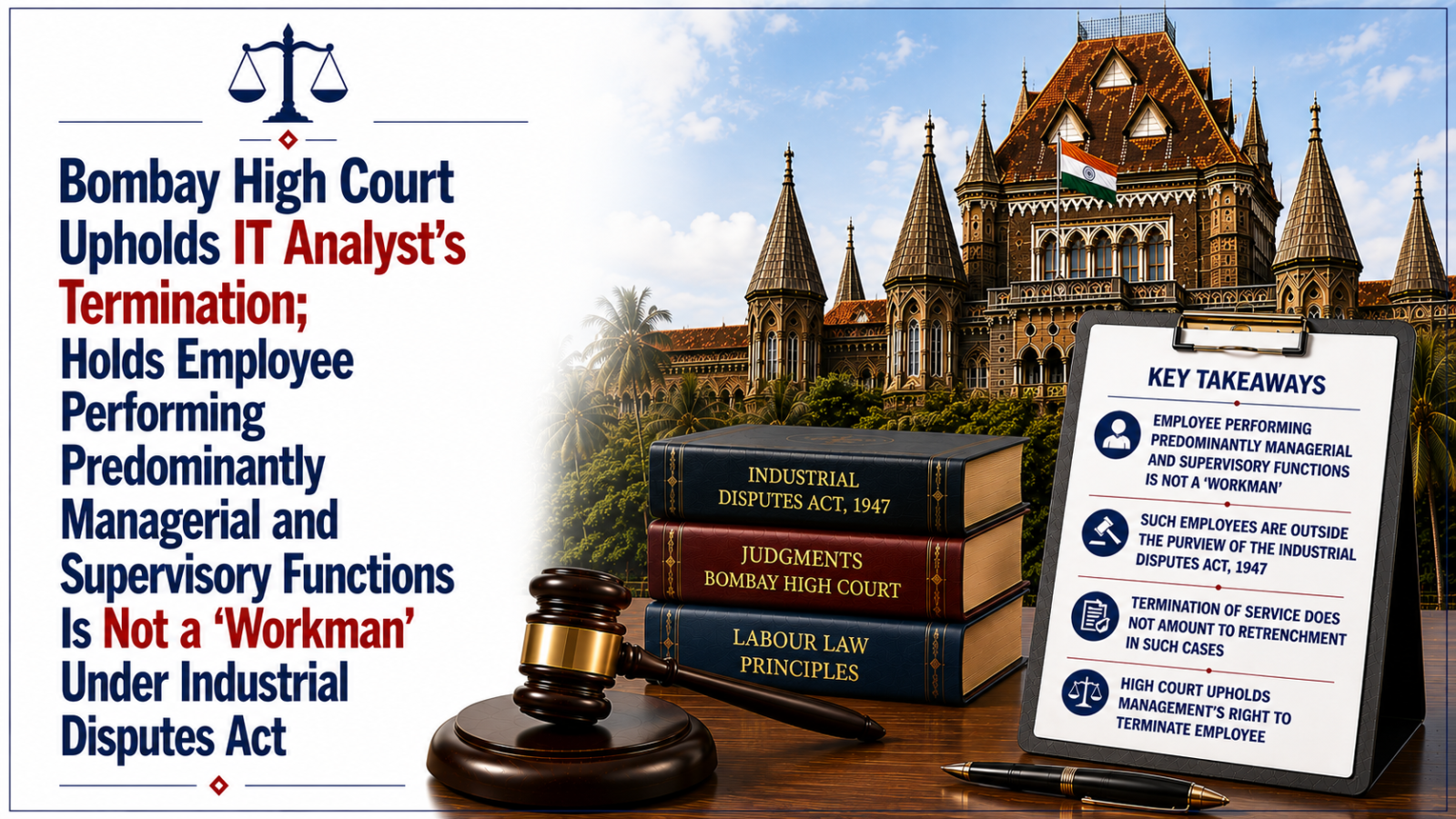
Bombay High Court Upholds IT Analyst’s Termination; Holds Employee Was Not a ‘Workman’ Under Industrial Disputes Act
Facts
The petitioner, Dilip M. Bobade, joined the respondent company in 1997 as a Secretarial Assistant and was subsequently promoted to IT Support Analyst and later IT Delivery Analyst. Following disputes over denial of salary increment, he alleged that he was forced to resign under threat of false allegations. Shortly thereafter, the respondent suspended him and terminated his services on allegations that he had remotely accessed the company’s IT systems and damaged critical servers affecting operations across several countries. The petitioner denied the allegations and sought reinstatement with continuity of service and back wages.
An industrial dispute was referred to the Labour Court. However, the Labour Court held that the petitioner was not a “workman” under Section 2(s) of the Industrial Disputes Act, 1947, and therefore declined to examine the legality of his termination. The petitioner challenged that finding before the Bombay High Court.
Issues
- Whether the petitioner qualified as a “workman” under Section 2(s) of the Industrial Disputes Act, 1947.
- Whether the Labour Court erred in refusing to adjudicate the legality of the petitioner’s termination after holding that he was not a workman.
- Whether the petitioner was entitled to reinstatement with continuity of service and back wages.
Petitioner’s Arguments
The petitioner contended that he was primarily engaged in technical functions relating to troubleshooting IT issues and providing desktop support. He argued that he had no authority to appoint or dismiss employees, sanction leave, or take independent managerial decisions. Any purchases or software-related decisions required approval from his superiors, and therefore he could not be treated as a managerial or supervisory employee.
He further submitted that the Labour Court wrongly interpreted his job profile and the evidence on record, ignoring admissions made by the respondent’s witnesses demonstrating that his role was predominantly technical.
Respondent’s Arguments
The respondent submitted that the petitioner was the sole IT Delivery Analyst in India, possessed exclusive access to the company’s servers, underwent specialised overseas training, guided other employees, interacted directly with international teams and exercised substantial discretion in software-related decisions.
It was further argued that the petitioner himself admitted during cross-examination that he was not performing technical work, and the Labour Court rightly concluded that his dominant functions were managerial and supervisory, excluding him from the definition of “workman.”
Analysis of the Law
The High Court reiterated that designation is not decisive in determining whether an employee is a workman. The determining factor is the dominant nature of duties and responsibilities actually performed.
The Court observed that in modern corporate organisations, managerial employees may function within systems of approvals and checks and balances. Consequently, absence of authority to appoint, dismiss or sanction leave does not by itself establish that an employee is a workman. What matters is whether the employee predominantly performs technical, supervisory, administrative or managerial functions.
Precedent Analysis
The Court relied upon:
- Inthru Noronha v. Colgate Palmolive (India) Ltd., holding that in modern organisations managerial status cannot be determined solely by powers such as appointment, dismissal or sanction of leave, and emphasis must be placed on the nature of duties.
- Standard Chartered Bank v. Vandana Joshi, reiterating that modern corporate decision-making operates through checks and balances and that managerial employees do not become workmen merely because their decisions require approval.
- Rohit Dembiwal v. Tata Consultancy Services Ltd., where the Court clarified that an IT Analyst is not automatically excluded from the definition of workman merely because of designation; rather, the actual duties performed must be examined.
Court’s Reasoning
The High Court found that the petitioner’s own cross-examination contained a clear admission that he was not performing technical work while addressing IT problems. Evidence further showed that he trained more than 125 users, guided other personnel, advised management on software matters, interacted directly with international headquarters, possessed exclusive access to company servers and exercised independent decision-making authority regarding IT operations.
The Court held that although the petitioner lacked powers such as granting leave or dismissing employees, those factors were not decisive in the modern corporate environment. Considering the dominant nature of his functions, responsibilities and authority, the Court concluded that he performed managerial and supervisory functions rather than purely technical duties, and therefore did not qualify as a workman under Section 2(s) of the Industrial Disputes Act.
Conclusion
The Bombay High Court dismissed the writ petition and upheld the Labour Court’s award. It held that the petitioner failed to establish that he was a “workman” under Section 2(s) of the Industrial Disputes Act, and consequently his challenge to the termination and claim for reinstatement could not succeed.
Case Details
Case: Dilip M. Bobade v. M/s. Lloyd’s Register
Court: Bombay High Court
Case Number: Writ Petition No. 1964 of 2025
Judge: Hon’ble Mr. Justice Sandeep V. Marne
Date: 05 August 2026
Result: Writ Petition dismissed; Labour Court’s finding that the petitioner was not a “workman” under Section 2(s) of the Industrial Disputes Act upheld.