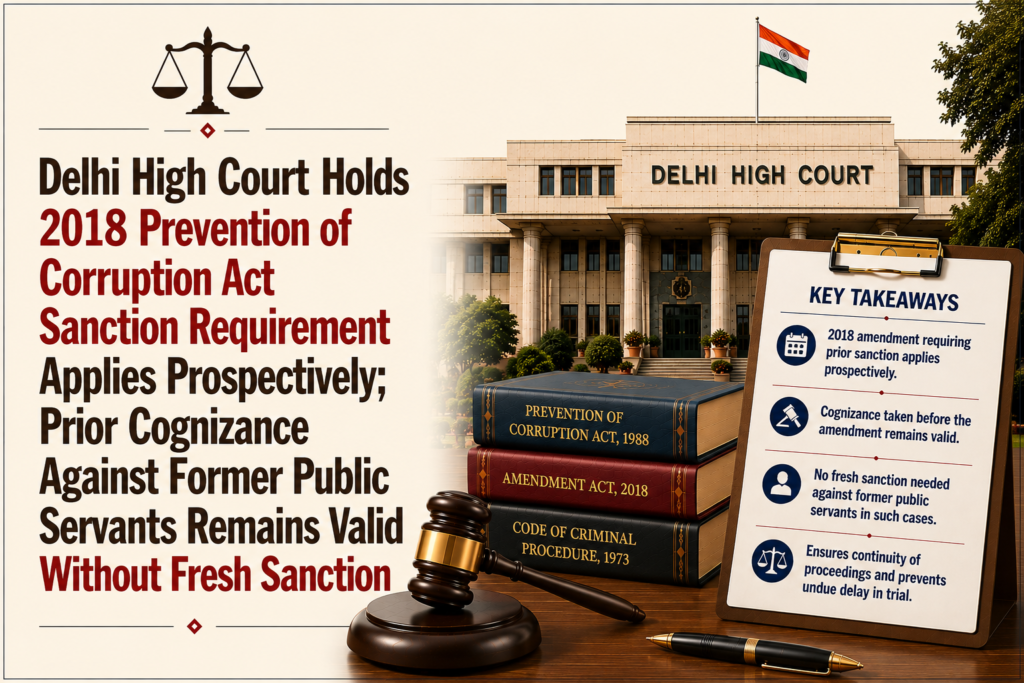
Delhi High Court Holds 2018 Prevention of Corruption Act Sanction Requirement Applies Prospectively; Prior Cognizance Against Former Public Servants Remains Valid Without Fresh Sanction

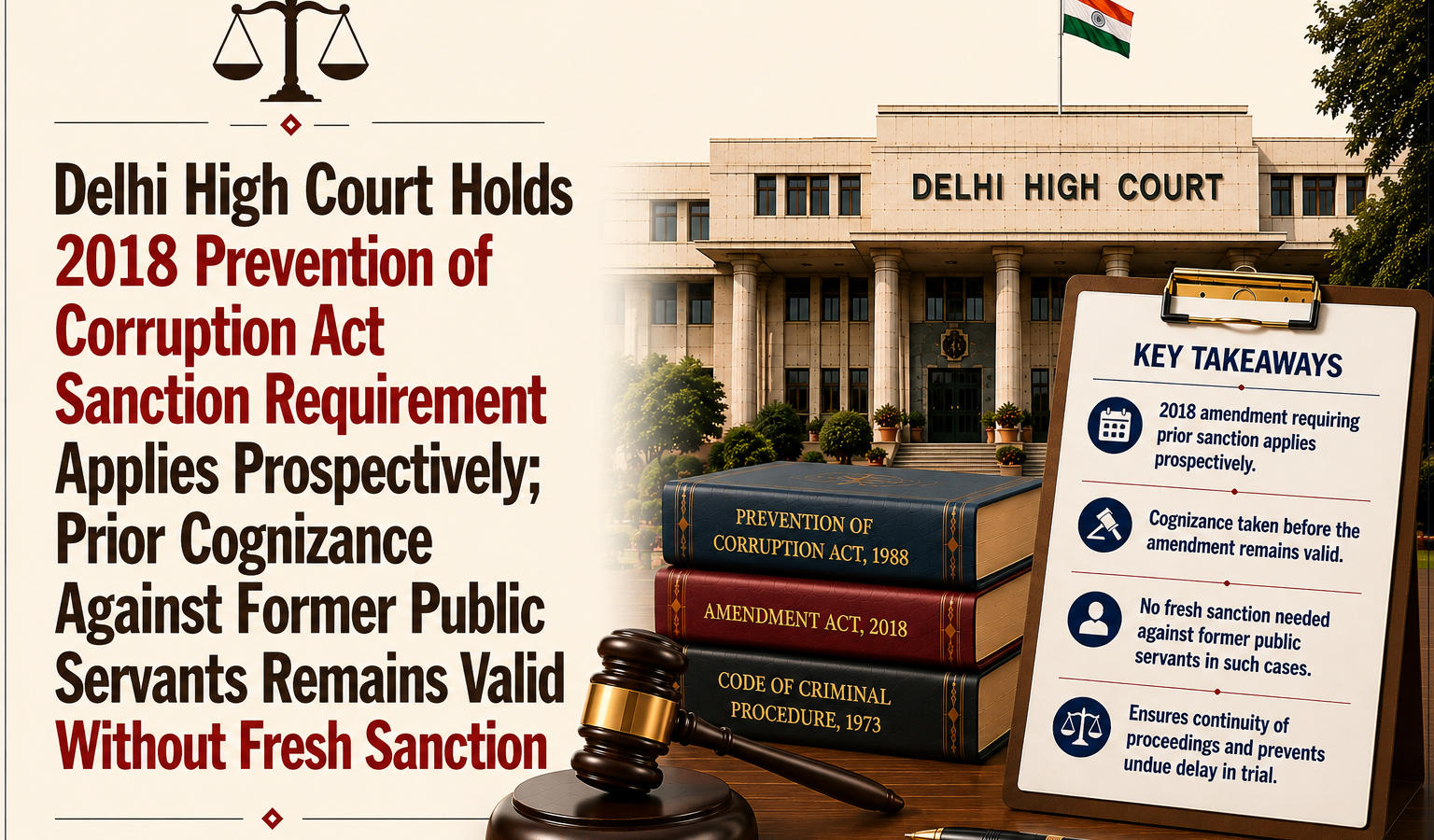
Delhi High Court Rules Fresh Sanction Not Required Where Cognizance Under Prevention of Corruption Act Was Taken Before 26 July 2018
Facts
A Special Judge (PC Act), Delhi, made a reference to the Delhi High Court under Sections 395 and 482 CrPC seeking authoritative answers on important questions arising from the Prevention of Corruption (Amendment) Act, 2018. The principal issue was whether the amended Section 19 of the Prevention of Corruption Act, 1988—which extended the requirement of previous sanction to former public servants—would apply retrospectively to pending cases where cognizance had already been taken before 26 July 2018. The Court treated the matter as a reference on questions of law without deciding the facts of the underlying criminal case.
Issues
- Whether under the Prevention of Corruption Act, cognizance is taken of the offence or of the accused public servant.
- Whether the 2018 amendment to Section 19 of the Prevention of Corruption Act applies retrospectively.
- Whether fresh sanction is required to prosecute a former public servant where cognizance had already been taken before 26 July 2018.
- Whether the amendment affects pending corruption trials in which cognizance had already been validly taken.
Petitioner’s Arguments
The Amicus Curiae and several counsel submitted that although, generally, criminal courts take cognizance of an offence, the Prevention of Corruption Act is a special statute overriding the general provisions of the CrPC. They relied upon decisions including Dilawar Singh to contend that sanction under Section 19 is required in respect of a particular accused public servant. Some parties further argued that the 2018 amendment merely clarified the law, corrected earlier judicial interpretation and therefore ought to apply retrospectively to pending prosecutions involving former public servants.
Respondent’s Arguments
The opposing submissions maintained that the 2018 amendment created substantive additional protection by extending the benefit of prior sanction to retired public servants and those holding different offices. Since the amendment altered substantive rights rather than merely clarifying the existing law, it could not retrospectively invalidate cognizance already taken before its commencement. It was argued that pending trials validly instituted under the unamended law should continue unaffected.
Analysis of the Law
The Court undertook an extensive examination of the evolution of sanction provisions beginning with Section 6 of the Prevention of Corruption Act, 1947, followed by Section 19 of the Prevention of Corruption Act, 1988, and finally the 2018 Amendment. It reviewed the consistent line of Supreme Court decisions holding that, prior to the amendment, sanction was unnecessary where the accused had ceased to hold the relevant public office by the date cognizance was taken. The Court noted that the 2018 amendment expressly expanded the protection to former public servants by inserting the words “was at the time of commission of the alleged offence employed” and by adding an Explanation covering retired public servants.
Precedent Analysis
The Court analysed numerous Supreme Court authorities, including:
- S.A. Venkataraman v. State – sanction under the old law was unnecessary where the accused had ceased to be a public servant when cognizance was taken.
- R.S. Nayak v. A.R. Antulay – the relevant date for sanction is the date of cognizance.
- Parkash Singh Badal v. State of Punjab – Section 19 of the 1988 Act followed the same principle.
- Abhay Singh Chautala v. CBI and L. Narayana Swamy v. State of Karnataka – reaffirmed that sanction was unnecessary where the accused no longer occupied the office allegedly abused.
- Dilawar Singh v. Parvinder Singh – under the Prevention of Corruption Act, sanction is required in relation to the specific accused public servant and the special statute overrides the general CrPC principle that cognizance is taken only of the offence.
Court’s Reasoning
The High Court held that Dilawar Singh conclusively establishes that, under Section 19 of the Prevention of Corruption Act, sanction relates to the prosecution of a specific public servant and not merely the offence. However, while the 2018 amendment broadened the category of persons entitled to protection by including former public servants, it did not expressly provide that cognizance already taken before its commencement would become invalid.
The Court observed that the relevant date for applying Section 19 is the date on which the court takes cognizance. Therefore, where cognizance had already been validly taken before 26 July 2018, the amendment could not retrospectively require a fresh sanction or nullify existing proceedings. Giving such retrospective operation would unsettle completed judicial acts and disturb pending trials without any express legislative mandate.
Conclusion
The Delhi High Court answered the reference by holding that under the Prevention of Corruption Act, sanction is required with respect to the prosecution of a particular public servant and not merely the offence. It further held that the 2018 amendment extending sanction protection to former public servants operates prospectively. Accordingly, where cognizance had already been taken before 26 July 2018, no fresh sanction is required merely because the accused had retired or ceased to hold public office, and pending prosecutions remain unaffected.
Case Details
Case: Court on Its Own Motion v. State
Court: Delhi High Court
Case Number: CRL. REF. 1/2019
Judges: Hon’ble Mr. Justice Navin Chawla and Hon’ble Mr. Justice Ravinder Dudeja
Date: 06 August 2026
Result: Reference answered. The Court held that the 2018 amendment to Section 19 of the Prevention of Corruption Act applies prospectively and does not require fresh sanction in cases where cognizance had already been taken before 26 July 2018.