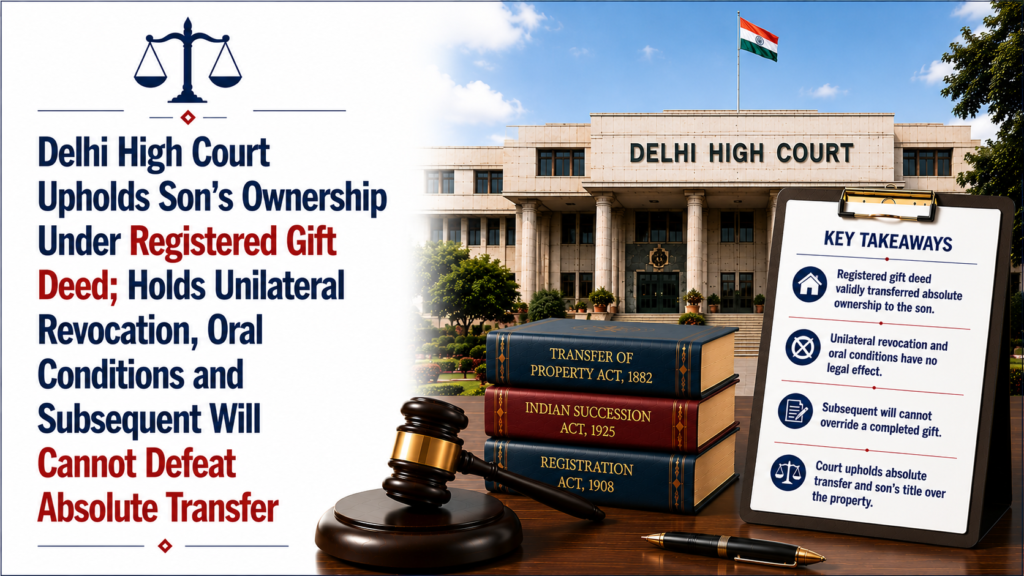
Delhi High Court Upholds Son’s Ownership Under Registered Gift Deed; Holds Unilateral Revocation, Oral Conditions and Subsequent Will Cannot Defeat Absolute Transfer

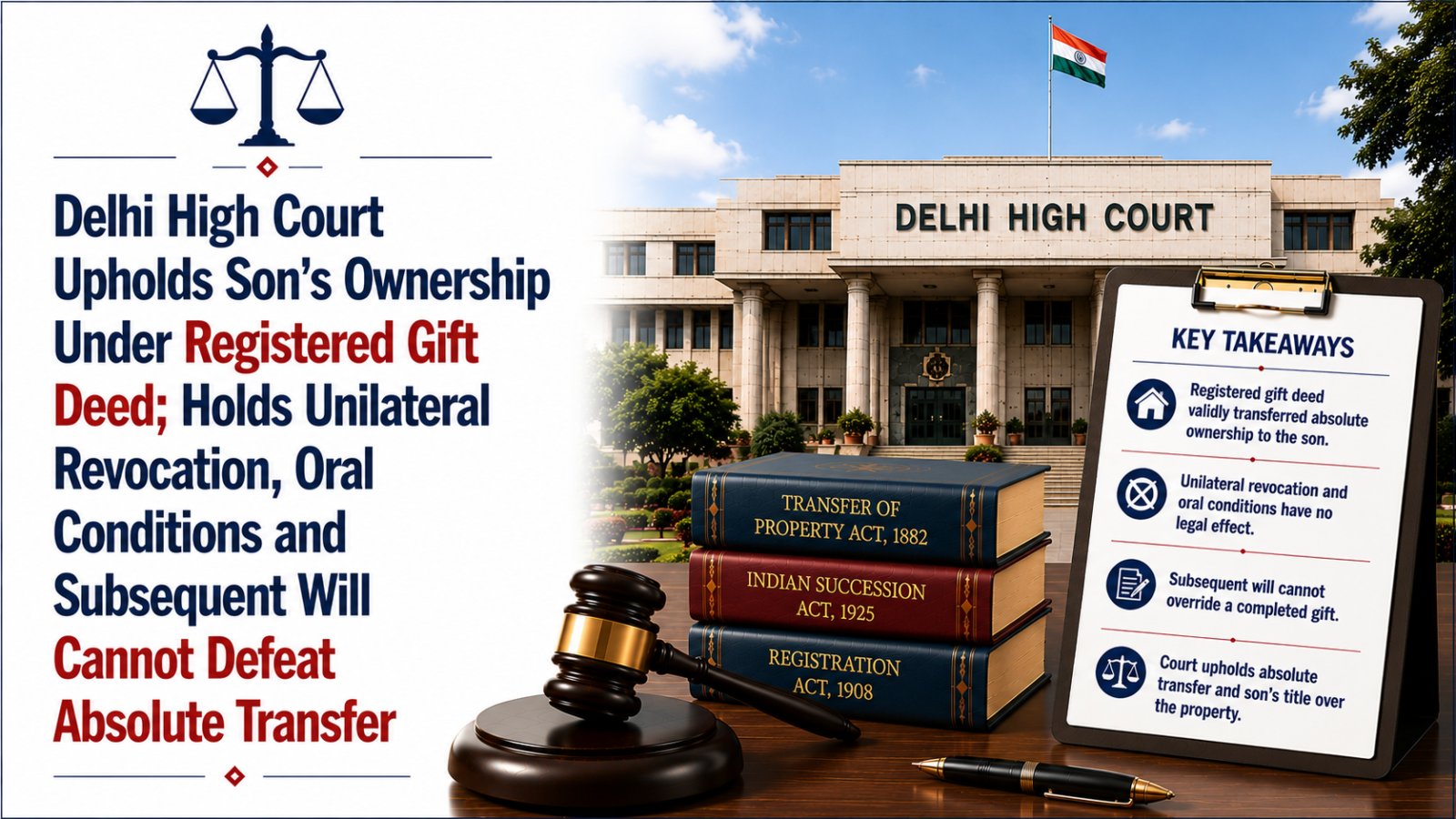
Delhi High Court Upholds Registered Gift Deed; Holds Donor Cannot Unilaterally Cancel Absolute Gift by Notice
Facts
The dispute concerned a flat in Vasant Kunj, New Delhi, originally allotted by the Delhi Development Authority to the defendant-father. In 2007, the father executed a registered Gift Deed transferring the property absolutely in favour of his elder son (the plaintiff). On the same day, the son executed a General Power of Attorney (GPA) authorising the father to manage the property while the son resided in the USA. Subsequently, disputes arose between the parties, the GPA was revoked, and the father filed a suit seeking cancellation of the Gift Deed, which he later withdrew unconditionally. Thereafter, the son instituted the present suit seeking declaration of ownership and permanent injunction. The Trial Court decreed the suit on admissions under Order XII Rule 6 CPC, leading to the present appeal.
Issues
- Whether the Trial Court rightly exercised its power under Order XII Rule 6 CPC to pass a judgment on admissions.
- Whether the registered Gift Deed was absolute and unconditional despite the simultaneous execution of a GPA.
- Whether the donor could unilaterally revoke the Gift Deed under Section 126 of the Transfer of Property Act.
- Whether absence of delivery of possession or original title deeds invalidated the Gift Deed.
- Whether Section 23 of the Maintenance and Welfare of Parents and Senior Citizens Act, 2007 could invalidate the Gift Deed executed before the Act came into force.
Appellants’ Arguments
The appellants contended that the Trial Court wrongly invoked Order XII Rule 6 CPC because several disputed questions of fact required trial. They argued that the Gift Deed was only a temporary arrangement executed on the understanding that the plaintiff would take care of his ageing parents and that the simultaneously executed GPA demonstrated that ownership was intended to remain with the father. It was further argued that possession and original title deeds were never handed over, the Gift Deed had been validly revoked under Section 126 of the Transfer of Property Act, and a subsequent Will superseded the Gift Deed. They also sought to rely upon Section 23 of the Senior Citizens Act as a statutory basis for cancellation of the gift.
Respondent’s Arguments
The respondent submitted that execution and registration of the Gift Deed were admitted by the defendants and that the deed unequivocally conveyed absolute ownership. The GPA merely authorised the father to manage the property because the plaintiff resided abroad and did not dilute the Gift Deed. The respondent further argued that oral understandings contrary to a registered document were barred by Sections 91 and 92 of the Indian Evidence Act, that unilateral revocation of an unconditional gift was impermissible under Section 126 of the Transfer of Property Act, and that the Senior Citizens Act could not retrospectively invalidate rights vested under a Gift Deed executed before its commencement.
Analysis of the Law
The High Court held that the execution and registration of the Gift Deed were unequivocally admitted. It found that the Gift Deed expressly transferred absolute ownership to the plaintiff and recorded delivery of possession. The Court observed that Sections 91, 92 and 94 of the Indian Evidence Act prohibit reliance upon oral arrangements inconsistent with the express terms of a written registered document.
The Court further held that Section 123 of the Transfer of Property Act requires only execution of a duly registered gift deed signed by the donor and attested by witnesses; physical delivery of possession or handing over of title deeds is not a statutory requirement. With regard to Section 126, the Court reiterated that an unconditional gift cannot be unilaterally revoked by the donor unless the deed itself reserves such a right or both donor and donee consent. Since the Gift Deed contained no revocation clause, the donor’s revocation notice was legally ineffective. The Court also held that the Senior Citizens Act, 2007 has no retrospective application to gifts executed before the Act came into force.
Precedent Analysis
The Court relied upon several important precedents, including:
- Roop Kumar v. Mohan Thedani, (2003) 6 SCC 595, and Promila Gulati v. Anil Gulati, holding that oral evidence cannot contradict the terms of a written registered document.
- Mohinder Singh Verma v. J.P.S. Verma and Sahdev Singh Verma v. J.P.S. Verma, holding that delivery of possession is not essential for a valid gift of immovable property under Section 123 of the Transfer of Property Act.
- Asokan v. Lakshmi Kutty, (2007) 13 SCC 210, holding that an unconditional gift cannot be revoked merely because the donee fails to maintain the donor unless such a condition forms part of the gift.
- Ramti Devi v. Union of India, (1995) 1 SCC 198, holding that a registered document remains operative until set aside by a competent court.
- Charanjeet Singh Ahluwalia v. Union of India, Human Rights and Social Welfare Forum v. Union of India, and M.M. Ramesh v. M.S. Manikavasagam, holding that Section 23 of the Senior Citizens Act does not retrospectively affect vested rights under gifts executed before the Act.
- P.P.A. Impex Pvt. Ltd. v. Mangal Sain Metal and Rajeev Tandon v. Rashmi Tandon, affirming that where admissions disclose no real triable issue, a decree under Order XII Rule 6 CPC is justified.
Court’s Reasoning
The Court observed that the defendants admitted execution and registration of the Gift Deed. The plea that the Gift Deed was merely a temporary family arrangement directly contradicted both the Gift Deed and the contemporaneously executed GPA, each of which unequivocally recognised the plaintiff as the absolute owner.
The Court rejected the contention that ownership remained with the donor because possession and original documents were retained, observing that Section 123 of the Transfer of Property Act imposes no such requirement. It further held that the donor’s unilateral revocation notice was ineffective because the Gift Deed was absolute and contained no revocation clause. Likewise, the subsequent Will could not defeat rights already vested under the registered Gift Deed.
The Court also rejected the attempt to invoke the Senior Citizens Act, noting that the Gift Deed had been executed before the Act came into force and that the donor never sought relief under the Act during his lifetime. Finally, the Court held that the defendants’ pleas were mutually destructive, contrary to the written documents and raised no genuine triable issue, making the suit fit for disposal under Order XII Rule 6 CPC.
Conclusion
The Delhi High Court dismissed the appeal and affirmed the Trial Court’s decree declaring the plaintiff as the owner of the property and restraining the defendants from interfering with his rights. It held that the admitted execution of the registered Gift Deed, coupled with the absence of any legally sustainable defence, justified a decree on admissions under Order XII Rule 6 CPC. The Court further held that an unconditional registered Gift Deed cannot be defeated by alleged oral conditions, unilateral revocation, a subsequent Will, or retrospective reliance upon the Senior Citizens Act.
Case Details
Case: Padam Chand Jain & Anr. v. Arun Jain
Court: Delhi High Court
Case Number: RFA 128/2019
Judge: Hon’ble Mr. Justice Amit Bansal
Date: 06 August 2026
Result: Appeal dismissed; Trial Court’s decree declaring the plaintiff’s ownership under the registered Gift Deed and granting permanent injunction upheld.