Delhi High Court Refuses Repeat Anticipatory Bail to Habitual Impersonation Accused; Holds No Change in Circumstances After Supreme Court Rejection and Questions Police Inaction

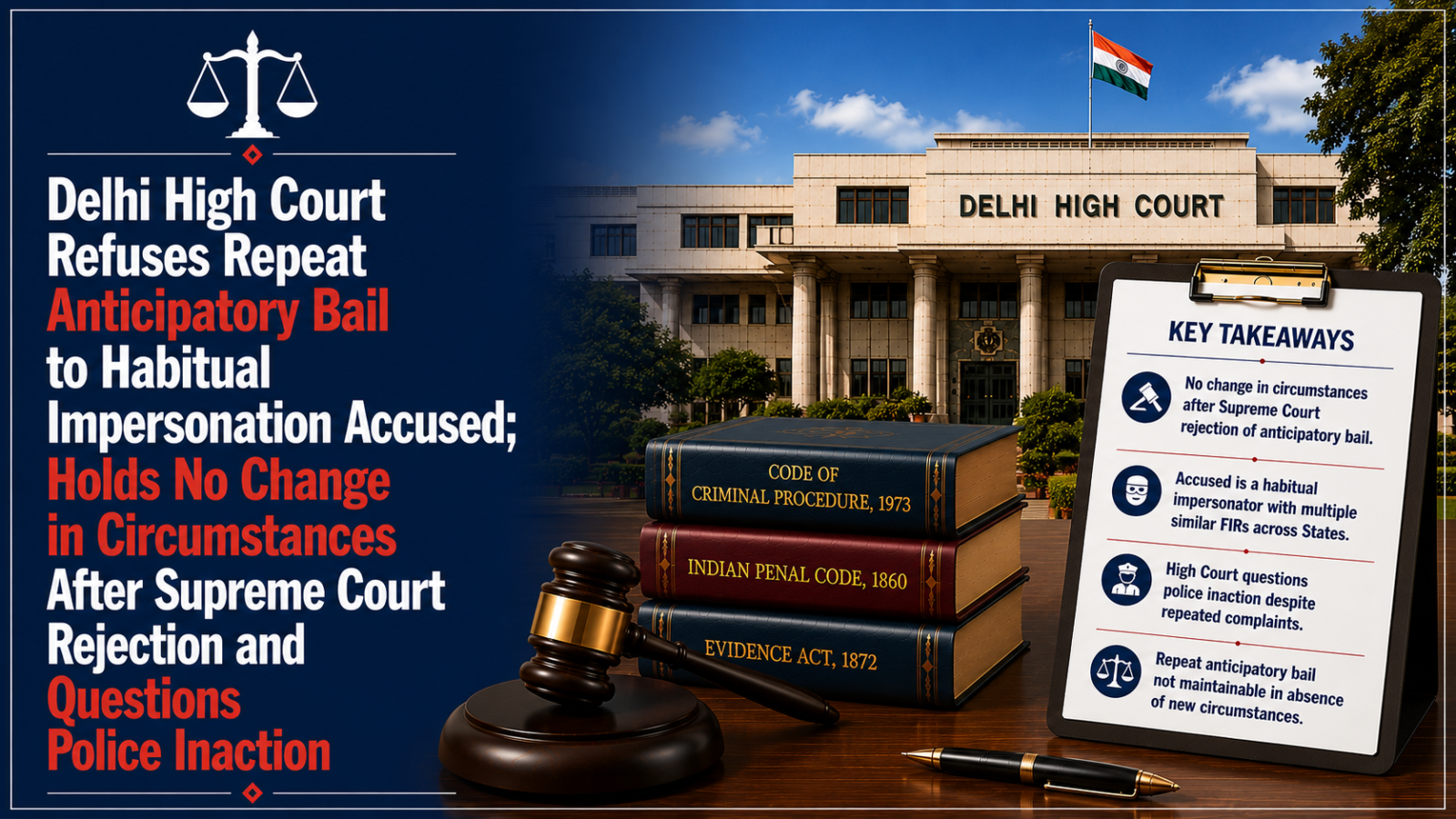
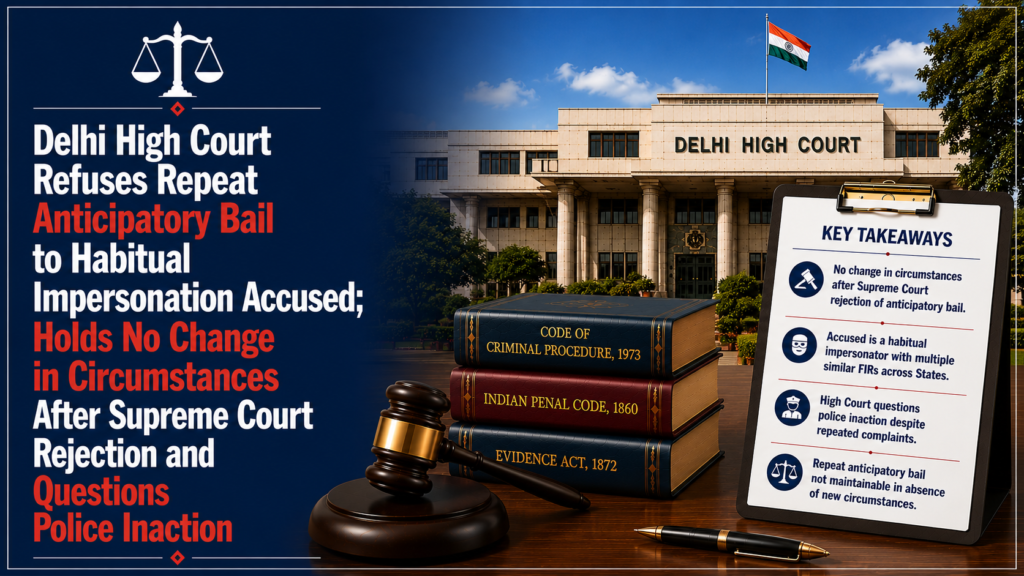
Delhi High Court Refuses Third Anticipatory Bail Plea; Holds No Change in Circumstances After Supreme Court’s Rejection
Facts
The petitioner sought anticipatory bail in FIR No. 81/2024 registered at Police Station Parliament Street for offences under Sections 204, 337 and 340(2) of the Bharatiya Nyaya Sanhita (BNS). The prosecution alleged that the petitioner impersonated a civil servant and attempted to obtain confidential information from senior government authorities. He was also accused of impersonating a Judge of the Patna High Court. This was the petitioner’s third anticipatory bail application before the High Court after his earlier anticipatory bail applications had been rejected in 2024 and 2025, and the Supreme Court had also dismissed his Special Leave Petition on 8 September 2025.
Issues
- Whether the petitioner was entitled to anticipatory bail despite earlier rejection of his anticipatory bail applications, including by the Supreme Court.
- Whether any subsequent change in circumstances justified reconsideration of the petitioner’s request for anticipatory bail.
- Whether the continued failure of the police to arrest the petitioner despite repeated rejection of anticipatory bail warranted judicial concern.
Petitioner’s Arguments
The petitioner argued that although his anticipatory bail applications had been rejected earlier and even the Supreme Court had declined relief, the police had not arrested him for a considerable period. According to him, this demonstrated that custodial interrogation was unnecessary. On this basis, he sought grant of anticipatory bail in the present proceedings.
Respondent’s Arguments
The State opposed the application and expressed concern that despite the Supreme Court having refused anticipatory bail, the police had still not arrested the petitioner. The prosecution also placed before the Court details of numerous criminal cases registered against the petitioner across several States involving allegations of impersonation, cheating, forgery and related offences, contending that he was a habitual offender and did not deserve the discretionary relief of anticipatory bail.
Analysis of the Law
The High Court emphasised that anticipatory bail cannot ordinarily be reconsidered when earlier applications have been rejected, particularly after the Supreme Court has declined relief, unless there is a substantial change in circumstances. The Court observed that judicial discipline required it to respect the Supreme Court’s earlier refusal of anticipatory bail. Since no subsequent development or material change had been shown, there was no legal basis to depart from the earlier orders. The Court also considered the petitioner’s criminal antecedents and the seriousness of the allegations while exercising its discretionary jurisdiction.
Precedent Analysis
Although the Court did not rely upon any reported judicial precedent, it applied the settled principle of judicial discipline, observing that once the Supreme Court has declined anticipatory bail, a subordinate court should not grant the same relief in the absence of any material change in circumstances. The Court also applied settled principles governing anticipatory bail by considering the seriousness of allegations, criminal antecedents and the absence of fresh grounds warranting reconsideration.
Court’s Reasoning
The Court noted that the petitioner was accused of impersonating senior constitutional and public functionaries and attempting to obtain confidential information. It further recorded that he was facing numerous criminal cases across different States involving similar allegations of impersonation, cheating and forgery, indicating a pattern of criminal conduct.
The Court held that there was no change in circumstances after the Supreme Court rejected the petitioner’s request for anticipatory bail. Consequently, judicial discipline required the High Court to refuse the same relief.
However, the Court expressed serious concern over the conduct of the local police. It observed that despite repeated dismissal of anticipatory bail applications up to the Supreme Court, no effective steps had been taken to arrest the petitioner. The Court remarked that such inaction created an impression that the petitioner was being assisted and that “there is something more that meets the eye.” Accordingly, it directed that a copy of the order be forwarded to the concerned Deputy Commissioner of Police for appropriate action.
Conclusion
The Delhi High Court dismissed the petitioner’s third anticipatory bail application, holding that no change in circumstances had occurred after the Supreme Court refused anticipatory bail and that the petitioner’s criminal antecedents further disentitled him from discretionary relief. Simultaneously, the Court directed the concerned Deputy Commissioner of Police to examine the apparent failure of the local police to arrest the petitioner despite repeated judicial orders declining anticipatory bail.
Case Details
Case: Manoj Kumar Jha v. State (Govt. of NCT of Delhi)
Court: Delhi High Court
Case Number: BAIL APPLN. 3143/2026
Judge: Hon’ble Mr. Justice Girish Kathpalia
Date: 06 August 2026
Result: Anticipatory bail application dismissed; Court directed that a copy of the order be sent to the concerned Deputy Commissioner of Police for information and necessary action regarding the apparent police inaction.