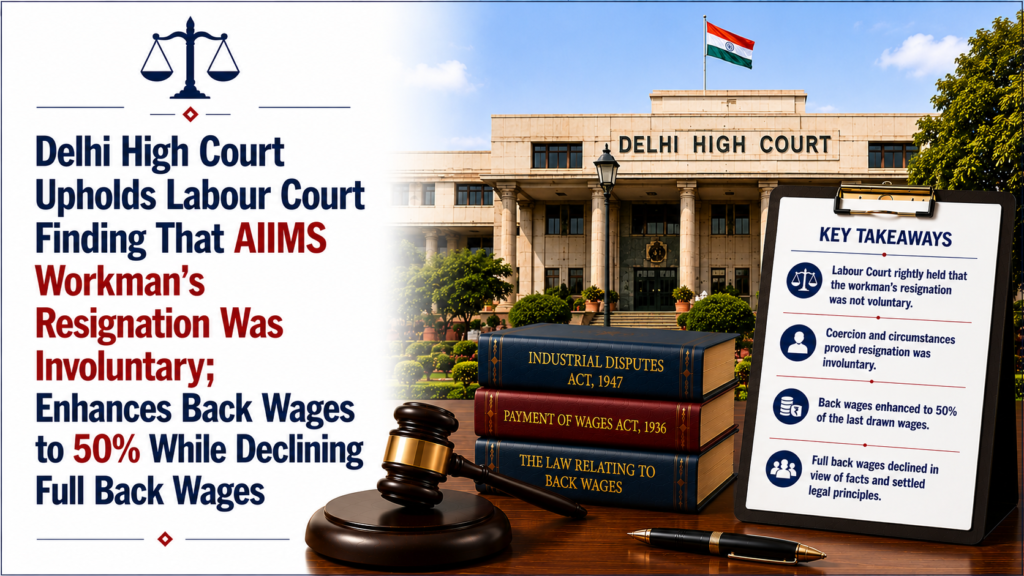
Delhi High Court Upholds Labour Court Finding That AIIMS Workman’s Resignation Was Involuntary; Enhances Back Wages to 50% While Declining Full Back Wages

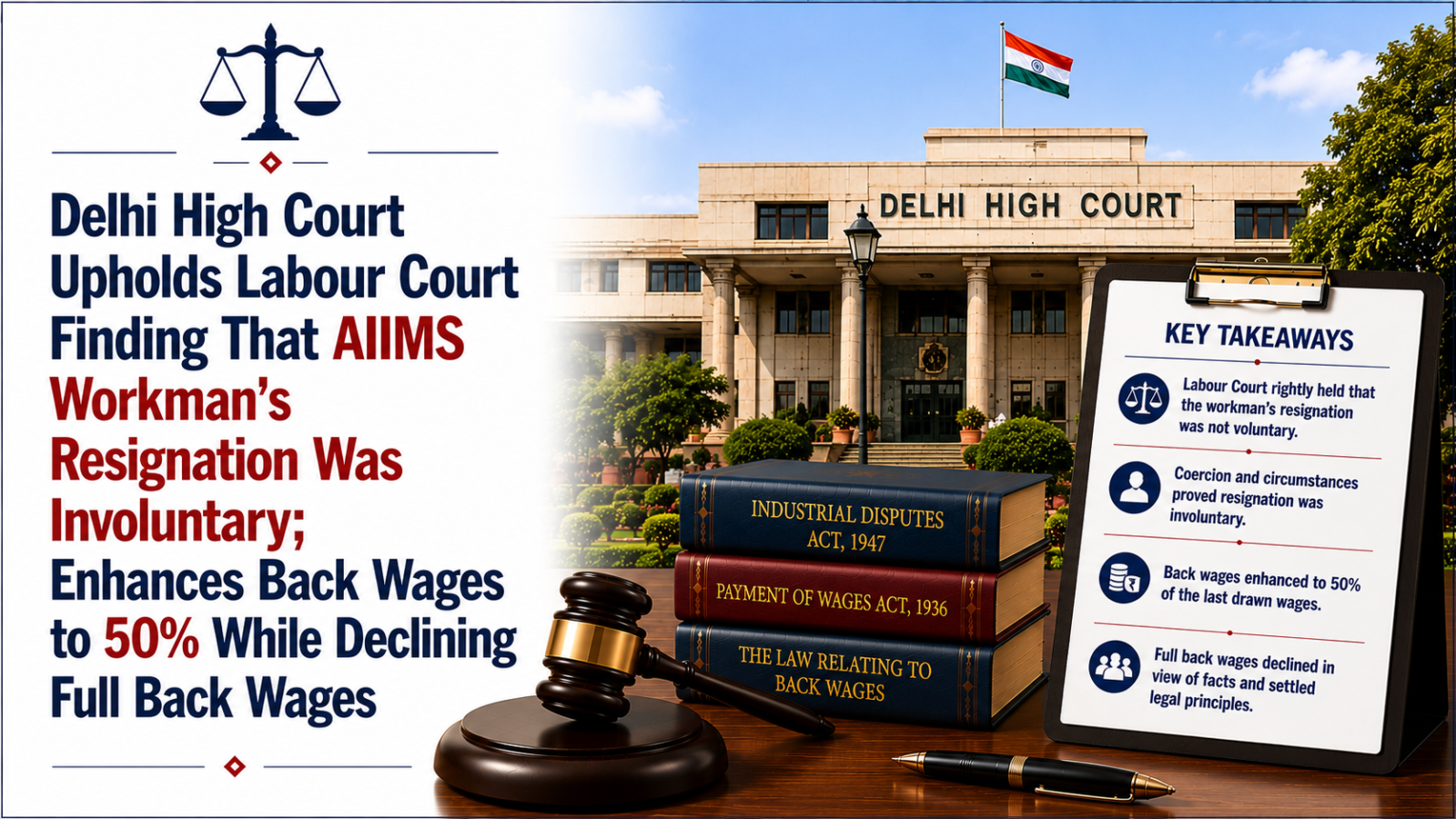
Delhi High Court Holds AIIMS Employee’s Resignation Was Not Voluntary; Enhances Back Wages from 40% to 50%
Facts
Mohd. Rafiq was employed as a Nursing Orderly with AIIMS since 1964. In 1979, he remained absent due to his wife’s illness. Upon reporting back for duty on 15 October 1979, AIIMS claimed that he voluntarily resigned because of personal difficulties. The workman, however, asserted that he had merely signed a document believing it to be a joining report and never intended to resign. He immediately made several representations seeking permission to resume duty. The Labour Court held that the resignation was involuntary, directed reinstatement with continuity of service and awarded 40% back wages. AIIMS challenged the finding of involuntary resignation, while the workman sought enhancement of back wages to 100%. During the pendency of the writ petitions, the workman died and his legal representatives were substituted.
Issues
- Whether the Industrial Disputes Act, 1947 applied to the workman despite his service being governed by the CCS (CCA) Rules.
- Whether the Labour Court travelled beyond the terms of the reference by deciding the validity of the alleged resignation.
- Whether the Labour Court correctly held that the resignation dated 15 October 1979 was not voluntary.
- Whether the workman was entitled to full back wages or only partial back wages.
Petitioner’s Arguments
AIIMS contended that the respondent held a civil post governed by the CCS (CCA) Rules and therefore the Industrial Disputes Act was inapplicable. It further argued that the Labour Court exceeded the scope of the reference by framing an issue regarding resignation. AIIMS maintained that the respondent had voluntarily resigned owing to domestic difficulties, that the resignation was validly accepted, and that subsequent correspondence did not mention any withdrawal of resignation. It also submitted that no back wages ought to have been awarded because the workman failed to prove that he remained unemployed during the relevant period.
Respondent’s Arguments
The workman contended that he had returned to duty intending to resume service and was misled into signing a document represented to him as a joining report. He relied upon his repeated representations made immediately after the alleged resignation requesting reinstatement, demonstrating that he never intended to sever his employment. He further argued that AIIMS could not challenge the validity of the industrial reference after participating in the proceedings and that the Labour Court’s findings were factual findings immune from interference under Article 226. The workman also sought full back wages, contending that AIIMS had failed to prove any gainful employment on his part after cessation of service.
Analysis of the Law
The High Court held that applicability of the Industrial Disputes Act depends upon whether the establishment is an “industry” and the employee is a “workman” under Section 2(s), not merely upon the applicability of service rules like the CCS (CCA) Rules. The Court also held that determining whether the workman had voluntarily resigned was integral to deciding whether his cessation of service was legal and therefore fell squarely within the terms of the reference.
On the merits, the Court reiterated that resignation is valid only if it reflects a conscious, voluntary and unequivocal intention to relinquish employment. Mere signing of a document does not by itself establish voluntary resignation. The Court further observed that a resignation requiring acceptance may ordinarily be withdrawn before acceptance unless the governing rules provide otherwise. The Court also emphasised the limited scope of judicial review under Article 226, holding that factual findings of Labour Courts cannot be reappreciated unless they are perverse, unsupported by evidence or suffer from jurisdictional error.
Precedent Analysis
The Court relied upon several precedents, including:
- Syed Yakoob v. K.S. Radhakrishnan, AIR 1964 SC 477, reiterating that High Courts exercising jurisdiction under Article 226 do not act as appellate courts and cannot reappreciate evidence unless findings are perverse.
- Indian Overseas Bank v. I.O.B. Staff Canteen Workers’ Union, (2000) 4 SCC 245, holding that interference with Labour Court findings is permissible only where conclusions are irrational or unsupported by evidence.
- G.T. Lad v. Chemicals & Fibres India Ltd., (1979) 1 SCC 590, laying down that abandonment or resignation depends upon the employee’s intention.
- Raj Kumar v. Union of India, AIR 1969 SC 180, holding that resignation ordinarily becomes effective only upon acceptance and may be withdrawn before acceptance.
- Hindustan Tin Works Pvt. Ltd. v. Employees, (1979) 2 SCC 80, J.K. Synthetics Ltd. v. K.P. Agrawal, (2007) 2 SCC 433, and Deepali Gundu Surwase v. Kranti Junior Adhyapak Mahavidyalaya, (2013) 10 SCC 324, regarding principles governing grant of back wages.
Court’s Reasoning
The High Court found that the Labour Court had comprehensively appreciated both oral and documentary evidence. It observed that the workman’s repeated requests to rejoin service immediately after the alleged resignation were wholly inconsistent with a genuine intention to resign. The representation dated 20 October 1979, forming part of AIIMS’s own official records, strongly supported the workman’s case.
The Court also noted that the official records showed the resignation had not yet been accepted when the workman sought reinstatement, thereby supporting the conclusion that any resignation could have been withdrawn before acceptance. Since the Labour Court’s conclusions were based on plausible appreciation of evidence, the High Court held that it could not substitute its own view merely because another interpretation of the evidence was possible.
On the issue of back wages, the Court found that the Labour Court had assigned no reasons for restricting back wages to 40%. At the same time, it held that grant of full back wages was also not justified in the absence of independent evidence regarding unemployment throughout the relevant period and considering the workman’s earlier absenteeism. Balancing the equities, the Court enhanced the back wages to 50% together with continuity of service for computation of retiral benefits.
Conclusion
The Delhi High Court dismissed AIIMS’s writ petition and upheld the Labour Court’s finding that the respondent had not voluntarily resigned and that the cessation of his employment was illegal. However, it partly allowed the workman’s writ petition by modifying the award and enhancing back wages from 40% to 50%. The Court directed AIIMS to compute and release 50% back wages along with consequential retiral and terminal benefits to the legal representatives of the deceased workman within twelve weeks, failing which interest at 6% per annum would become payable.
Case Details
Case: A.I.I.M.S. v. Mohd. Rafiq & Ors. (Connected with Mohd. Rafiq v. Presiding Officer, Labour Court)
Court: Delhi High Court
Case Number: W.P.(C) 2551/1999 and W.P.(C) 2447/2000
Judge: Hon’ble Ms. Justice Shail Jain
Date: 06 August 2026
Result: AIIMS’s writ petition dismissed; workman’s writ petition partly allowed. Labour Court’s finding that the resignation was involuntary was upheld, and back wages were enhanced from 40% to 50% with continuity of service for computation of retiral and terminal benefits.