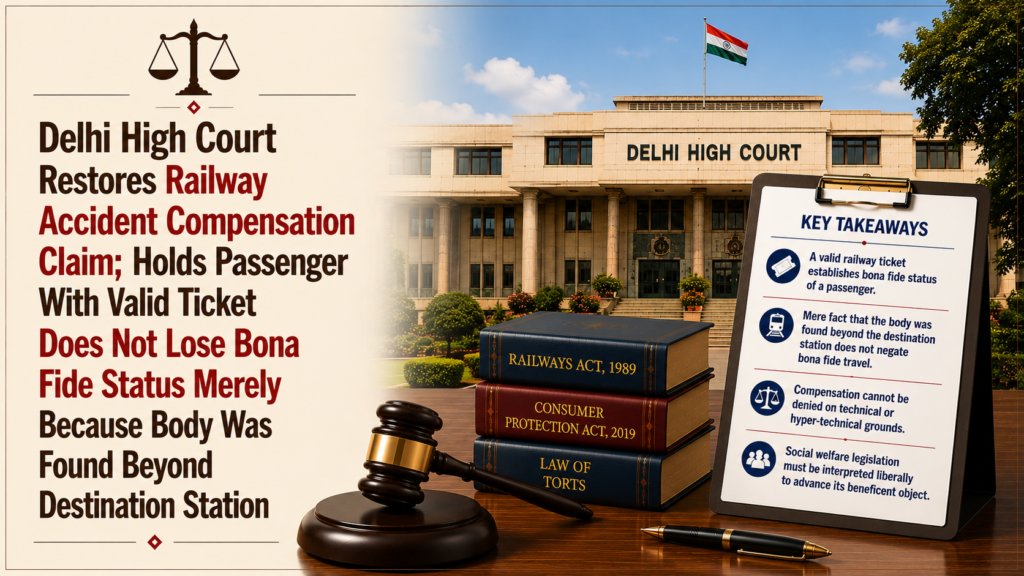
Delhi High Court Restores Railway Accident Compensation Claim; Holds Passenger With Valid Ticket Does Not Lose Bona Fide Status Merely Because Body Was Found Beyond Destination Station

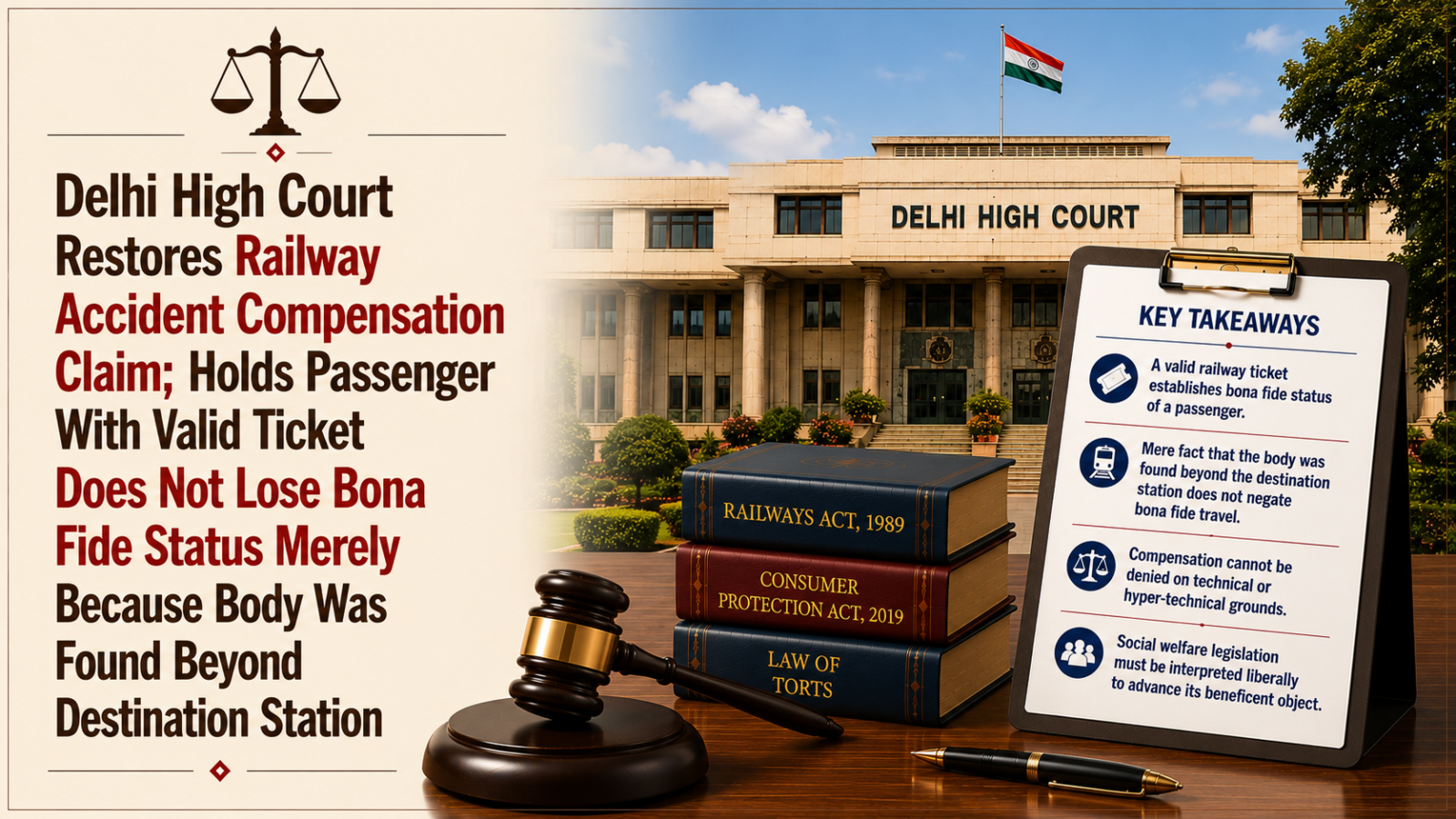
Delhi High Court Sets Aside Railway Tribunal Order; Holds Recovery of Body Beyond Destination Alone Cannot Defeat Compensation Claim
Facts
The appellants, parents of the deceased Satyapal Sharma, filed a claim before the Railway Claims Tribunal after their son died from injuries allegedly sustained when he accidentally fell from a running train while travelling from New Delhi to Aligarh on a valid second-class railway ticket. The Railway Claims Tribunal dismissed the claim, holding that since the deceased’s body was recovered approximately 1.5 kilometres beyond Aligarh Railway Station, his journey had already ended, he was no longer a bona fide passenger, and therefore the incident did not qualify as an “untoward incident” under the Railways Act. The appellants challenged this finding before the Delhi High Court.
Issues
- Whether a passenger travelling on a valid railway ticket loses the status of a bona fide passenger merely because his body is found beyond the destination station.
- Whether the deceased’s death constituted an “untoward incident” under Sections 123(c) and 124-A of the Railways Act, 1989.
- Whether the Railway Claims Tribunal was justified in rejecting the compensation claim on technical grounds.
Petitioners’ Arguments
The appellants contended that the deceased was travelling with a valid railway ticket recovered during the jamatalashi, a fact also acknowledged in the DRM Report. They argued that merely because the body was recovered beyond Aligarh Railway Station did not mean that the deceased had ceased to be a bona fide passenger. Relying upon Section 124-A of the Railways Act, they submitted that the statute embodies the principle of strict or no-fault liability and that courts have consistently interpreted the legislation liberally in favour of victims and their dependants.
Respondent’s Arguments
The Union of India argued that the Tribunal’s decision was correct because the deceased’s journey ended at Aligarh Station, whereas the body was found beyond the station near Pala Phatak. According to the Railways, once the destination station had been crossed, the deceased ceased to be a bona fide passenger and therefore the incident fell outside the scope of compensable railway accidents.
Analysis of the Law
The High Court examined Sections 123(c) and 124-A of the Railways Act, 1989 and reiterated that the legislation is a beneficial statute intended to provide prompt compensation through a regime of strict liability. The Court observed that the statutory framework does not contemplate automatic termination of a passenger’s status immediately upon reaching the destination station, particularly where the passenger continues to be connected with the railway journey. It held that technical objections cannot defeat the beneficial purpose of the Act unless the Railways establish one of the statutory exceptions, such as suicide, self-inflicted injury, intoxication, insanity, criminal acts, or deliberate trespass.
Precedent Analysis
The Court relied upon:
- Union of India v. Prabhakaran Vijaya Kumar & Ors., (2008) 9 SCC 527, holding that the Railways Act is a beneficial legislation imposing strict or no-fault liability and requiring liberal interpretation.
- Guruvachan Singh v. Union of India, 2026 SCC OnLine Del 2351, where it was held that recovery of a body away from the railway track does not by itself disprove an untoward incident.
- Vaishali w/o Nitesh Bhalerao v. Union of India, 2010 (5) Mh.L.J., wherein the Bombay High Court held that travelling beyond the destination station does not automatically extinguish the status of a bona fide passenger.
- Union of India v. Leela Devi, 2014 SCC OnLine Del 1440, reiterating that speculative and hyper-technical reasoning has no place in adjudicating railway compensation claims.
Court’s Reasoning
The High Court found that there was no dispute regarding the deceased’s possession of a valid railway ticket, which had been recovered during the jamatalashi and acknowledged in the DRM Report. It held that the Tribunal committed an error by denying compensation solely because the body was found beyond Aligarh Station.
The Court observed that several plausible explanations existed for the deceased being found beyond the destination station, including the possibility that he could not alight due to crowding and accidentally fell after the train had moved ahead. In the absence of evidence establishing that the deceased had safely completed his journey or that the death resulted from any statutory exception under Section 124-A, the Railways could not avoid liability merely on assumptions drawn from the place where the body was recovered.
The Court further criticised the Tribunal for adopting a hyper-technical approach inconsistent with the beneficial object of the Railways Act and the settled judicial interpretation favouring compensation in doubtful cases.
Conclusion
The Delhi High Court allowed the appeal, set aside the judgment of the Railway Claims Tribunal, and held that the deceased continued to be a bona fide passenger despite the recovery of his body beyond the destination station. The Court further held that the death constituted an “untoward incident” under the Railways Act. The matter was remanded to the Railway Claims Tribunal for determination of the compensation payable and for disbursement in accordance with law within the stipulated time.
Case Details
Case: Hoti Lal & Anr. v. Union of India
Court: Delhi High Court
Case Number: FAO 95/2022
Judge: Hon’ble Mr. Justice Manoj Kumar Ohri
Date: 06 August 2026
Result: Appeal Allowed; Tribunal’s order set aside and matter remanded to the Railway Claims Tribunal for assessment and disbursement of compensation.