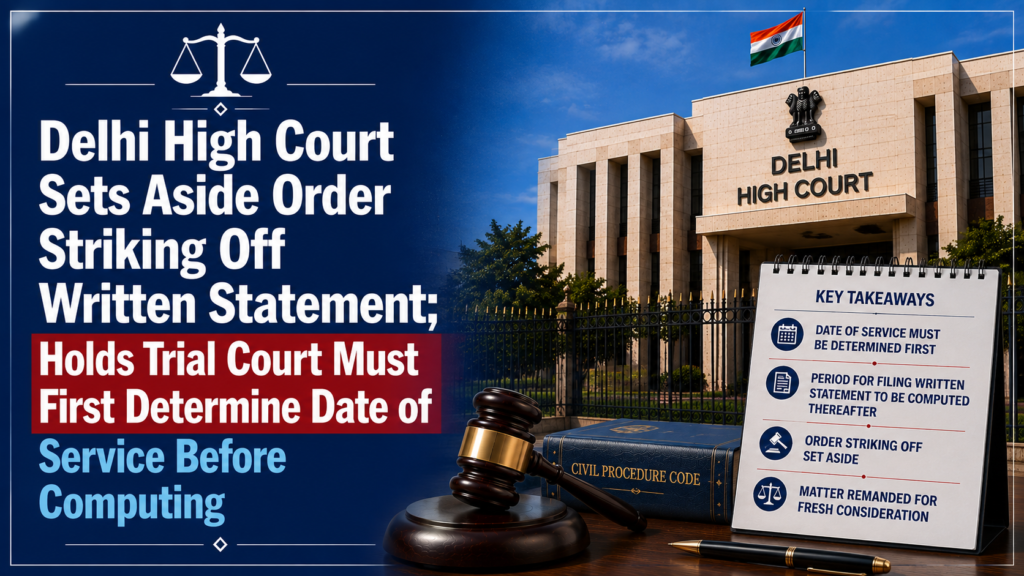
Delhi High Court Sets Aside Order Striking Off Written Statement; Holds Trial Court Must First Determine Date of Service Before Computing Commercial Suit Limitation

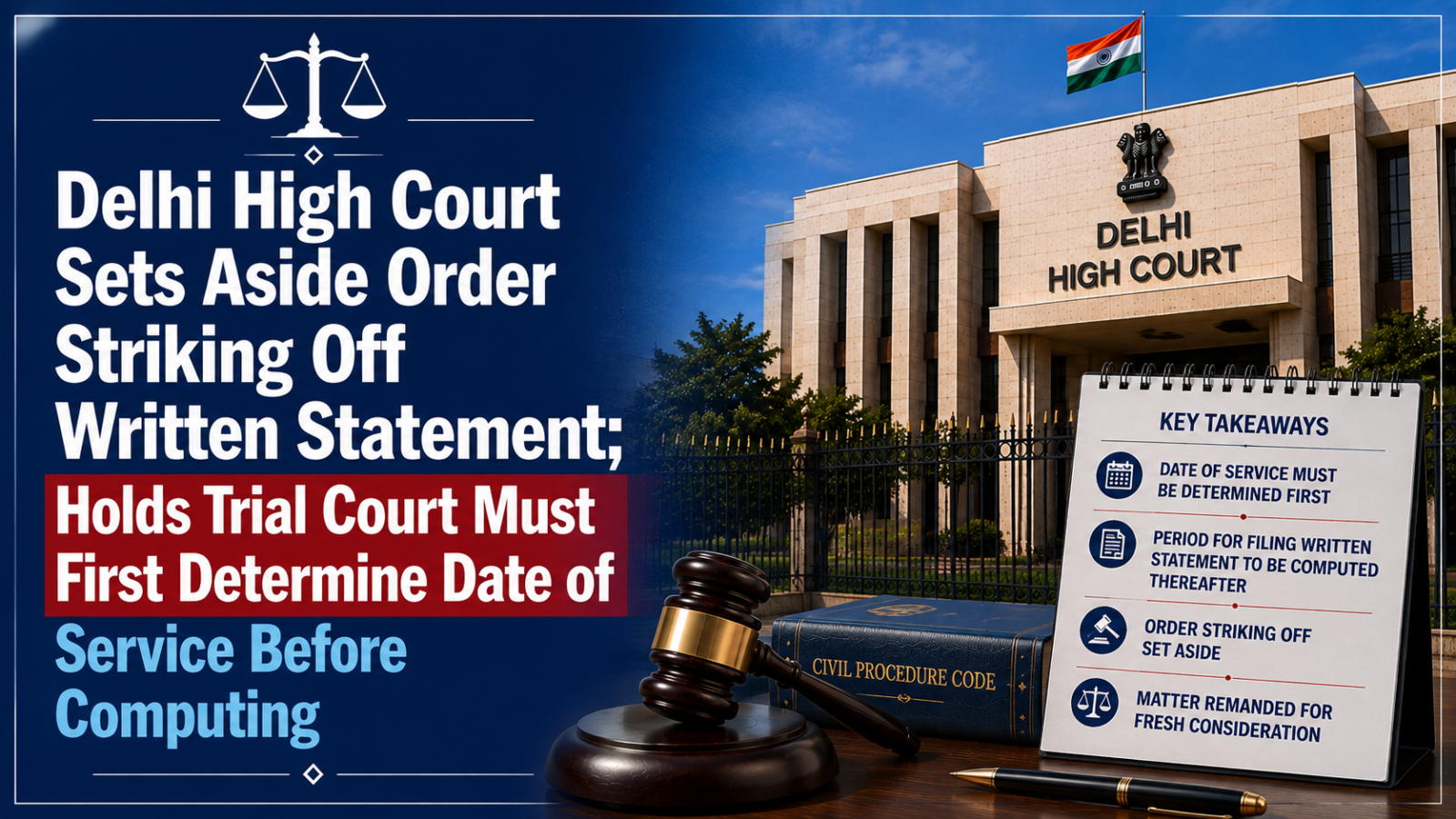
Delhi High Court Sets Aside Order Removing Written Statement; Holds Date of Service Must First Be Determined
Facts
The respondent instituted a commercial recovery suit seeking recovery of ₹23.75 lakh along with interest arising out of a Flipkart gift voucher facilitation arrangement between the parties. The dispute arose after Flipkart blocked the gift vouchers purchased through the petitioners. Summons were issued by the Commercial Court, and the petitioners eventually filed their written statement along with an application seeking condonation of delay under Order VIII Rule 1 CPC.
The Trial Court dismissed the application and directed that the written statement be taken off the record, primarily on the ground that it was not accompanied by an affidavit of admission and denial of documents. Aggrieved thereby, the petitioners invoked the supervisory jurisdiction of the Delhi High Court under Article 227 of the Constitution.
Issues
- Whether the Trial Court erred in rejecting the petitioners’ written statement without first determining the actual date of service of summons.
- Whether the Trial Court rightly dismissed the condonation application solely because the affidavit of admission and denial had not been filed.
- Whether the matter required reconsideration by the Commercial Court.
Petitioners’ Arguments
The petitioners contended that the Trial Court itself had observed that the delay in filing the written statement was condonable, yet dismissed the application solely due to the absence of the affidavit of admission and denial.
They further argued that the actual date on which they first became aware of the proceedings was 7 September 2022, through an e-Courts email, and not the earlier dates reflected in the postal records. According to them, if this date were accepted, the written statement had been filed well within the 120-day outer limit prescribed under the Commercial Courts Act.
The petitioners also relied upon decisions of the Delhi High Court treating the non-filing of an affidavit of admission and denial as a curable procedural defect.
Respondent’s Arguments
The respondent argued that the postal records obtained under the Right to Information Act established that summons had been delivered on 12 July 2022, making the written statement filed on 16 November 2022 beyond the mandatory outer limit of 120 days.
It was further submitted that the petitioners had not filed the affidavit of admission and denial either before the Trial Court or even before the High Court. The respondent relied upon judgments holding that the timelines prescribed under the Commercial Courts Act are mandatory and that failure to file the affidavit along with the written statement has serious procedural consequences.
Analysis of the Law
The High Court examined the statutory framework governing filing of written statements in commercial suits and observed that computation of the 120-day limitation period necessarily depends upon a definite finding regarding the date on which summons were actually served.
The Court found that there were conflicting dates emerging from the record, including the date pleaded in the condonation application, the postal delivery report and the petitioners’ assertion regarding receipt of the e-Courts notification. Without first resolving this factual controversy, the Trial Court could not correctly determine whether the written statement had been filed within or beyond the statutory period.
The Court also observed that the question relating to the absence of the affidavit of admission and denial ought to be considered only after the limitation issue is determined.
Precedent Analysis
The Trial Court had relied upon:
- Mayank Gupta v. Aditya Birla Fashion & Retail Ltd., holding that filing of an affidavit of admission and denial along with the written statement is mandatory in commercial suits.
- Unilin Beheer B.V. v. Balaji Action Buildwell, holding that failure to file the affidavit may result in the written statement not being taken on record and documents being deemed admitted.
Before the High Court, the petitioners relied upon:
- Sudhakar Singh v. Webkul Software (P) Ltd., and
- COSCO (India) Ltd. v. Paramsukh Nirman (P) Ltd.,
where the omission to file the affidavit was treated as a curable procedural defect in appropriate circumstances.
The High Court deliberately refrained from expressing any opinion on the correctness of either line of authority, leaving the issue open for fresh consideration by the Trial Court after determining the date of service.
Court’s Reasoning
The High Court observed that the Trial Court had not recorded any finding regarding the actual date on which summons were served, despite the existence of conflicting material on record. Since computation of the statutory period entirely depended upon that determination, the Court held that the Trial Court ought to have first decided the issue of service before considering whether the written statement was barred by limitation.
The High Court further noted that the impugned order proceeded on the assumption that the delay was condonable but nevertheless rejected the written statement solely because of the absence of the affidavit of admission and denial. In these circumstances, the Court held that the matter required fresh consideration and that both issues—the date of service and the effect of non-filing of the affidavit—ought to be decided together in accordance with law.
Conclusion
The Delhi High Court set aside the Trial Court’s order striking the written statement off the record and remanded the matter for fresh adjudication. The Trial Court was directed to first determine the actual date of service of summons, compute the statutory 120-day period, and thereafter decide the issue relating to the affidavit of admission and denial in accordance with law.
Case Details
Case: Prajna Insuretech Pvt. Ltd. & Ors. v. Payvorite India OPC Pvt. Ltd.
Court: High Court of Delhi
Case Number: CM(M) 1845/2023
Judge: Hon’ble Mr. Justice Ajay Digpaul
Date: 05 August 2026
Result: Petition allowed; Trial Court’s order set aside; matter remanded for fresh consideration after determining the actual date of service of summons.