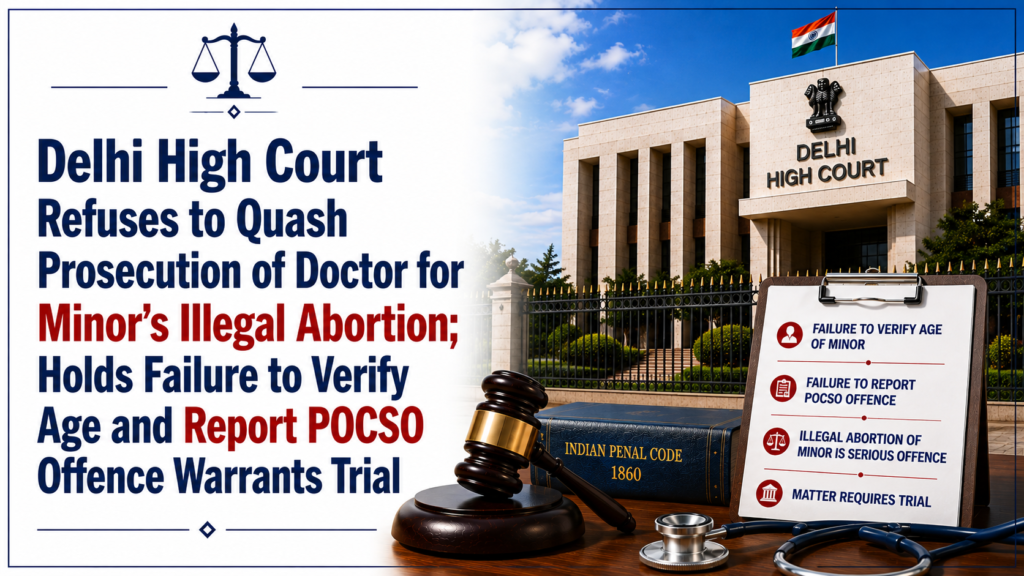
Delhi High Court Refuses to Quash Prosecution of Doctor for Minor’s Illegal Abortion; Holds Failure to Verify Age and Report POCSO Offence Warrants Trial

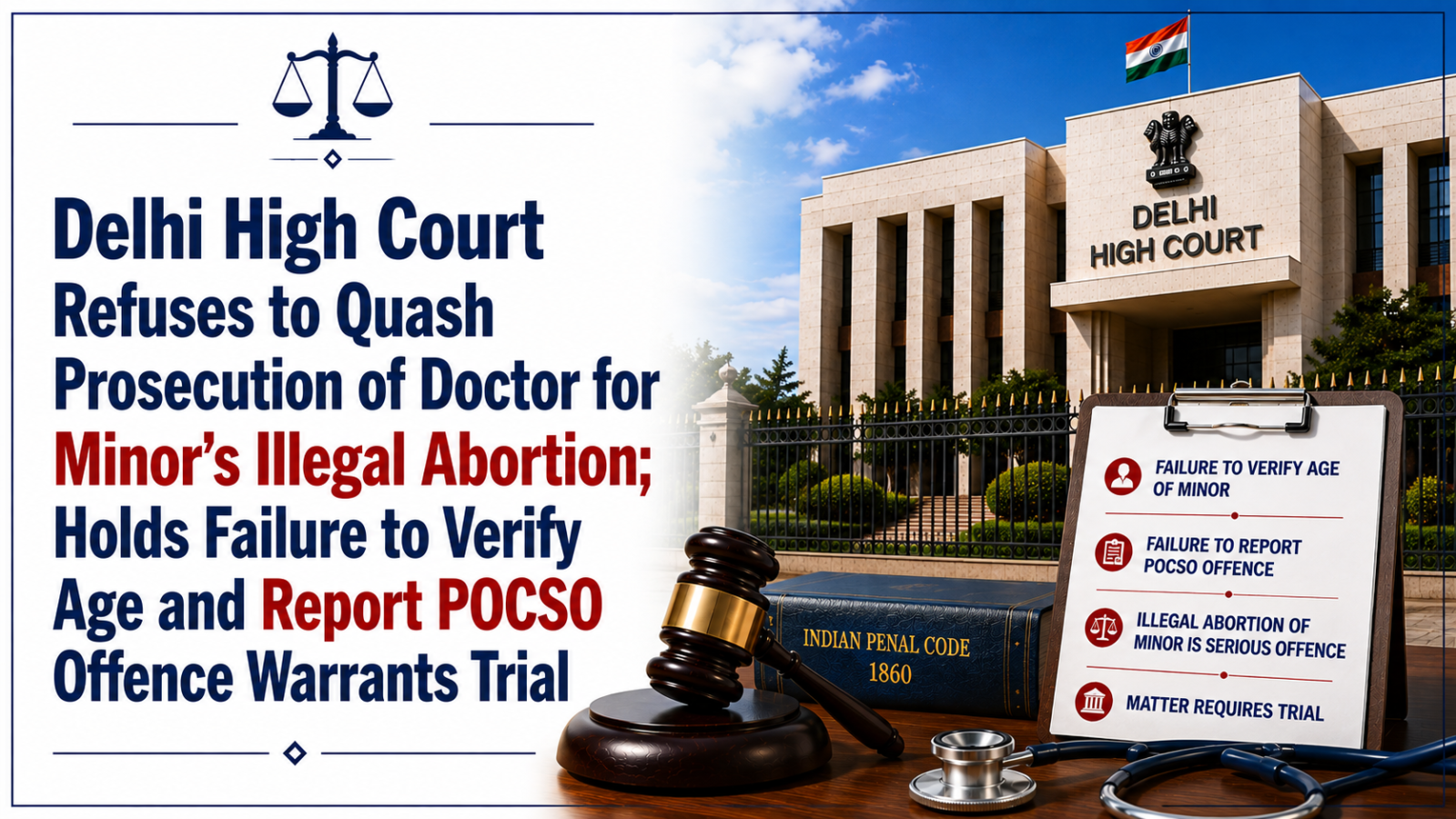
Delhi High Court Holds Doctor Must Verify Age Before Medical Termination of Pregnancy; Declines to Quash Criminal Proceedings
Facts
An FIR was registered alleging that a 16-year-old prosecutrix had been sexually assaulted, resulting in pregnancy. The prosecutrix was taken to Bhatia Medical Centre, where the petitioner, a gynaecologist, examined her and referred her to Talwar Medical Centre, where the pregnancy was terminated on 26 July 2019. Initially, the petitioner was treated only as a prosecution witness, and no allegations were made against her in the prosecutrix’s statements under Sections 161 and 164 CrPC.
Subsequently, during further investigation ordered by the Trial Court, the prosecutrix alleged that she had written her true date of birth on the admission slip, but the petitioner directed that her age be recorded as 20 years instead. The investigation further revealed that no documentary proof of age had been obtained, the mandatory statutory forms under the Medical Termination of Pregnancy Act, 1971 (“MTP Act”) had not been completed, guardian’s consent had not been obtained, and no report had been made to the police under the Protection of Children from Sexual Offences Act, 2012 (“POCSO Act”). A supplementary charge-sheet was therefore filed against the petitioner under Sections 313 and 201 IPC, Section 21 POCSO Act, and the provisions of the MTP Act. The petitioner sought quashing of the proceedings under Section 482 CrPC.
Issues
- Whether the Trial Court validly directed further investigation after taking cognizance.
- Whether a prima facie case existed against the petitioner for terminating a minor’s pregnancy without complying with the MTP Act.
- Whether the petitioner was under a statutory obligation to report the offence under Section 19 of the POCSO Act.
- Whether the criminal proceedings deserved to be quashed under Section 482 CrPC.
Petitioner’s Arguments
The petitioner contended that throughout the initial investigation she had been treated only as a prosecution witness and that allegations against her surfaced only during a supplementary statement recorded more than a year later.
She argued that she had been informed by the prosecutrix and the accompanying woman that the prosecutrix was 20 years old, had no knowledge that she was a minor, and therefore no obligation to obtain guardian’s consent or report the matter under Section 19 of the POCSO Act arose. The petitioner further relied upon the good-faith protection available under the MTP Act and submitted that the MTP Act protected medical practitioners acting bona fide. She also contended that Section 7 of the MTP Act did not itself create any criminal offence and that continuation of the prosecution amounted to abuse of the process of law.
Respondent’s Arguments
The State submitted that the prosecutrix was admittedly a minor and that guardian’s written consent under Section 3(4)(a) of the MTP Act was mandatory. It argued that the petitioner neither verified the prosecutrix’s age through any documentary proof nor completed the mandatory statutory forms required under the MTP Regulations.
The prosecution further relied upon the prosecutrix’s supplementary statement alleging that the petitioner had directed hospital staff to alter her recorded age from 16 to 20 years. It was argued that this allegation, together with the failure to obtain statutory consent and failure to report the pregnancy to the police despite knowledge of the victim’s minority, disclosed a clear prima facie case requiring trial.
Analysis of the Law
The High Court undertook an extensive analysis of the Medical Termination of Pregnancy Act, 1971 (as it stood before the 2021 amendment) and the POCSO Act.
The Court held that the MTP Act does not confer an unrestricted right to terminate pregnancy but only creates statutory exceptions to criminal liability subject to strict compliance with prescribed conditions. In the case of a minor, guardian’s written consent under Section 3(4)(a) is an independent statutory requirement and cannot be substituted merely by the minor’s own signature.
The Court further held that verification of the patient’s age is foundational to the statutory scheme. A registered medical practitioner cannot simply rely upon an oral declaration regarding age without seeking documentary verification, particularly when statutory obligations regarding guardian consent and mandatory reporting depend upon whether the patient is a minor.
The Court also emphasised that every pregnancy involving a minor necessarily indicates commission of an offence under the POCSO Act, thereby triggering the mandatory reporting obligation under Section 19, with failure attracting penal consequences under Section 21.
Precedent Analysis
The Court relied upon several important decisions, including:
- Vinubhai Haribhai Malaviya v. State of Gujarat, holding that courts may direct further investigation even after cognizance where necessary to ensure a fair investigation.
- State of Maharashtra v. Dr. Maroti, holding that doctors having knowledge of a POCSO offence are under a mandatory duty to report it and failure to do so may attract prosecution.
- Dr. Ditto Tom P. v. State of Kerala, holding that a doctor’s deliberate failure to report a POCSO offence warrants criminal prosecution.
- George P.O. v. State of Kerala, explaining that the reporting obligation under Section 19 POCSO attaches to every person acquiring knowledge of an offence and operates independently of professional capacity.
- Union of India v. Vinubhai Haribhai Malaviya, Ram Lal Narang, and H.N. Rishbud, recognising the power of courts to order further investigation after cognizance where justice requires.
Court’s Reasoning
The High Court found no illegality in the Trial Court’s order directing further investigation. It observed that the direction merely required independent investigation into the role of the doctors and expressly stated that the investigating officer should not be influenced by the observations contained in the order.
The Court further held that the prosecution had produced sufficient prima facie material to justify trial. It noted the allegation that the petitioner had instructed hospital staff to alter the prosecutrix’s recorded age, the admitted failure to verify age through documentary proof, the absence of the mandatory Form I and Form C under the MTP Regulations, the absence of guardian’s written consent, and the failure to report the offence despite the alleged knowledge of the prosecutrix’s minority.
The Court rejected the argument that the prosecutrix’s signature alone constituted valid consent, observing that under the MTP Act a minor’s signature cannot substitute the mandatory guardian’s written consent. It also observed that, if the prosecution version were ultimately established, the petitioner’s silence for nearly 70 days before registration of the FIR frustrated the very object of Section 19 of the POCSO Act, namely prompt reporting and immediate criminal investigation.
Accordingly, the Court held that the allegations raised substantial triable issues which could not be examined in proceedings under Section 482 CrPC.
Conclusion
The Delhi High Court dismissed the petition and refused to quash either the order directing further investigation or the order taking cognizance against the petitioner. The Court held that the prosecution materials disclosed a prima facie case regarding failure to verify the prosecutrix’s age, non-compliance with the mandatory requirements of the MTP Act, absence of guardian’s consent, and failure to report a POCSO offence. The Court clarified that its observations were confined to deciding whether a prima facie case existed and would not influence the trial on merits.
Case Details
Case: Dr. Poonam Mishra v. State (NCT of Delhi) & Anr.
Court: High Court of Delhi
Case Number: CRL.M.C. 2900/2021
Judge: Hon’ble Mr. Justice Purushaindra Kumar Kaurav
Date: 05 August 2026
Result: Petition dismissed; orders directing further investigation and taking cognizance upheld; criminal proceedings against the petitioner permitted to continue.