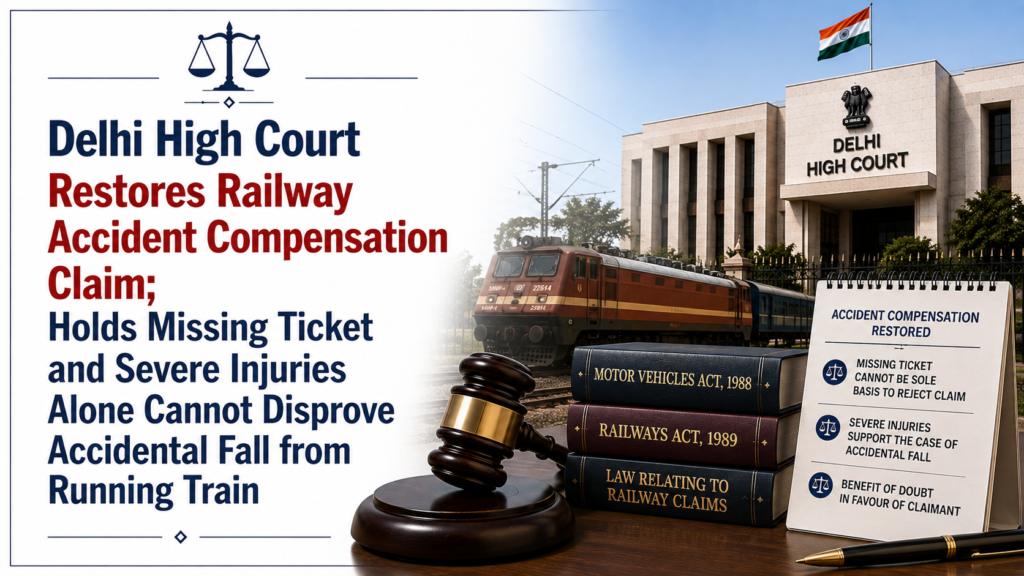
Delhi High Court Restores Railway Accident Compensation Claim; Holds Missing Ticket and Severe Injuries Alone Cannot Disprove Accidental Fall from Running Train

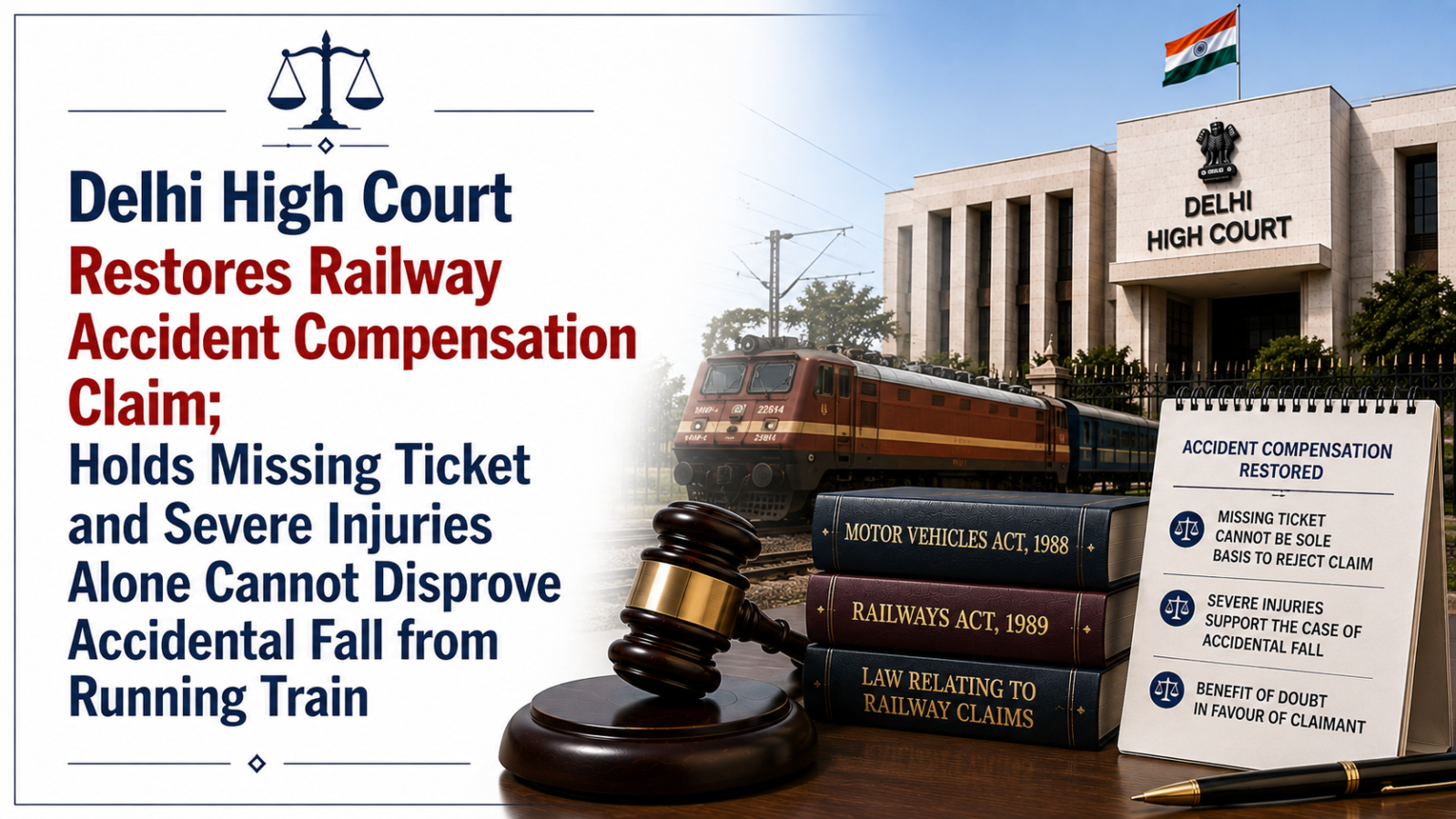
Delhi High Court Holds Railway Cannot Deny Compensation Solely Because Ticket Was Not Recovered After Fatal Accident
Facts
The appellants, the legal heirs of Ram Avtar Pandey, challenged the Railway Claims Tribunal’s order rejecting their claim for compensation under the Railways Act, 1989. According to the claimants, on 13 December 2014, the deceased was travelling from Ghaziabad to Khurja on a valid second-class railway ticket when, due to heavy rush and jerks inside the train, he accidentally fell from the moving train between Ghaziabad and Maripat Railway Station near Chipiyana Bujurg and died on the spot. The journey ticket was allegedly lost during the accident. The Tribunal dismissed the claim, holding that the deceased was neither a bona fide passenger nor a victim of an “untoward incident” under the Railways Act, leading to the present appeal.
Issues
- Whether the deceased was a bona fide passenger despite non-recovery of the railway ticket.
- Whether the deceased’s death resulted from an “untoward incident” under Section 124A of the Railways Act, 1989.
- Whether the Railway Claims Tribunal was justified in rejecting the compensation claim.
Appellants’ Arguments
The appellants contended that the deceased had lawfully travelled after purchasing a valid railway ticket, which was lost at the place of the accident. They relied upon the affidavit and testimony of a witness who accompanied the deceased to the railway station and personally saw him purchase the ticket.
It was further argued that the deceased accidentally fell due to overcrowding and jerks inside the train, bringing the incident squarely within the definition of an “untoward incident”. Relying upon Union of India v. Rina Devi, the appellants submitted that mere non-recovery of the ticket cannot by itself negate the status of a bona fide passenger.
Respondent’s Arguments
The Railways supported the Tribunal’s decision and argued that the injuries suffered by the deceased—including crush injuries, fractures and amputation of both legs below the knees—showed that he had been run over while trespassing on the railway track rather than falling from a train.
The respondent also relied upon the DRM Report, which attributed responsibility for the accident to the deceased, and argued that the absence of a recovered railway ticket further weakened the claim that he had been travelling as a bona fide passenger.
Analysis of the Law
The High Court reiterated that proceedings under the Railways Act arise out of a beneficial and welfare-oriented legislation, requiring a liberal interpretation in favour of genuine claimants.
The Court held that the initial burden upon claimants to establish bona fide travel is relatively light and may be discharged through an affidavit or other reliable evidence. Once such evidence is produced, the burden shifts to the Railway Administration to rebut it by cogent evidence.
The Court further observed that merely because a deceased sustained severe crush injuries or was run over does not automatically exclude the possibility that he first accidentally fell from the train and thereafter came under its wheels. Such conclusions cannot rest upon speculation unsupported by direct evidence.
The Court also reaffirmed that Section 124A of the Railways Act imposes strict liability, and contributory negligence is generally not available as a defence in railway accident compensation claims.
Precedent Analysis
The Court relied upon:
- Union of India v. Rina Devi, (2019) 3 SCC 572, holding that non-recovery of a railway ticket alone cannot defeat a claim for compensation and that the claimant may discharge the initial burden through affidavit evidence.
- Lata v. Union of India, 2026 SCC OnLine SC 1350, reiterating that absence of a recovered ticket does not negate bona fide passenger status where credible evidence establishes purchase of the ticket.
- Rajpati v. Union of India, 2014 SCC OnLine Del 2540, holding that even where the body is found in a mutilated condition, it remains possible that the victim first fell from the train before coming under its wheels.
- Union of India v. Prabhakaran Vijaya Kumar, (2008) 9 SCC 527, reaffirming that liability under Section 124A is based on strict liability and that contributory negligence is not a valid defence.
Court’s Reasoning
The High Court found that the appellants had successfully discharged their initial burden through the affidavit and testimony of Ram Niwas Pandey, who specifically deposed that he had accompanied the deceased to the railway station and witnessed him purchasing the railway ticket. The minor inconsistency during cross-examination regarding a possible duty pass did not undermine this categorical assertion.
The Court further held that the Tribunal wrongly inferred trespassing solely from the nature of the injuries. The post-mortem report and panchnama merely described the injuries and location of the body; they did not establish how the accident occurred. Importantly, the Railways failed to examine any eyewitness, loco pilot, guard or railway official to prove that the deceased had been run over while trespassing. Consequently, the DRM Report rested merely on inference rather than direct evidence.
The Court concluded that the Tribunal had adopted a speculative approach contrary to the beneficial object of the Railways Act and the settled principles laid down by the Supreme Court.
Conclusion
The Delhi High Court allowed the appeal, set aside the Railway Claims Tribunal’s judgment and remanded the matter to the Tribunal for determination of the compensation payable in accordance with law. The Tribunal was directed to assess the compensation and ensure its disbursement within two months, with the matter directed to be listed before the Tribunal on 21 August 2026.
Case Details
Case: Meena Devi & Ors. v. Union of India
Court: High Court of Delhi
Case Number: FAO 180/2022
Judge: Hon’ble Mr. Justice Manoj Kumar Ohri
Date: 05 August 2026
Result: Appeal allowed; Tribunal’s order set aside and matter remanded to the Railway Claims Tribunal for assessment and disbursement of compensation in accordance with law