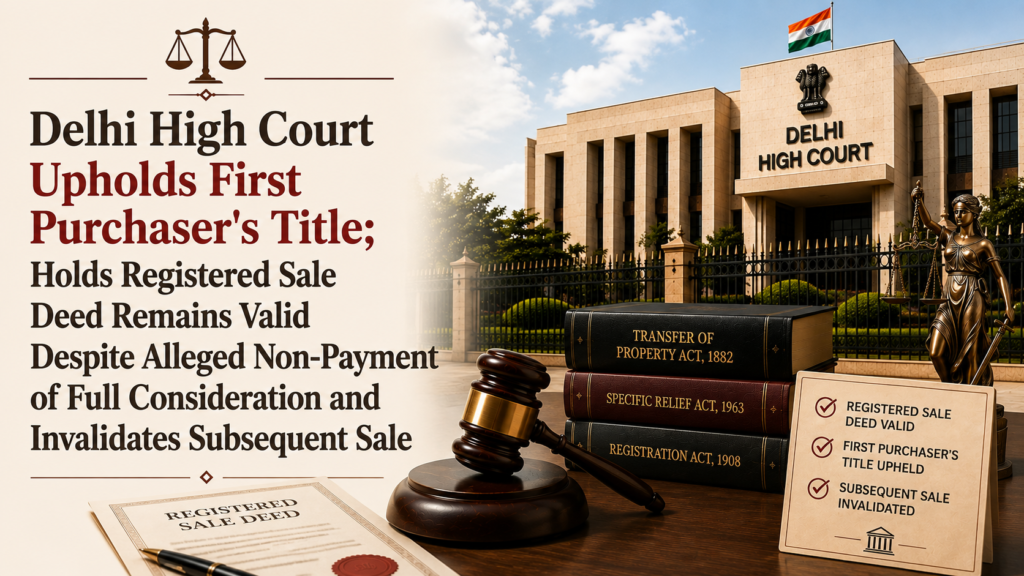
Delhi High Court Upholds First Purchaser’s Title; Holds Registered Sale Deed Remains Valid Despite Alleged Non-Payment of Full Consideration and Invalidates Subsequent Sale

Delhi High Court Rejects Appeal Challenging First Sale; Holds Section 54 TPA Recognises Sale Even Where Price Is Partly Paid or Promised
Facts
The appellant executed a registered Sale Deed dated 12 September 2016 in favour of the respondent, transferring ownership of the first, second and third floors with terrace rights of the suit property for a consideration of ₹28.50 lakh. On the same day, the appellant was inducted as a tenant under a registered lease deed for six months at a monthly rent of ₹20,000. After expiry of the tenancy, the appellant neither vacated the premises nor paid rent. Instead, she executed another registered Sale Deed dated 2 June 2017 in favour of a third party in respect of the third floor and terrace rights. The respondent filed a suit seeking declaration that the second sale deed was null and void, possession, arrears of rent, damages and permanent injunction. The Trial Court decreed the suit, following which the appellant preferred the present first appeal.
Issues
- Whether the first registered Sale Deed remained valid despite the appellant’s allegation that the entire sale consideration had not been paid.
- Whether the appellant could validly execute a second Sale Deed after transferring ownership under the first registered Sale Deed.
- Whether the Trial Court rightly declared the subsequent Sale Deed null and void and granted possession, arrears of rent and damages.
Appellant’s Arguments
The appellant contended that the respondent failed to establish payment of the entire sale consideration of ₹28.50 lakh. It was argued that although the Sale Deed referred to payment through five cheques, the respondent failed to prove encashment of all the cheques through bank records. According to the appellant, only two cheque payments were reflected in her bank account and there was no proof of payment of the remaining amount.
The appellant further argued that the Trial Court wrongly invoked Section 54 of the Transfer of Property Act, 1882, without first determining whether the respondent had actually proved payment of the consideration as pleaded. It was also contended that the Trial Court wrongly relied upon Vidyadhar v. Manikrao, failed to frame an issue regarding proof of payment of the sale consideration, and erroneously granted possession, rent and damages despite the alleged defects in the respondent’s title.
Respondent’s Arguments
The respondent submitted that ownership had validly passed through the registered Sale Deed dated 12 September 2016, after which the appellant herself accepted the status of a tenant by executing a registered lease deed on the same day. It was argued that the appellant’s written statement had never been taken on record, and she had not led any admissible evidence to establish non-payment of the sale consideration.
The respondent further contended that, after executing the first Sale Deed, the appellant ceased to be the owner and therefore lacked any authority to execute the subsequent Sale Deed in favour of the second purchaser. It was also pointed out that the subsequent purchaser had not challenged the Trial Court’s findings and had already handed over possession of the property.
Analysis of the Law
The High Court analysed Section 54 of the Transfer of Property Act, 1882, which defines a sale as a transfer of ownership in exchange for a price paid, promised, or partly paid and partly promised. The Court held that the statute itself makes it clear that payment of the entire consideration at the time of execution is not an essential prerequisite for completion of a valid sale.
The Court observed that once a registered Sale Deed is executed with the intention of transferring ownership, title passes to the purchaser. Any dispute regarding unpaid consideration gives the vendor an independent legal remedy for recovery of the balance amount but does not invalidate the transfer itself. The Court emphasised that the decisive test is the intention of the parties, to be gathered from the Sale Deed, surrounding circumstances and conduct of the parties.
Precedent Analysis
The Court relied upon Vidyadhar v. Manikrao & Anr., (1999) 3 SCC 573, wherein the Supreme Court held that:
- A sale under Section 54 of the Transfer of Property Act is complete once ownership is intended to be transferred through a duly executed and registered Sale Deed.
- Actual payment of the entire sale consideration is not a sine qua non for completion of a sale.
- If any portion of the consideration remains unpaid, the vendor’s remedy is to pursue appropriate legal proceedings for recovery and not to deny the validity of the Sale Deed or claim continued ownership.
Court’s Reasoning
The High Court observed that the appellant’s written statement had never been taken on record because of her failure to file it within the prescribed time, and that order had already attained finality. Consequently, there was no admissible defence challenging the respondent’s title.
The Court further held that, even assuming that part of the sale consideration remained unpaid, Section 54 of the Transfer of Property Act and the decision in Vidyadhar clearly establish that such non-payment does not invalidate a registered Sale Deed. Once the appellant executed the Sale Deed dated 12 September 2016, ownership stood transferred to the respondent, and the appellant immediately accepted the status of a tenant under the registered lease deed executed on the same day.
Accordingly, the appellant had no subsisting ownership rights and was legally incapable of executing another Sale Deed in favour of the second purchaser. The subsequent Sale Deed was therefore rightly declared null and void. The Court also upheld the Trial Court’s apportionment of rent and damages between the appellant and the second purchaser based upon their respective possession of different portions of the property.
Conclusion
The Delhi High Court dismissed the appeal and affirmed the Trial Court’s decree. It held that a registered Sale Deed transfers ownership even if the entire sale consideration has not been paid, provided the parties intended to complete the sale. The Court further held that, after transferring ownership through the first registered Sale Deed, the appellant had no authority to execute a second Sale Deed, rendering the subsequent conveyance null and void. The decree for possession, arrears of rent, damages and permanent injunction was accordingly upheld.
Case Details
Case: Amarjeet Kaur v. Usha Garg
Court: High Court of Delhi
Case Number: RFA 769/2026
Judge: Hon’ble Ms. Justice Neena Bansal Krishna
Date: 05 August 2026
Result: Appeal dismissed; Trial Court’s decree declaring the subsequent Sale Deed null and void, granting possession, arrears of rent, damages and permanent injunction affirmed