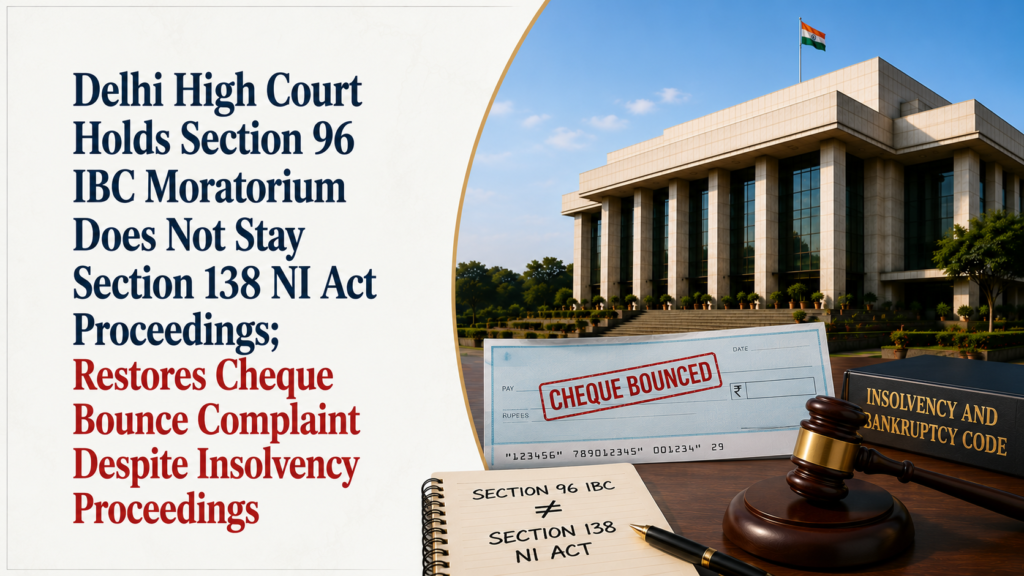
Delhi High Court Holds Section 96 IBC Moratorium Does Not Stay Section 138 NI Act Proceedings; Restores Cheque Bounce Complaint Despite Insolvency Proceedings

Insolvency Proceedings Cannot Halt Section 138 NI Act Complaint, Rules Delhi High Court Following Supreme Court’s Rakesh Bhanot Decision
Facts
The petitioner advanced a friendly loan of ₹30 lakhs to the respondent under a loan agreement dated 6 July 2015. Towards repayment, the respondent issued six post-dated cheques of ₹5 lakhs each. Two cheques were honoured, while the remaining four were dishonoured in July 2018 for “Insufficient Funds” and “Payment Stopped by Drawer.”
After issuing the statutory demand notice, the petitioner filed a complaint under Section 138 of the Negotiable Instruments Act, 1881. During the proceedings, the parties entered into a settlement for ₹20 lakhs, of which the respondent paid ₹13.50 lakhs, leaving an outstanding amount of ₹6.50 lakhs. The Trial Court had earlier directed recovery of ₹13 lakhs as arrears of land revenue.
Subsequently, the respondent relied upon insolvency proceedings pending before the NCLT under the Insolvency and Bankruptcy Code, 2016. Relying on the interim moratorium under Section 96 IBC, the Metropolitan Magistrate stayed the cheque bounce proceedings. The petitioner challenged the stay before the Delhi High Court.
Issues
- Whether an interim moratorium under Section 96 of the Insolvency and Bankruptcy Code, 2016 stays criminal proceedings under Section 138 of the Negotiable Instruments Act, 1881.
- Whether the Trial Court rightly stayed the cheque bounce complaint.
- Whether insolvency proceedings can defeat criminal prosecution for dishonoured cheques.
Petitioner’s Arguments
The petitioner contended that:
- The Trial Court wrongly stayed the complaint solely because insolvency proceedings had commenced.
- The Supreme Court in Rakesh Bhanot v. Gurdas Agro (P) Ltd. had conclusively held that Sections 96 and 101 IBC do not bar criminal prosecution under Section 138 NI Act.
- The respondent repeatedly defaulted despite entering into a settlement and giving undertakings before the Trial Court.
- The impugned order was passed without supplying copies of the NCLT and NCLAT orders or granting an effective opportunity of hearing.
Respondent’s Position
The respondent relied upon:
- Orders passed by the NCLT and NCLAT.
- The interim moratorium under Section 96 IBC.
- The contention that all legal proceedings relating to the debt stood stayed during insolvency proceedings, justifying the Trial Court’s order.
Analysis of the Law
The Delhi High Court examined Section 96 of the Insolvency and Bankruptcy Code, which stays legal proceedings “in respect of any debt” during the interim moratorium.
The Court held that the controversy stood conclusively settled by the Supreme Court in Rakesh Bhanot, which distinguished between:
- civil proceedings for recovery of debt; and
- criminal prosecution under Section 138 NI Act.
The Court observed that Section 138 proceedings are criminal in nature and are intended to preserve the credibility of negotiable instruments and commercial discipline. Consequently, insolvency moratorium cannot be invoked to suspend such prosecutions.
Precedent Analysis
The Court principally relied upon:
- Rakesh Bhanot v. Gurdas Agro (P) Ltd. — Held that moratorium under Sections 96 and 101 IBC postpones only civil recovery proceedings and does not stay criminal prosecution under Section 138 of the Negotiable Instruments Act. The deterrent purpose of Section 138 must be preserved.
Court’s Reasoning
The High Court held that:
- The Trial Court proceeded on an incorrect understanding of Section 96 IBC.
- The Supreme Court has already clarified that insolvency moratorium does not extend to criminal proceedings under Section 138 NI Act.
- Mere initiation of insolvency proceedings cannot justify staying a cheque bounce complaint.
- Since the legal issue stood authoritatively settled by the Supreme Court, it was unnecessary to examine the petitioner’s procedural challenge regarding denial of hearing.
- After setting aside the stay, the Trial Court should continue the proceedings from the stage at which they had been stayed.
Conclusion
The Delhi High Court allowed the petition.
The order dated 17 November 2022 staying the Section 138 proceedings was set aside. The cheque bounce complaint was restored to the file of the Trial Court, which was directed to proceed further in accordance with law without being influenced by the earlier stay order.
Case Details
Case: Shri Amarjeet Singh v. Shri Hardeep Singh
Court: Delhi High Court
Case Number: CRL.M.C. 2494/2023
Judge: Hon’ble Ms. Justice Madhu Jain
Date: 30 July 2026
Citation: 2026:DHC:6083
Result: Petition allowed. The Delhi High Court set aside the Trial Court’s order staying the Section 138 NI Act proceedings, holding that the interim moratorium under Section 96 of the Insolvency and Bankruptcy Code, 2016 does not bar criminal prosecution for cheque dishonour. The complaint was restored for continuation before the Trial Court.