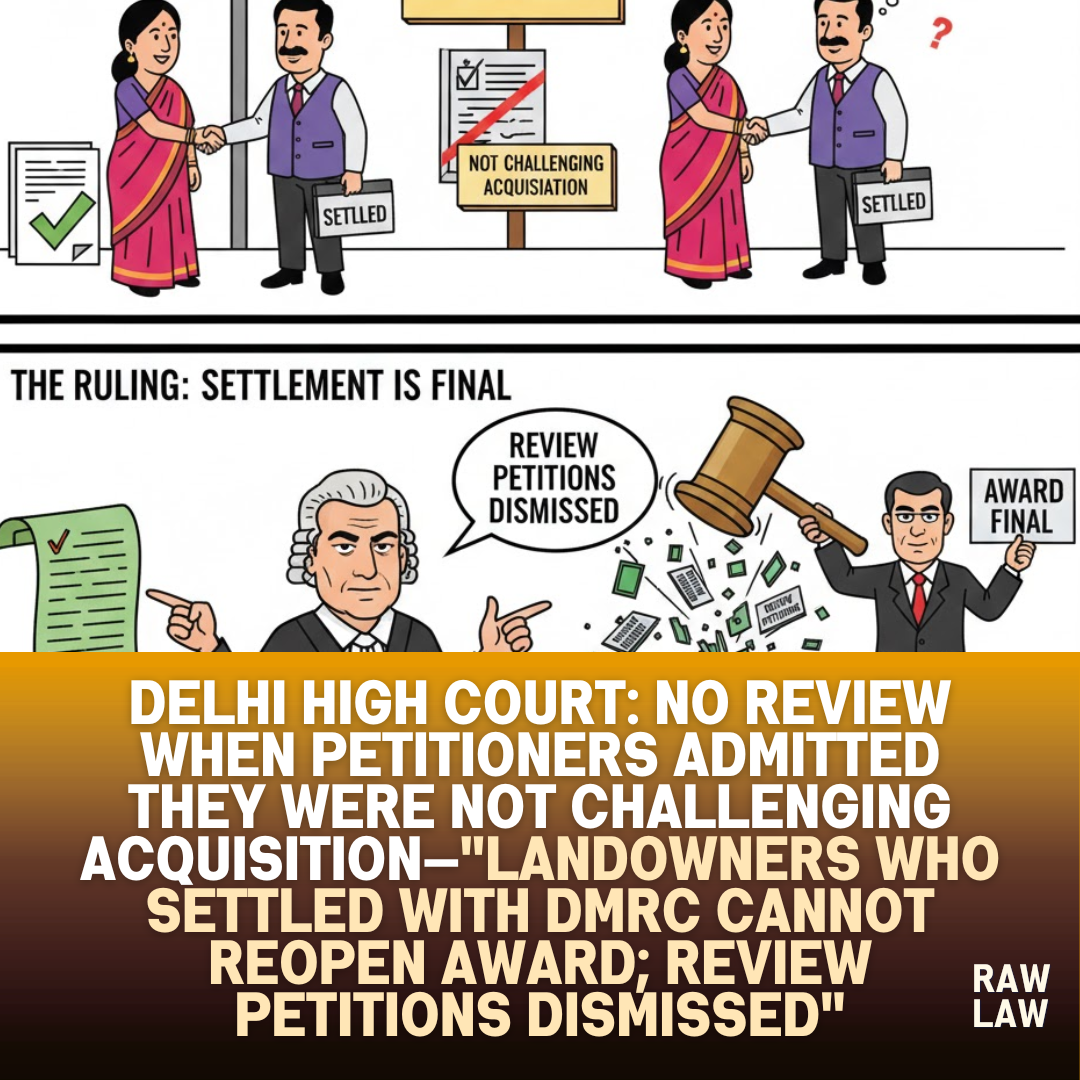
Delhi High Court: No review when petitioners admitted they were not challenging acquisition—”Landowners who settled with DMRC cannot reopen award; review petitions dismissed”

Court’s decision
The Delhi High Court dismissed a batch of review petitions filed by multiple landowners, including M/s Evinix Designs Concepts Pvt. Ltd. and connected matters, seeking reconsideration of the judgment dated 24 December 2024. The Court held that the review petitions were “clearly beyond the well settled parameters governing exercise of review jurisdiction” and amounted to an attempt to reargue issues already decided. It found no error apparent on the face of the record and reaffirmed that the petitioners had expressly stated they were not challenging the acquisition proceedings. The review petitions were dismissed.
Facts
The petitioners had originally filed writ petitions challenging aspects of land acquisition proceedings under the Land Acquisition Act, 1894 concerning land handed over to Delhi Metro Rail Corporation.
In the main judgment dated 24 December 2024, the High Court rejected their claims, noting that the petitioners had entered into an agreement with DMRC and voluntarily handed over possession in consideration of allotment of commercial space.
In the review petitions, the petitioners contended that the judgment incorrectly recorded that they had given up their right to challenge the acquisition and possession, and that key issues—such as ante-dating of the award and non-compliance with Sections 9 and 10 of the 1894 Act—were not properly considered.
Issues
- Whether there was an error apparent on the face of the record warranting review under Order 47 Rule 1 CPC.
- Whether the Court wrongly recorded that the petitioners had given up challenge to acquisition proceedings.
- Whether alleged ante-dating of the award or non-service of notice under Sections 9 and 10 justified review.
Petitioners’ arguments
The review petitioners argued that the Court had misconstrued their pleadings and wrongly relied upon the Supreme Court’s judgment in Delhi Airtech Services Pvt. Ltd. They contended that they never gave up their challenge to acquisition proceedings and that the judgment overlooked contentions regarding ante-dating of the award under Section 11 and violation of notice requirements under Sections 9 and 10 of the Land Acquisition Act, 1894.
They also claimed that the Court treated the wrong writ petition as the lead matter and recorded certain factual inaccuracies.
Respondents’ arguments
The respondents contended that the review petitions were a disguised appeal. They pointed out that the Court had extracted the petitioners’ own pleadings, including categorical statements that they were not challenging the acquisition notifications or proceedings.
It was further submitted that all issues regarding service of notice and ante-dating of the award had been specifically addressed in the main judgment, including reliance on May George v. Special Tehsildar.
Analysis of the law
The High Court reiterated the narrow scope of review jurisdiction. Relying on the Supreme Court decision in Sanjay Kumar Agarwal v. State Tax Officer (2024) 2 SCC 362, the Court emphasized that review is permissible only where there is a self-evident error apparent on the face of the record.
A review cannot be used to reargue issues or correct alleged erroneous findings. It is not an appeal in disguise.
The Court examined its earlier judgment and found that it had explicitly considered the issues regarding Section 9 and Section 10 notices, ante-dating of the award, and the petitioners’ agreement with DMRC.
Precedent analysis
The Court relied on Sanjay Kumar Agarwal v. State Tax Officer to restate settled principles:
- Review is justified only in cases of error apparent on the face of record.
- A judgment is final unless substantial and compelling reasons exist.
- An error requiring elaborate reasoning is not an apparent error.
- Review cannot become an appeal in disguise.
It also reaffirmed reliance on May George v. Special Tehsildar in the main judgment, holding that alleged defects in Section 9 notices do not automatically invalidate the award.
Court’s reasoning
The Court found that paragraph 27 of the original judgment reproduced the petitioners’ own pleading stating they were not challenging acquisition proceedings.
The contention that the Court wrongly assumed abandonment of challenge was described as “wholly incorrect” and “clearly misconceived.”
The issues of ante-dating and notice under Sections 9 and 10 had been dealt with in specific paragraphs of the earlier judgment.
The Court also rejected arguments regarding the identification of the lead matter, observing that factual and legal issues were identical across petitions.
Ultimately, the review petitions merely sought rehearing on merits.
Conclusion
The Delhi High Court dismissed all review petitions. It held that no error apparent on the face of record was established and that the petitioners were attempting to reargue matters already adjudicated.
All pending applications were disposed of.
Implications
This judgment reinforces the finality of judicial decisions and the limited scope of review under Order 47 Rule 1 CPC.
Landowners who voluntarily settle with acquiring authorities and expressly disclaim challenge to acquisition cannot later seek to reopen proceedings through review jurisdiction.
The ruling underscores judicial discipline in preventing review petitions from becoming substitute appeals.
Case Law References
- Sanjay Kumar Agarwal v. State Tax Officer (2024) 2 SCC 362
- May George v. Special Tehsildar (2010) 13 SCC 98
- Delhi Airtech Services Pvt. Ltd. v. State of U.P. (2022 SCC OnLine SC 1408)
FAQs
1. Can a review petition be used to reargue the merits of a case?
No. Review is limited to correcting errors apparent on the face of the record and cannot function as an appeal.
2. Does alleged defect in notice under Sections 9 and 10 of the Land Acquisition Act invalidate an award?
Not automatically. Courts examine whether prejudice is caused; minor defects do not render the award void.
3. What qualifies as an “error apparent on the face of the record”?
An obvious, self-evident error that does not require elaborate reasoning or reappreciation of evidence.