

Court’s decision
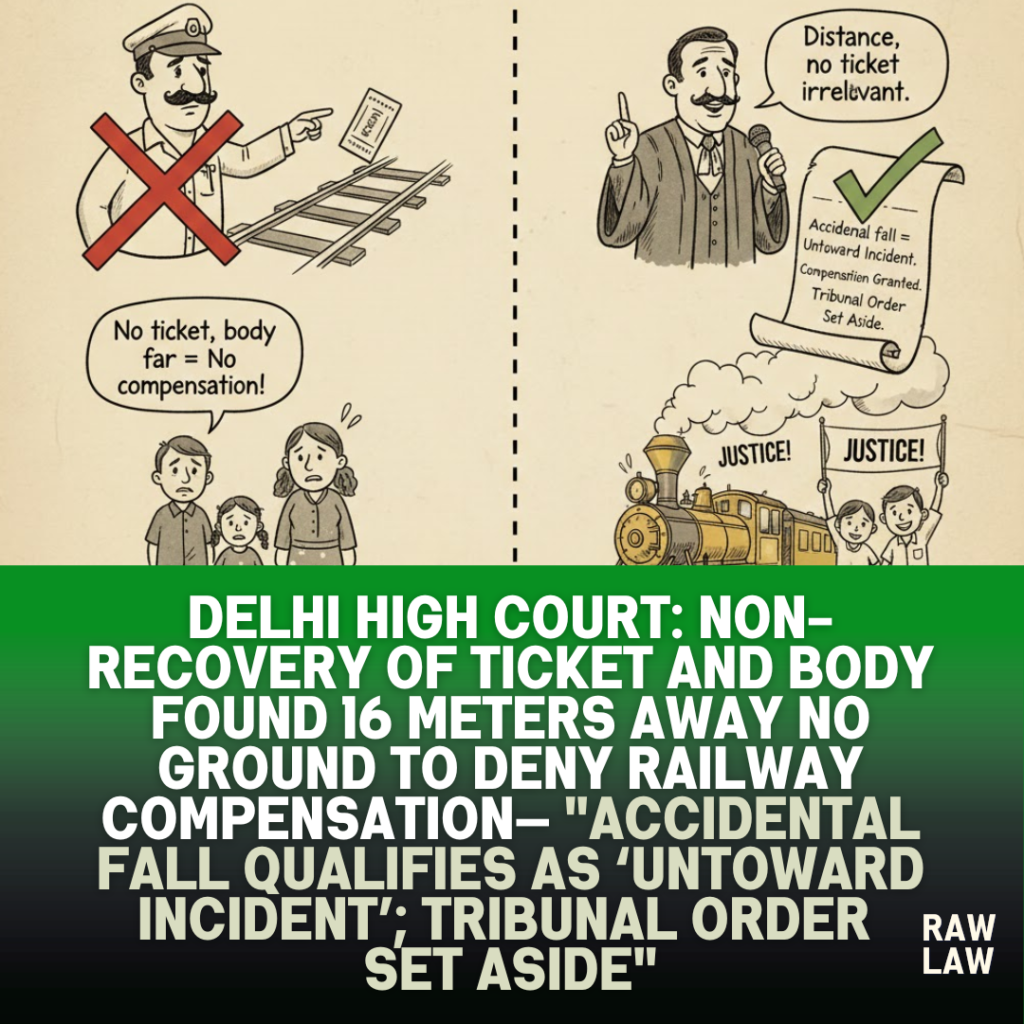
The Delhi High Court set aside the Railway Claims Tribunal’s order dismissing a compensation claim arising from a fatal fall from a running train. The Court held that mere non-recovery of the journey ticket during jamatalashi and the recovery of the body 16 meters away from the track are insufficient to deny compensation under Sections 123(c) and 124-A of the Railways Act, 1989.
Declaring that the Tribunal adopted a hyper-technical and speculative approach, the High Court remanded the matter for assessment and disbursement of compensation within two months.
Facts
The appellants, parents of the deceased, approached the Railway Claims Tribunal seeking compensation for the death of their son, who allegedly fell from Train No. 13258 (Jan Sadharan Express) on 12 February 2024 between Anand Vihar Terminal and Sahibabad Junction.
It was claimed that the deceased had purchased a valid journey ticket from Anand Vihar to Patna and, due to heavy crowding, was standing near the door when he was pushed following a sudden jerk, leading to an accidental fall.
The Tribunal dismissed the claim, holding that the appellants failed to establish that the deceased was a bona fide passenger or that the incident constituted an “untoward incident” under Section 123(c) of the Railways Act.
Issues
The primary issues before the High Court were:
- Whether the deceased was a bona fide passenger despite non-recovery of the ticket during jamatalashi.
- Whether the fall constituted an “untoward incident” under Section 123(c)(2) of the Railways Act.
- Whether the Tribunal erred in rejecting the claim based on speculative reasoning regarding the location of the body and nature of injuries.
Appellants’ arguments
The appellants contended that the deceased had purchased a valid ticket, which was subsequently produced and verified during the Divisional Railway Manager inquiry. They relied on the testimony of a co-passenger (AW-2), who deposed about assisting in ticket purchase and witnessing the fall.
They further relied on Call Detail Records showing that AW-2 informed the deceased’s employer immediately after the incident, corroborating his presence.
It was argued that the Tribunal wrongly relied on non-recovery of the ticket and speculative inferences about the body’s distance from the track. The appellants invoked the Supreme Court’s decision in Union of India v. Rina Devi to argue that absence of ticket recovery does not negate bona fide travel once initial burden is discharged.
Respondent’s arguments
The Union of India opposed the claim on two grounds. First, it argued that no valid ticket was recovered from the deceased during jamatalashi proceedings.
Second, it contended that the body was found 16 meters away from the track on which the train was running, rendering the theory of accidental fall improbable.
The respondent also relied on the Divisional Railway Manager report, which noted that the fall occurred due to the deceased’s negligence and that railway administration was not responsible.
Analysis of the law
The High Court examined Sections 123(c) and 124-A of the Railways Act, 1989. Under Section 124-A, railway liability in cases of “untoward incident” is strict and based on no-fault principle, subject only to limited statutory exceptions.
Relying on Union of India v. Rina Devi, the Court reiterated that non-recovery of ticket does not automatically defeat a claim. Once claimants present prima facie evidence, the burden shifts to the Railways.
The Court also invoked Union of India v. Prabhakaran Vijaya Kumar, which held that liability under Section 124-A is strict and fault of the victim is irrelevant unless covered by statutory exceptions.
The Tribunal’s reliance on speculative conclusions regarding body location was found inconsistent with settled precedent.
Precedent analysis
In Union of India v. Rina Devi (2019) 3 SCC 572, the Supreme Court held that absence of ticket recovery is not decisive and that initial burden can be discharged through affidavit and attending circumstances.
In Union of India v. Prabhakaran Vijaya Kumar (2008) 9 SCC 527, the Supreme Court clarified that Section 124-A embodies strict liability, and negligence of the victim does not bar compensation.
The High Court also relied on Union of India v. Leela Devi (2014 SCC OnLine Del 1440), where it was held that recovery of a body from a different track does not conclusively negate accidental fall.
Applying these principles, the Court held that the Tribunal erred in denying compensation.
Court’s reasoning
The Court noted that the journey ticket, though not recovered during jamatalashi, was subsequently produced and verified by railway authorities. The Divisional Railway Manager report confirmed its authenticity.
The testimony of AW-2 remained consistent regarding ticket purchase, boarding, and the fall. The Call Detail Records corroborated contemporaneous communication with the employer, strengthening credibility.
The Court rejected the Tribunal’s inference that recovery of the body 16 meters away made the fall impossible. It held that no expert or eyewitness evidence ruled out accidental fall and that multiple injuries recorded in post-mortem did not conclusively negate the claim.
The Court emphasized that hyper-technical scrutiny defeats the beneficial object of the Railways Act. In absence of proof of any exception under Section 124-A proviso, compensation cannot be denied.
Conclusion
The Delhi High Court allowed the appeal, set aside the Tribunal’s judgment dated 10 June 2025, and remanded the matter for assessment and disbursement of compensation within two months.
The Court held that the deceased was a bona fide passenger and victim of an “untoward incident” within Section 123(c)(2) of the Railways Act.
Implications
This ruling reinforces three critical principles in railway compensation law:
- Non-recovery of ticket is not fatal if bona fide travel is otherwise established.
- Liability under Section 124-A is strict and no-fault.
- Tribunals must avoid speculative or hyper-technical reasoning inconsistent with the beneficial nature of the statute.
The judgment strengthens victim-centric interpretation of railway accident claims and reiterates the liberal approach mandated in compensation jurisprudence.
Case law references
- Union of India v. Rina Devi (2019) 3 SCC 572
Held that absence of ticket recovery does not automatically defeat claim. - Union of India v. Prabhakaran Vijaya Kumar (2008) 9 SCC 527
Declared strict liability under Section 124-A; fault irrelevant. - Union of India v. Leela Devi (2014 SCC OnLine Del 1440)
Held that recovery of body from adjacent track does not negate accidental fall.
FAQs
1. Can railway compensation be denied if ticket is not recovered from the body?
No. Courts have held that non-recovery alone is insufficient if bona fide travel is otherwise established.
2. What is an ‘untoward incident’ under the Railways Act?
It includes accidental fall from a train carrying passengers under Section 123(c)(2).
3. Is negligence of passenger relevant under Section 124-A?
Generally no. Liability is strict unless the case falls under specific statutory exceptions.


