

Court’s decision
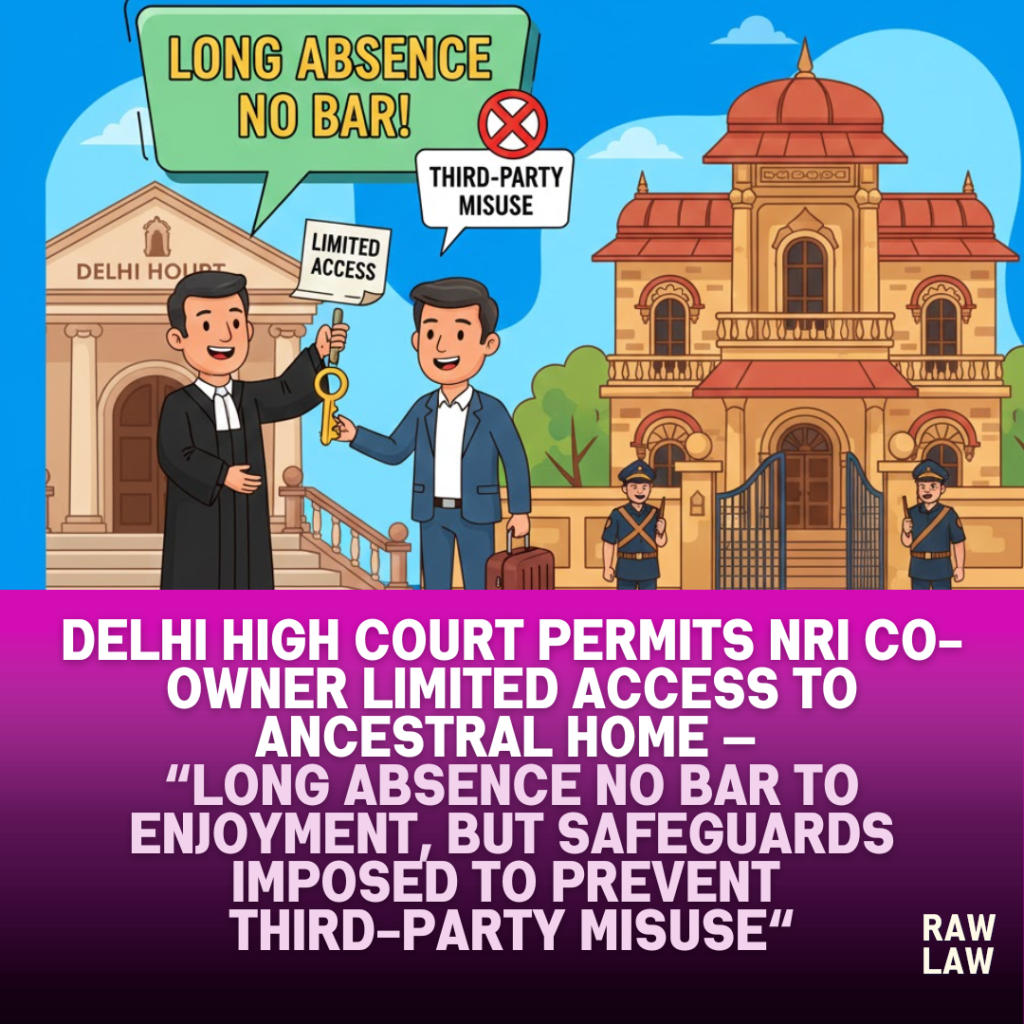
The Delhi High Court allowed an interim application in a long-pending partition suit and permitted an elderly non-resident Indian co-owner to access and use a specific room in the ancestral property, holding that mere long residence abroad does not extinguish co-ownership rights. While protecting the plaintiff’s right to enjoyment of the suit property, the Court simultaneously imposed safeguards to ensure that the interim arrangement is not misused to induct third parties or disturb existing occupants. The application seeking interim protection was disposed of with calibrated relief.
Court’s decision
Justice Subramonium Prasad permitted the plaintiff to access the ground-floor room marked in red in the site plan of the suit property, noting that an earlier status quo order on title and possession continued to operate. However, the Court restricted the plaintiff from allowing any other person to occupy the room in his absence and clarified that access would be limited to the plaintiff and his immediate family during his stay in Delhi.
Facts
The suit concerns an ancestral property at Nizamuddin East, New Delhi, originally held by the father of the parties under a perpetual lease and later conveyed by the Land & Development Office. After his death in 2001, disputes arose among siblings regarding partition and possession. The plaintiff, a Swedish citizen aged around 75 years, claimed a one-seventh share and asserted that the property had never been partitioned. He alleged that whenever he visited India, he was allowed to stay on the ground floor, but relations deteriorated over time, leading to obstruction of his access. He also pointed to criminal proceedings where one defendant was convicted for forging documents to mutate the property.
Issues
The principal issue before the Court was whether the plaintiff, despite residing abroad for decades, could be granted interim access to a specific portion of the suit property during pendency of the partition suit. A related issue was how to balance the plaintiff’s claimed co-ownership rights with the concerns of other occupants about disturbance, nuisance, or possible misuse of interim orders to induct third parties.
Plaintiff’s arguments
The plaintiff argued that he remained a co-owner of the suit property and that a subsisting status quo order protected his right to possession. He submitted that denial of access during his visits amounted to unlawful ouster and was part of a concerted attempt by siblings to deprive him of his rightful share. Emphasising his advanced age and lack of alternative accommodation in Delhi, he sought an injunction restraining the defendants from obstructing his entry and use of the ground-floor room historically occupied by him.
Defendants’ arguments
The defendants opposed the application, contending that the plaintiff had lived in Sweden for over 45 years and had no settled possession in India. They relied on an alleged Will of the father claiming exclusive bequest of the ground floor to one sibling and argued that the plaintiff’s intermittent visits did not confer any possessory right. It was also contended that the application was an abuse of process intended to harass the defendants and that the plaintiff might allow outsiders to occupy the premises, causing nuisance and security concerns.
Analysis of the law
The Court analysed interim injunction principles under Order XXXIX of the Code of Civil Procedure, focusing on preservation of property and prevention of irreparable harm. It reiterated that co-ownership rights do not get extinguished merely because a co-owner resides abroad for long periods. At the same time, interim relief must be moulded to prevent misuse and to ensure that status quo orders do not become instruments for altering possession or introducing new elements into a disputed property during pendency of litigation.
Precedent analysis
While the Court did not engage in an extensive precedent discussion, it relied on settled principles that interim orders in partition suits are meant to preserve peace and balance equities. The Court also took judicial notice of prior criminal proceedings involving forged mutation documents, which cast doubt on claims of exclusive ownership set up by the defendants. These circumstances justified cautious but meaningful protection of the plaintiff’s access rights pending trial.
Court’s reasoning
The Court noted that a status quo order on title and possession had been operating since 2019 and had not been varied. It found that the site plan showed the disputed room had a separate entrance and facilities, meaning the plaintiff’s access would not interfere with other occupants. At the same time, considering police complaints and the fact that the plaintiff resided abroad, the Court accepted that unrestricted access could lead to misuse. Balancing these considerations, the Court allowed limited access strictly for the plaintiff and his immediate family during his stay in Delhi, barring third-party occupation.
Conclusion
The Delhi High Court disposed of the interim application by permitting the plaintiff to access and use the designated ground-floor room of the suit property, subject to clear restrictions. It declined to grant an unqualified injunction but crafted a tailored arrangement that protects co-ownership rights while maintaining peace among family members. The suit and connected applications were directed to proceed before the Joint Registrar.
Implications
This decision underscores that non-resident status or long absence does not dilute proprietary or co-ownership rights in ancestral property. At the same time, it highlights the court’s role in carefully structuring interim relief to prevent escalation of family property disputes. For NRIs involved in partition litigation, the ruling affirms access rights while signalling that courts will impose safeguards against misuse of interim orders.
Case law references
- Co-ownership and possession: A co-owner’s rights are not lost merely due to residence abroad. Applied to allow limited access.
- Interim relief in partition suits: Courts must balance equities and preserve peace without altering substantive rights. Applied to restrict third-party use.
- Effect of prior criminal findings: Conviction relating to forged mutation documents weighed against claims of exclusive ownership. Applied contextually.
FAQs
1. Can an NRI co-owner be denied access to ancestral property?
No. Long residence abroad does not extinguish co-ownership rights, though courts may regulate access through interim conditions.
2. Can interim orders allow use of part of disputed property?
Yes. Courts can permit limited access to preserve rights while ensuring no disturbance or misuse during pendency of the suit.
3. Can a co-owner allow others to occupy the property under interim relief?
Generally no. Courts often prohibit induction of third parties to maintain status quo and prevent complications.


