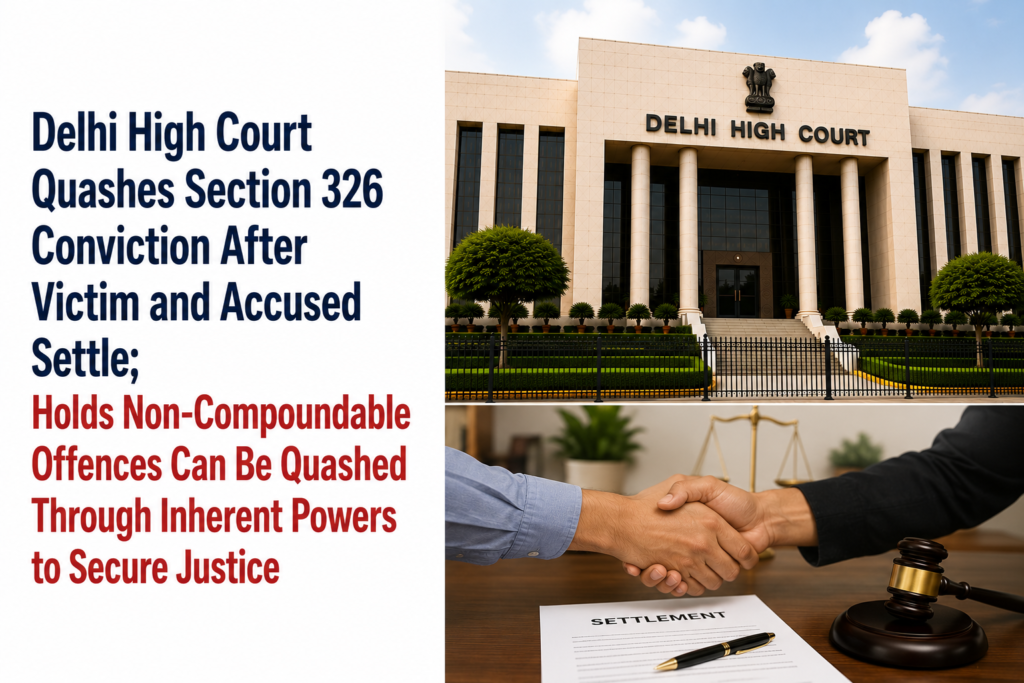
Delhi High Court Quashes Section 326 Conviction After Victim and Accused Settle; Holds Non-Compoundable Offences Can Be Quashed Through Inherent Powers to Secure Justice

Delhi High Court Sets Aside Grievous Hurt Conviction After Post-Trial Compromise; Holds High Court May Quash Non-Compoundable Cases Where Justice Requires
Facts
The Delhi High Court considered a criminal appeal filed by Pradeep, the sole accused in Sessions Case No. 534/1/2013, challenging his conviction and sentence under Section 326 IPC.
The prosecution case arose from an incident on 27 July 2012 at about 5:00 PM. The injured witness, PW2, was walking through Gali No. 4, Vishnu Garden while speaking on his mobile phone. Pradeep allegedly asked him to disconnect the call. When PW2 refused, Pradeep abused and assaulted him and then attacked him twice on the head with a sharp-edged object, causing bleeding injuries.
The Trial Court initially framed a charge under Section 308 IPC. After evaluating the evidence, however, it concluded that the prosecution had failed to establish the intention or knowledge necessary for Section 308. It nevertheless found beyond reasonable doubt that Pradeep had caused grievous hurt using a dangerous weapon, attracting Section 326 IPC.
By judgment dated 30 November 2015, Pradeep was convicted under Section 326 IPC. On 16 December 2015, he was sentenced to three years’ rigorous imprisonment and a fine of ₹60,000, with six months’ simple imprisonment in default of payment.
During the pendency of his appeal, Pradeep moved an application under Section 528 BNSS, 2023, seeking quashing of the proceedings on the basis of a settlement with PW2. The victim filed an affidavit dated 20 July 2026 recording his consent and no-objection, and the parties also executed a settlement deed on the same date.
PW2 personally appeared before the High Court and confirmed that he and Pradeep, who were neighbours, had amicably resolved their dispute. Their families were living peacefully in the same locality, and he did not wish to pursue the proceedings further.
Issues
The principal issues before the High Court were:
- Whether a conviction for Section 326 IPC, a non-compoundable offence, could nevertheless be quashed on the basis of a settlement between the accused and victim.
- Whether the High Court’s inherent jurisdiction to quash criminal proceedings is distinct from the statutory power of compounding under Section 320 CrPC.
- Whether inherent powers can be exercised after conviction and during the pendency of an appeal.
- Whether the settlement between Pradeep and PW2 was voluntary and genuine.
- Whether continuing the criminal proceedings despite reconciliation would serve the ends of justice or instead become purposeless.
Appellant’s Arguments
The appellant relied principally upon the settlement reached with PW2 during the pendency of the appeal.
He submitted that the victim had voluntarily resolved the dispute, had executed a settlement deed and had filed an affidavit expressly recording his consent and no-objection to termination of the criminal proceedings.
The appellant therefore sought exercise of the High Court’s inherent jurisdiction to bring the prosecution to an end despite the fact that Section 326 IPC is statutorily non-compoundable.
Respondent’s Position
The judgment does not record any substantive opposition by the State challenging the genuineness of the compromise.
The Court instead focused upon satisfying itself independently about the voluntariness and consequences of the settlement.
It personally interacted with PW2, explained the consequences of settlement to him and confirmed that he genuinely did not wish to continue the proceedings against Pradeep.
Analysis of the Law
Compounding and Quashing Are Distinct Powers
The High Court reiterated the settled distinction between:
statutory compounding under Section 320 CrPC, and
exercise of the High Court’s inherent power to quash criminal proceedings.
The latter is considerably wider and is directed towards two principal purposes:
- securing the ends of justice; and
- preventing abuse of the process of Court.
Therefore, the mere fact that an offence cannot formally be compounded under Section 320 does not automatically prevent the High Court from quashing the proceedings in an appropriate case.
Non-Compoundable Offence Can Still Be Quashed
The Court expressly acknowledged that Section 326 IPC is non-compoundable.
Nevertheless, it held that the High Court may exercise its inherent powers to accept a compromise and quash proceedings even in relation to a non-compoundable offence.
The decisive consideration is whether the ends of justice justify exercise of the inherent power, even though the ultimate consequence may be acquittal or termination of the indictment.
This makes the decision significant because the compromise was accepted after conviction, while the criminal appeal was pending.
Limits on Compromise-Based Quashing
The Court did not hold that every non-compoundable offence can be quashed following settlement.
It reiterated that inherent jurisdiction should ordinarily not be exercised for heinous and serious offences involving mental depravity, such as:
- murder;
- rape; and
- dacoity.
Such offences have a serious societal impact and cannot ordinarily be treated merely as private disputes between the victim and offender.
By contrast, offences overwhelmingly possessing a private or personal character may justify quashing where the parties have genuinely resolved their entire dispute and continuation of prosecution would be contrary to the interests of justice.
Voluntary Settlement Verified by Court
The Court did not rely merely upon the settlement deed and affidavit.
PW2 appeared personally before the Bench.
The Court interacted with him, explained the consequences of the settlement and specifically confirmed whether he voluntarily wished to terminate the prosecution.
PW2 unequivocally reiterated that:
- the dispute had been amicably resolved;
- Pradeep was his neighbour;
- their families were living peacefully;
- he did not wish to continue the case; and
- he had no objection to termination of the proceedings.
This verification was central to the Court’s satisfaction that the settlement was genuine.
Precedent Analysis
Gian Singh v. State of Punjab, (2012) 10 SCC 303
The Court relied upon Gian Singh for the foundational distinction between the High Court’s inherent jurisdiction and statutory compounding.
The Supreme Court recognised that the inherent power is wider than Section 320 CrPC and may be exercised to quash even non-compoundable offences where the factual circumstances and interests of justice justify doing so.
At the same time, Gian Singh cautions against compromise-based quashing in heinous offences having serious societal impact.
State of Madhya Pradesh v. Laxmi Narayan, (2019) 5 SCC 688
The Court relied upon Laxmi Narayan as part of the settled jurisprudence governing compromise-based quashing.
The decision reinforces that the High Court must consider the nature and gravity of the offence and cannot mechanically quash serious crimes merely because the parties have reached a settlement.
Ramgopal v. State of Madhya Pradesh
This authority is particularly relevant to the post-conviction context.
The Court cited Ramgopal while applying the principle that the High Court’s inherent jurisdiction may, in appropriate circumstances, be exercised where the parties genuinely settle their dispute even after the criminal proceedings have substantially progressed.
Daxaben v. State of Gujarat
The Court also relied upon Daxaben as part of the Supreme Court jurisprudence regulating the exercise of inherent powers where a settlement is invoked to terminate criminal proceedings.
The combined effect of these precedents is that settlement is relevant but not automatically decisive. The High Court must independently evaluate the offence, its societal impact, the genuineness of the compromise and whether continuation of proceedings would serve any meaningful purpose.
Court’s Reasoning
The High Court considered the circumstances of this particular case rather than treating the non-compoundable nature of Section 326 IPC as an absolute prohibition.
The incident arose from an altercation between two individuals who were neighbours.
Years had passed since the 2012 incident.
During the appeal, the victim and accused voluntarily settled their differences, and their families were presently residing peacefully in the same locality.
Most importantly, the victim personally appeared before the High Court and unequivocally confirmed that he did not wish to continue the proceedings.
In these circumstances, the Court concluded that “no purpose would be served” by continuing the matter and that bringing the proceedings to an end would serve the interests of justice.
Conclusion
The Delhi High Court held that although Section 326 IPC is a non-compoundable offence, that statutory restriction does not eliminate the High Court’s inherent power to quash criminal proceedings on the basis of a genuine settlement in an appropriate case.
Considering the voluntary settlement, the victim’s personal confirmation before the Court and the peaceful relationship between the neighbouring families, the Court concluded that continuation of the prosecution would serve no useful purpose.
Accordingly, the High Court quashed both the conviction and sentence imposed upon Pradeep in Sessions Case No. 534/1/2013 by the judgment dated 30 November 2015 and sentencing order dated 16 December 2015. The appeal was disposed of accordingly.
Case Details
Case: Pradeep v. The State
Court: High Court of Delhi at New Delhi
Case Number: CRL.A. 43/2016 & CRL.M.A. 22553/2026; CNR No. DLHC010118072016
Judge: Justice Chandrasekharan Sudha
Date: 13 August 2026
Result: Appeal disposed of; conviction under Section 326 IPC and sentence of three years’ rigorous imprisonment with ₹60,000 fine quashed on the basis of the parties’ settlement