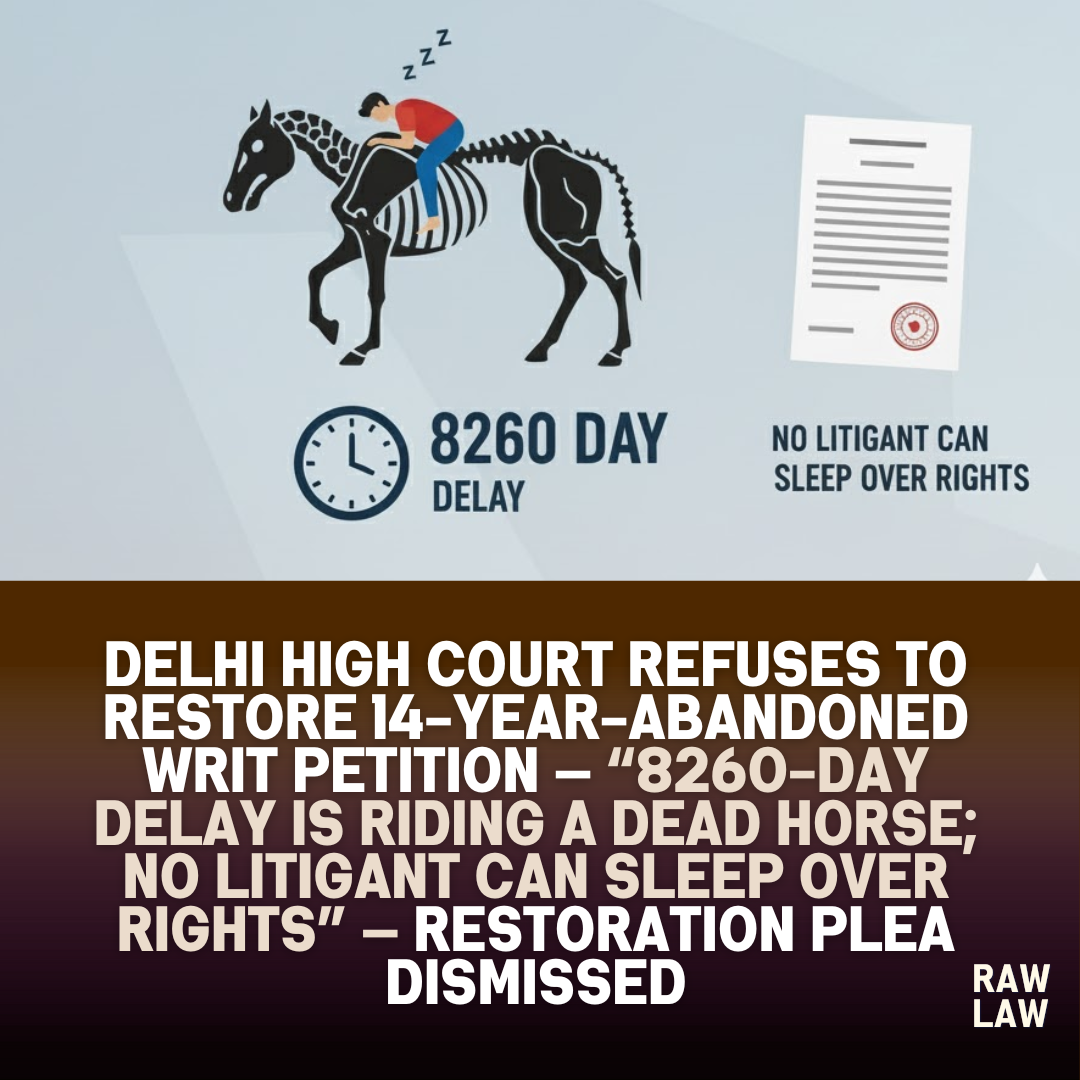
Delhi High Court refuses to restore 14-year-abandoned writ petition — “8260-day delay is riding a dead horse; no litigant can sleep over rights” — restoration plea dismissed

1. Court’s decision
The Delhi High Court dismissed an application seeking condonation of 8260 days (over 22 years) of delay in moving for restoration of a writ petition originally filed in 1997 and dismissed for non-prosecution in 2011. The Court held that the petitioner had shown no explanation for abandoning the case for nearly a decade before dismissal and then for an additional 14 years thereafter.
Condemning such extreme negligence, the Court described the restoration attempt as “a desperate attempt like riding on dead horses,” finding that allowing such applications would encourage litigants to take courts for granted. As a result, both the application for condonation of delay and the accompanying restoration application were dismissed.
2. Facts
The petitioner, a CISF Constable, was assigned IS duty at the residence of a Member of Parliament. On 7 March 1996, he allegedly abandoned his duty post without permission and left the Self Loading Rifle (SLR) issued to him unattended.
Believing he had gone to his village, the unit sent a call-up notice by registered post, which returned with remarks such as “Receiver went to Madrasa” and “Receiver not in village.” He returned to the unit only on 16 June 1996, after more than three months of unauthorized absence.
On 24 June 1996, a chargesheet was issued for (i) unauthorized absence and (ii) leaving the SLR unattended. The chargesheet mentioned that his past misconduct—multiple earlier instances of absence, including eight episodes of overstaying leave—would be considered for penalty.
An inquiry was conducted: five prosecution witnesses and one court witness were examined. The Inquiry Officer found the charges proved on 28 March 1997. After considering the petitioner’s reply dated 15 May 1997, the Commandant imposed removal from service on 17 June 1997. His departmental appeal was rejected on 2 September 1997.
The petitioner filed a writ petition in 1997 challenging his dismissal. Thereafter, he went entirely silent. The record showed that after filing two applications for early hearing in 2000 and 2001, the petitioner took no steps, did not contact counsel, and did not inquire about the status of his case. In 2011, the Court dismissed the writ petition for default when neither he nor his counsel appeared.
After remaining dormant for another 14 years, he resurfaced in 2025 with an application seeking restoration as well as condonation of 8260 days’ delay.
3. Issues
- Whether a writ petition dismissed for non-prosecution after long neglect can be restored after an unexplained delay of 8260 days.
- Whether the petitioner’s reasons for delay constitute “sufficient cause” under law.
- Whether equitable principles or sympathetic considerations can override extreme laches.
- Whether courts must protect the judicial process from abuse by litigants who abandon and later revive stale claims.
4. Petitioner’s arguments
The petitioner claimed he was unable to pursue the writ petition due to reasons of personal difficulty, health issues, and inability to remain in contact with his advocate. He attempted to justify the gap between 2011 and 2025 by stating that he was unaware of the dismissal of his writ petition and discovered it only recently, after which he took immediate steps to seek restoration.
He argued that his termination was harsh and that he had meritorious grounds to challenge the disciplinary action. He sought condonation on sympathetic grounds, asserting that he should not be penalized for procedural lapses.
5. Respondents’ arguments
The CISF contended that the petitioner’s application was entirely devoid of bona fides. He had offered no credible explanation for a 22-year delay, nor accounted for the nearly decade-long silence preceding the 2011 dismissal.
They emphasized the seriousness of the misconduct—unauthorized absence for more than three months, leaving a loaded SLR unattended, and documented history of similar past conduct. Restoration after such an enormous gap would undermine discipline in armed forces and set an unhealthy precedent. The respondents argued that the High Court should not reward egregious negligence.
6. Analysis of the law
The Court focused on the doctrine of laches, the requirement of sufficient cause, and the need to protect judicial efficiency.
(a) Standard for condonation: strict and exceptional
Condonation of delay is permitted only where sufficient cause is shown. Courts evaluate whether:
• the applicant acted with reasonable diligence,
• the cause was beyond the applicant’s control, and
• the delay does not defeat justice.
Here, the petitioner remained inactive for 14 years after dismissal and for nearly 26 years after initial filing—an extreme lapse impossible to justify.
(b) Litigant responsibility cannot be abdicated
The Court highlighted that the petitioner filed early hearing applications in 2000 and 2001 but never followed up thereafter—proving that he consciously abandoned the case.
The Court found no material to show:
• efforts to contact counsel,
• attempts to verify case status, or
• any obstacle preventing him from approaching the court earlier.
(c) Sympathy cannot override procedural discipline
The Court emphasised that misplaced sympathy would erode the integrity of judicial process:
“If applications like the present are allowed being swayed by unwarranted sympathetic consideration, litigants will start taking the courts for granted.”
(d) Delay of 8260 days is extraordinary and fatal
The Court termed the effort to revive the writ petition:
“…a desperate attempt like riding on dead horses.”
Such inordinate delay defeats even the concept of continuing cause.
(e) No arguable case shown even on merits
The Court noted that the petitioner’s disciplinary record reflected multiple prior absences. His defence theory—claiming illness and inability to communicate—was unsupported by documents and inconsistent with his recorded past behaviour.
7. Precedent analysis
Although the judgment does not cite case law, its reasoning aligns with well-established judicial principles:
1. Doctrine of laches
Courts routinely deny relief where litigants sleep over their rights for long periods without justification.
2. “Sufficient cause” under limitation jurisprudence
Only bona fide, unavoidable delays may be condoned; negligence, apathy, or carelessness is insufficient.
3. Abuse of process
Attempts to resurrect abandoned litigation after decades are considered detrimental to judicial efficiency.
4. Strict approach in service matters
In disciplined forces, courts adopt a stricter approach to timeliness and conduct.
These principles fully supported the Court’s dismissal.
8. Court’s reasoning
Summarising, the Court held:
• The petitioner abandoned his case for decades without explanation.
• No material demonstrated obstacles preventing timely action.
• Sympathy cannot legitimise indolence.
• Delay of 8260 days is legally irredeemable.
• Allowing the application would set a damaging precedent.
Consequently, the delay-condonation application was dismissed, and with it, the restoration application.
9. Conclusion
The High Court dismissed both applications:
• CM APPL. 8481/2025 (delay condonation)
• CM APPL. 8480/2025 (restoration)
The writ petition—dismissed in 2011—remains closed permanently.
10. Implications
This decision reinforces that:
• Courts will adopt a zero-tolerance approach toward unexplained, colossal delays.
• Litigants have a continuing duty to monitor their cases.
• Restoration after multiple decades is nearly impossible unless extraordinary reasons are shown.
• Judicial sympathy cannot condone procedural abuse.
• Members of disciplined forces face heightened scrutiny regarding misconduct and litigation delays.
The ruling serves as a stern warning against negligence in pursuing legal remedies.
CASE LAW REFERENCES
1. Doctrine of laches
Courts can decline relief where litigants sleep over rights for an unreasonable time.
2. “Sufficient cause” test for condonation
Negligence, apathy, or unexplained delay is fatal.
3. Judicial discipline and finality of litigation
Restoration is not a matter of right; excessive delay is rarely condoned.
FAQs
1. Can a writ petition dismissed 14 years ago be restored?
No. Courts require strict explanation for delay; unexplained delays of this magnitude are fatal.
2. What amounts to “sufficient cause” for delay condonation?
A cause must be genuine, unavoidable, and supported by evidence—not negligence or inaction.
3. Does sympathy influence decisions in delay condonation?
No. Courts caution that misplaced sympathy encourages abuse of process and cannot override procedural rules.