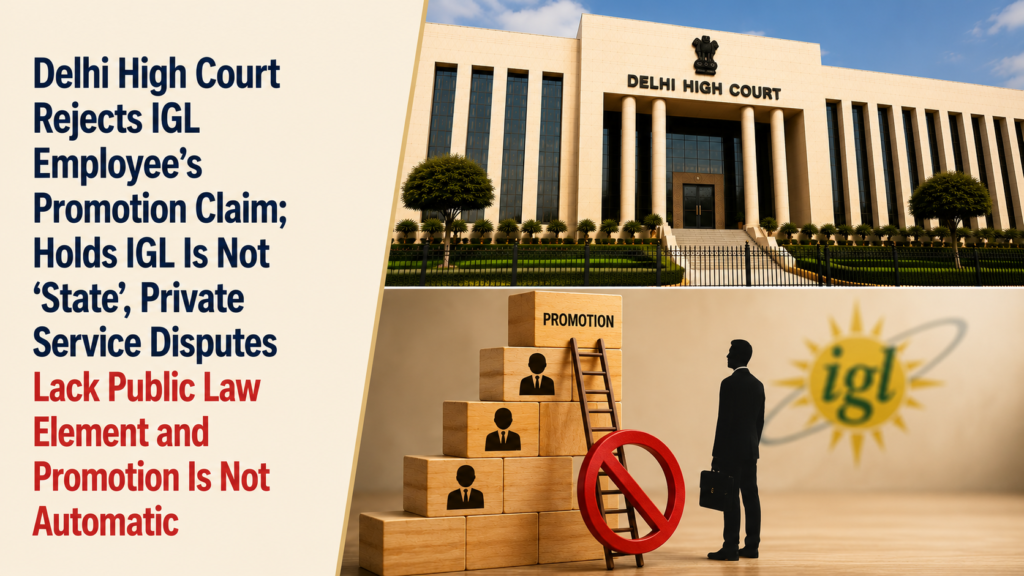
Delhi High Court Rejects IGL Employee’s Promotion Claim; Holds IGL Is Not ‘State’, Private Service Disputes Lack Public Law Element and Promotion Is Not Automatic

Delhi High Court Dismisses Deputy Manager’s Claim for Additional Manager, Manager and Chief Manager Posts; Says IGL Promotions Are Performance-Based and Non-Time-Bound
Facts
The appeal was filed by Rahul Mani, a Deputy Manager with Indraprastha Gas Limited (IGL), challenging the dismissal of his writ petition seeking retrospective promotions to the posts of Additional Manager, Manager and Chief Manager. The Division Bench consisted of the Chief Justice and Justice Tejas Karia.
The appellant had joined IGL as a Graduate Engineer Trainee in 2008 and was promoted to Deputy Manager in 2009. He claimed that, having completed the eligibility period prescribed under IGL’s Promotion Policy, he ought to have been promoted as Additional Manager with effect from 26 February 2012, Manager from 26 February 2015 and Chief Manager from 26 February 2018.
He made a representation to IGL on 26 April 2017, which was rejected on 26 May 2017. IGL stated that promotion was not automatic and depended upon minimum service, functional effectiveness and suitability. It further cited alleged shortcomings in the appellant’s work, including absenteeism, misconduct, casual approach to assignments and behavioural concerns despite warnings and counselling.
The learned Single Judge dismissed the underlying writ petition on 6 February 2026, principally holding that IGL was not “State” under Article 12 and that the service-related promotion dispute lacked the public law element necessary to sustain a writ against a non-State entity.
Rahul Mani challenged that decision through the present Letters Patent Appeal.
Issues
The Division Bench considered:
- Whether IGL is “State” within the meaning of Article 12 of the Constitution.
- Even if IGL performs public functions, whether an employee’s internal promotion dispute can be adjudicated under Article 226.
- Whether the claim was barred by delay and laches.
- Whether completion of the minimum eligibility period under IGL’s Promotion Policy conferred an enforceable or automatic right to promotion.
- Whether the appellant’s performance record justified refusal of promotion.
Appellant’s Arguments
The appellant argued that IGL was effectively a Government-controlled joint venture performing an important public function by supplying CNG and PNG.
He therefore submitted that IGL ought to be regarded as “State” under Article 12 or, in any event, amenable to writ jurisdiction under Article 226 because of the public character of its activities.
On merits, he contended that he had fulfilled the qualifying service prescribed under the Promotion Policy and that denial of promotion was arbitrary.
He also sought to overcome the delay objection by pointing out that he had earlier filed another writ petition in 2017, which was withdrawn in January 2019 with liberty to file a fresh petition.
Respondents’ Arguments
IGL challenged maintainability at the threshold.
It pointed out that:
- 50% of its shareholding was public;
- 22.5% each was held by GAIL and BPCL;
- only 5% was held by the Government of NCT of Delhi;
- it received no Government grants or aid;
- it was financially independent; and
- it was not under administrative, functional or financial Government control.
On merits, IGL relied on its Promotion Policy, which made promotion dependent not merely upon length of service but also upon performance, vacancies, functional suitability and business requirements.
It further relied on the appellant’s performance assessments, which included ratings such as “Needs Improvement” and “Does Not Meet Expectation” across several appraisal cycles.
Analysis of the Law
IGL Is Not “State” Under Article 12
The Court relied substantially upon the Supreme Court’s decision in Indian Council of Social Science Research v. Neetu Gaur.
The relevant test is whether the Government exercises “deep and pervasive” control over the entity.
Mere financing, regulation or guidance is insufficient. The control must extend to administrative, financial and functional affairs to a much higher degree, including substantial interference in day-to-day functioning.
The Court found no such control over IGL.
IGL did not receive Government grants or budgetary support, operated through its own resources, distributed profits to shareholders and functioned through a Board comprising nominee and independent directors in accordance with norms applicable to a listed company.
The appellant had also failed to produce any material showing deep and pervasive Government control.
The Division Bench therefore agreed with the Single Judge that IGL is not “State” under Article 12.
Article 226 Can Reach Non-State Bodies, But Only for Public Law Functions
The Court nevertheless clarified that an entity need not necessarily be “State” under Article 12 to be amenable to Article 226.
A private or non-State body performing a public function or public duty can, in appropriate circumstances, be subjected to writ jurisdiction.
However, what matters is the nature of the particular dispute.
If the dispute does not contain a public law element, Article 226 cannot be invoked merely because the entity performs some public functions in other contexts.
Promotion Dispute Was Purely Private
The appellant’s claim concerned his internal advancement from Deputy Manager to:
- Additional Manager;
- Manager; and
- Chief Manager.
The Court held that such an employment dispute did not lie in the realm of public law.
The fact that IGL supplies CNG and PNG to the public did not convert every internal HR or service decision into public law action.
The dispute arose from the appellant’s private contract of employment and non-statutory service conditions.
Precedent Analysis
Indian Council of Social Science Research v. Neetu Gaur
This recent Supreme Court judgment governed the Article 12 issue.
It clarified that “deep and pervasive” Government control requires much more than financing, regulation or occasional influence. There must be substantial administrative, financial and functional control, including interference with the entity’s day-to-day operations.
Applying that standard, IGL could not be treated as “State.”
St. Mary’s Education Society v. Rajendra Prasad Bhargava
This was central to the Article 226 maintainability issue.
The Supreme Court held that even where a private body performs public functions, every dispute involving that body is not automatically amenable to writ jurisdiction.
The right sought to be enforced must itself possess a public law character.
Individual service disputes, breaches of private employment contracts and non-statutory service conditions ordinarily remain in the realm of private law.
The Supreme Court further clarified that employees of a body performing public functions cannot ordinarily invoke Article 226 concerning service matters where their service conditions are not governed by statutory provisions.
The Division Bench expressly agreed with the Single Judge that the appellant’s private promotion rights could not be enforced under Article 226 merely by invoking IGL’s broader public functions.
Delay and Laches
The Court independently upheld dismissal on the ground of delay.
According to the appellant’s own case:
- promotion as Additional Manager became due in 2012;
- promotion as Manager became due in 2015; and
- promotion as Chief Manager became due in 2018.
Yet the underlying writ petition was instituted in 2019.
The claim for the first two promotions was therefore brought after approximately seven years and four years respectively.
Even the earlier writ filed in 2017 did not explain the delay preceding it.
The Court consequently held that the Single Judge had correctly non-suited the appellant on delay and laches as well.
No Automatic Right to Promotion
Even on merits, the appellant failed.
Clause 4(C) of IGL’s Promotion Policy prescribed a three-year minimum eligibility period for advancement to each of the relevant posts.
However, the Court emphasised that eligibility is only a threshold for consideration; it does not confer a right to promotion.
Clause 6 provided that promotion would depend upon:
- vacancies;
- performance; and
- business requirements.
Clause 12 further expressly stated that promotions were not time-bound and that completion of the minimum eligibility period did not create automatic entitlement even to consideration in every case; promotions remained subject to management discretion under the policy.
Performance Record
IGL’s case was that the appellant failed to satisfy the performance benchmarks necessary for promotion.
Its Performance Management System involved annual and mid-year reviews and Key Result Areas.
The appellant had allegedly received ratings such as “Needs Improvement” and “Does Not Meet Expectation” in several appraisal periods between 2010–11 and 2018–19.
The Division Bench therefore agreed with the Single Judge that the appellant could not establish an entitlement to promotion merely because he had completed the stipulated minimum years in the grade.
Court’s Reasoning
The Court upheld the impugned judgment on three independent grounds.
First, IGL was not “State” under Article 12 because there was no deep and pervasive Government control.
Second, even assuming IGL was amenable to Article 226 in relation to certain public functions, the appellant’s promotion dispute was a private service matter with no public law element.
Third, the petition suffered from substantial unexplained delay.
And even if those threshold objections were ignored, the appellant failed on merits because IGL’s Promotion Policy made clear that promotion was neither automatic nor time-bound and depended upon performance, vacancies and business needs.
Conclusion
The Delhi High Court held that the Single Judge had correctly dismissed Rahul Mani’s writ petition.
The Division Bench found no ground to interfere either on maintainability, delay or the merits of the promotion claim.
Accordingly, the Letters Patent Appeal was dismissed along with all pending applications, with no order as to costs.
Case Details
Case: Rahul Mani v. Union of India & Ors.
Court: High Court of Delhi at New Delhi
Case Number: LPA 146/2026 & CM APPL. 17561/2026; CNR No. DLHC010108972026
Judges: Chief Justice Devendra Kumar Upadhyaya and Justice Tejas Karia
Date: 13 August 2026
Result: Appeal dismissed; IGL held not to be “State” under Article 12, promotion dispute held non-maintainable under Article 226, and claim also rejected on delay and merits.