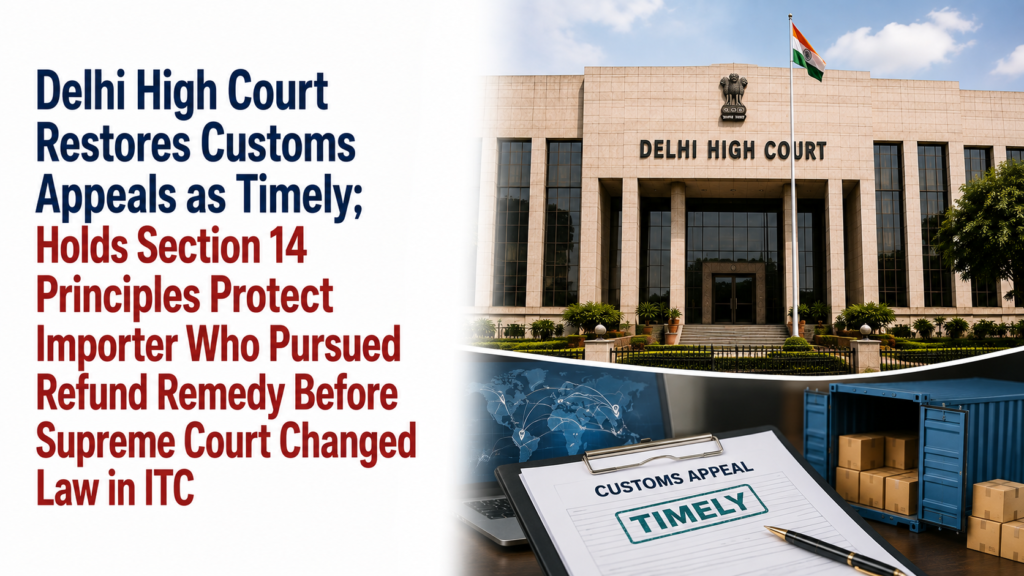
Delhi High Court Restores Customs Appeals as Timely; Holds Section 14 Principles Protect Importer Who Pursued Refund Remedy Before Supreme Court Changed Law in ITC

Delhi High Court Allows 15 Customs Appeals Against Limitation Dismissals; Remands Fourteen to Commissioner and One to CESTAT for Merits Decision
Facts
The Delhi High Court decided a batch of 15 customs appeals filed by Senior India Pvt. Ltd. under Section 130 of the Customs Act, 1962. Fourteen appeals arose from CESTAT Final Order Nos. 59757–59770/2024 dated 13 November 2024, as later modified, while CUSAA 75/2026 arose from another CESTAT order dated 7 January 2026.
The controversy originated from the classification of pressure relief valves imported by the appellant. The goods had earlier been cleared under CTI 8481 40 00. From September 2018, the appellant declared them under CTI 8409 99 41 and paid duty at a higher rate, allegedly on insistence of Customs. Fourteen Bills of Entry were assessed between September 2018 and February 2019, with two further Bills of Entry filed in March and May 2019.
At that time, Delhi High Court judgments in Aman Medical Products Ltd. v. Commissioner of Customs and Micromax Informatics Ltd. v. Union of India permitted an importer to pursue a refund claim under Section 27 without first challenging the assessment in appeal. Acting on that prevailing jurisdictional law, Senior India filed refund applications on 26 August 2019.
On 18 September 2019, however, the Supreme Court in ITC Limited v. Commissioner of Central Excise held that a refund could not be granted unless the underlying assessment or self-assessment was first modified through an appeal under Section 128 or another statutory mechanism.
Within six days of ITC, Senior India filed an application under Section 149 of the Customs Act seeking amendment of the Bills of Entry and asked that the refund proceedings be kept in abeyance.
The Refund Authority later rejected one refund claim as premature for want of reassessed Bills of Entry. Senior India then filed appeals under Section 128 on 31 August 2020 and sought exclusion of the period spent pursuing the refund remedy on principles underlying Section 14 of the Limitation Act, 1963. The Commissioner (Appeals) rejected the appeals as time-barred, and CESTAT ultimately sustained that result.
Issues
The principal substantial question of law was:
Whether the authorities below were justified in denying Senior India the benefit of the principles underlying Section 14 of the Limitation Act after the Supreme Court’s decision in ITC Limited changed the procedural route for obtaining customs refunds.
A separate issue arose in CUSAA 28/2026: whether CESTAT could dismiss Customs Appeal No. 52100/2022 as time-barred when the underlying first appeal had itself been filed within the statutory period prescribed under Section 128.
Appellant’s Arguments
Senior India argued that it had acted throughout with due diligence and bona fides.
When it filed its refund claims on 26 August 2019, the binding Delhi High Court law permitted a refund under Section 27 without first challenging the Bill of Entry assessment. The appellant therefore pursued a remedy that was legally available and recognised at that time.
Once the Supreme Court altered the legal position in ITC Limited, Senior India acted promptly, filing its Section 149 application within six days and requesting that the pending refund process be held in abeyance.
Accordingly, the period spent pursuing the refund route should not be treated as ordinary delay or inaction. The appellant sought protection under the principles underlying Section 14 of the Limitation Act.
It also pointed out factual errors in the orders below, including the Commissioner’s mistaken assumption that one of the refund applications related only to two Bills of Entry when Refund File No. 286 actually concerned the fourteen disputed Bills.
Respondent’s Arguments
The Customs Department supported the orders rejecting the appeals on limitation.
Its position effectively rested on the statutory time limits under Section 128 and the contention that the appellant could not rely on Section 14 to overcome an otherwise delayed customs appeal.
The Department also relied on the fact that refund proceedings are original proceedings, raising the question whether the period prior to institution of such proceedings could legally be excluded.
Analysis of the Law
1. Section 14 Does Not Apply Proprio Vigore, But Its Principles Do
The High Court relied heavily on M.P. Steel Corporation v. Commissioner of Central Excise.
The Supreme Court there held that the Limitation Act, including Section 14, does not directly apply of its own force to an appeal before the Commissioner (Appeals). However, the principles underlying Section 14 do apply to appeals under Section 128 of the Customs Act.
Thus, time spent bona fide and with due diligence pursuing an abortive remedy due to a defect of jurisdiction or similar cause may be excluded.
Importantly, this is exclusion of time, not condonation or extension of limitation. Therefore, the statutory ceiling on the Commissioner’s power to condone delay does not bar exclusion of a qualifying period.
2. Original Proceedings and the Earlier Period
The Court acknowledged the nuance in M.P. Steel that where the abortive proceeding itself is an original proceeding, the period before that original proceeding was instituted ordinarily cannot be excluded merely under Section 14 principles.
Since Refund File No. 286 was an original proceeding commenced on 26 August 2019, M.P. Steel alone could not justify excluding the entire earlier period.
The High Court therefore examined the matter on a different basis: before ITC Limited, the binding jurisdictional law itself treated the refund remedy under Section 27 as independently sufficient.
Effect of the Supreme Court’s ITC Decision
The High Court found this legal transition critical.
Senior India had not been negligent. It had invoked the remedy that binding Delhi precedent then recognised. Only later did ITC Limited authoritatively require prior modification of assessment.
The appellant reacted almost immediately—within six days—by invoking Section 149. Its conduct therefore disclosed neither negligence nor inaction.
The Court relied on its earlier decision in Vishal Video and Appliances Pvt. Ltd. v. Commissioner of Customs, where it had recognised the disruptive effect of ITC Limited upon refund proceedings commenced under the previously prevailing law.
The Court held that this reasoning applied here as well.
No Need for Formal Rejection of Every Refund File
One refund file had not received a formal rejection order.
The Revenue sought to rely upon this, but the High Court rejected such a formalistic approach.
After ITC Limited, that refund proceeding could not independently result in a refund unless the assessments were first modified. The rejection of the other refund file on 2 June 2020 crystallised the same legal impediment.
Requiring another formal order merely repeating that position would, in the Court’s words, elevate form over substance.
Computation of Limitation
The Court held that the period during which Senior India pursued the refund remedy and Section 149 process was liable to be excluded up to 2 June 2020.
For the peculiar facts of the case, limitation was therefore required to be computed from that date.
Even thereafter, another statutory factor protected the appeals.
The ordinary 60-day period under Section 128 would have expired on 1 August 2020. That date fell within the period covered by the Taxation and Other Laws (Relaxation and Amendment of Certain Provisions) Act, 2020 and the notification extending compliance periods during the COVID-19 disruption.
The appeals filed on 31 August 2020 were therefore within the extended statutory period. No further condonation was required.
CUSAA 28/2026
This appeal was even more straightforward.
The relevant Bill of Entry was given out-of-charge on 9 May 2019, and the underlying appeal was filed on 6 June 2019—within 28 days.
The High Court therefore held that CESTAT’s conclusion that this appeal was time-barred was manifestly erroneous.
Precedent Analysis
M.P. Steel Corporation v. Commissioner of Central Excise
This was the principal authority on limitation.
The Court applied its distinction between:
- direct application of the Limitation Act, which is unavailable; and
- application of the equitable principles underlying Section 14, which remains permissible in statutory customs appeals.
The decision also clarified that exclusion of time is conceptually different from condonation of delay.
ITC Limited v. Commissioner of Central Excise
This Supreme Court decision transformed the legal landscape by holding that a refund claim could not succeed unless the underlying assessment or self-assessment was first modified.
The Delhi High Court treated this as the intervening legal event that rendered the earlier refund route insufficient.
Aman Medical Products Ltd. v. Commissioner of Customs
This earlier Delhi High Court authority permitted an importer to seek refund where there had been no adversarial assessment without first appealing the assessed Bill of Entry.
It represented the binding jurisdictional law when Senior India initially acted.
Micromax Informatics Ltd. v. Union of India
This decision likewise recognised, after the 2011 amendment to Section 27, that a refund could be entertained even without prior review or appellate modification of assessment.
Together with Aman Medical, it explained why Senior India’s initial resort to Section 27 was bona fide and legally reasonable.
Vishal Video and Appliances Pvt. Ltd. v. Commissioner of Customs
The High Court relied on this coordinate Bench decision for the proposition that where the fundamental legal basis of a refund remedy was later altered by ITC Limited, the affected importer could receive the benefit of Section 14 principles.
Court’s Reasoning
The Court’s reasoning centred on fairness in the face of a midstream change in binding law.
Senior India had not slept over its rights. It pursued the remedy recognised by jurisdictional precedent, filed refund applications within time, responded to deficiency memoranda, and after ITC Limited promptly invoked Section 149.
The authorities below therefore erred in treating the intervening period as ordinary delay.
The High Court also noted factual and legal errors in the lower orders:
- the Commissioner wrongly understood the scope of Refund File No. 286;
- CESTAT initially proceeded on a supposed concession on limitation;
- after correcting that recital, CESTAT still failed independently to examine the Section 14 applications; and
- another CESTAT order relied upon Vishal Video even though that decision had already been reversed by the Delhi High Court.
The High Court therefore concluded that the statutory and equitable framework required the appeals to be treated as within limitation.
Conclusion
The Delhi High Court answered the principal question of law in favour of Senior India Pvt. Ltd.
It held that, in the peculiar legal transition caused by ITC Limited, the authorities below were not justified in denying the benefit of the principles underlying Section 14 of the Limitation Act. Appeal Nos. 728–741/2020 were consequently held to be within limitation.
The Court accordingly:
- set aside the relevant CESTAT final and miscellaneous orders;
- set aside the Commissioner (Appeals) order insofar as it rejected Appeal Nos. 728–741/2020 on limitation;
- restored those appeals to the Commissioner (Appeals) for decision on merits;
- restored Customs Appeal No. 52100/2022 in CUSAA 28/2026 to CESTAT for merits adjudication; and
- directed the restored appeals to be decided, as far as practicable, within four months after production of the certified copy.
The Court expressly did not decide the substantive classification of the pressure relief valves, leaving that issue open before the competent appellate authorities.
Case Details
Case: Senior India Pvt. Ltd. v. Commissioner of Customs, Air Cargo Complex (Import)
Court: Delhi High Court
Case Number: CUSAA Nos. 18–31 of 2026 and CUSAA 75 of 2026 with connected applications
Judge: Justice Anil Kshetarpal and Justice Shail Jain
Date: 13 August 2026
Result: Appeals allowed; limitation dismissals set aside; fourteen appeals restored to Commissioner (Appeals) and one to CESTAT for merits adjudication.