
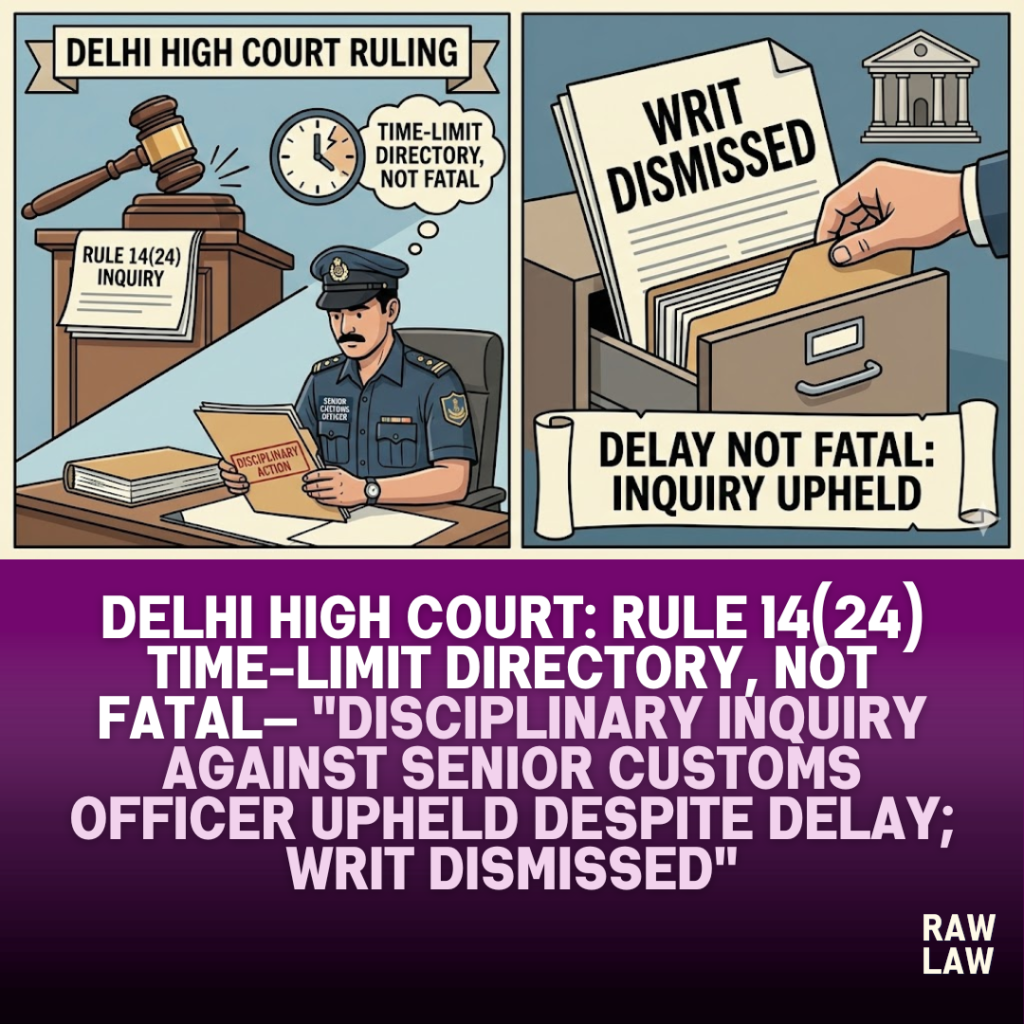

Court’s decision
The Delhi High Court dismissed a writ petition challenging the Central Administrative Tribunal’s refusal to quash a charge memorandum and ongoing disciplinary proceedings against a senior Additional Commissioner of Customs.
The Court held that non-adherence to the six-month timeline under Rule 14(24) of the Central Civil Services (Classification, Control and Appeal) Rules, 1965 does not automatically vitiate disciplinary proceedings in the absence of demonstrated prejudice. It further ruled that allegations of mechanical approval and violation of deputation rules were unsubstantiated. The writ petition was dismissed.
Facts
The petitioner, a 1993-batch direct recruit Appraiser promoted up to Additional Commissioner of Customs, had served on deputation at SEEPZ, Mumbai, under the Ministry of Commerce between 2015 and 2019.
During his tenure as Deputy Development Commissioner and Joint Development Commissioner, he was also entrusted with the additional charge of Estate Manager and Secretary to the SEEPZ Authority. After his repatriation to the parent cadre in June 2019, vigilance proceedings were initiated.
Based on first-stage advice from the Central Vigilance Commission, a charge memorandum dated 21.05.2021 was issued proposing major penalty proceedings. Five Articles of Charge alleged irregularities in tendering, award of works, contractor selection, structural decisions, and allotments in SDF Tower VIII.
The petitioner challenged the charge memorandum before the Tribunal, which declined to quash the proceedings but directed expeditious conclusion within six months.
Issues
The High Court framed two principal issues:
- Whether failure to conclude the inquiry within the timeline prescribed under Rule 14(24) of the CCS (CCA) Rules vitiates disciplinary proceedings.
- Whether the charge memorandum dated 21.05.2021 was liable to be quashed for alleged non-application of mind and violation of Rules 14 and 20.
Petitioner’s arguments
The petitioner argued that Rule 14(24) mandates conclusion of disciplinary inquiry within six months, extendable only with written reasons and approval. Since no such written extension was obtained, continuation of proceedings was illegal.
Relying on Prem Nath Bali v. Registrar, High Court of Delhi, Union of India v. M.R. Diwan, and Anish Gupta v. Union of India, it was contended that the time prescription was mandatory and non-compliance rendered the proceedings void.
The petitioner further alleged mechanical approval by the disciplinary authority in violation of Union of India v. B.V. Gopinath. It was submitted that the draft charge memorandum originated from the borrowing department without proper independent application of mind by the Minister of Finance.
He also argued that the acts alleged were administrative decisions lacking mala fides and did not constitute misconduct warranting major penalty proceedings.
Respondents’ arguments
The Union of India contended that Rule 14(24) is directory and does not provide for automatic abatement upon expiry of time. It was submitted that delay does not vitiate proceedings unless prejudice or mala fides are demonstrated.
The respondents relied on Government of A.P. v. V. Appala Swamy, asserting that delay alone is insufficient to nullify disciplinary proceedings.
It was argued that approval of the competent disciplinary authority had indeed been obtained. Rule 20 permits the borrowing department to initiate disciplinary proceedings for misconduct during deputation, and the final charge memorandum was issued by the parent cadre authority.
The respondents emphasized that allegations involved financial and procedural irregularities and could not be adjudicated at the threshold stage.
Analysis of the law
The Court examined Rule 14(24), which prescribes a six-month period for conclusion of inquiry and permits extensions for recorded reasons.
It noted that the Rule does not specify any consequence of abatement or invalidation for non-compliance. In absence of an express statutory consequence, the provision cannot be construed as mandatory in a manner that nullifies proceedings automatically.
Relying on V. Appala Swamy, the Court reiterated that delay must be shown to be inordinate, unexplained, and prejudicial.
The Court distinguished earlier Delhi High Court decisions in M.R. Diwan and Anish Gupta as fact-specific and not laying down a rigid universal rule.
Precedent analysis
Prem Nath Bali emphasized expeditious completion of inquiries but did not declare that delay automatically nullifies proceedings.
Union of India v. B.V. Gopinath concerned absence of approval by the competent authority. In the present case, approval was undisputed; only its alleged adequacy was questioned.
The Court clarified that judicial review does not extend to examining the depth of deliberation in administrative approval unless absence of approval or jurisdictional defect is established.
Court’s reasoning
The Court held that Rule 14(24) does not stipulate automatic abatement. Mere procedural delay, without demonstrated prejudice, cannot invalidate proceedings.
The petitioner failed to show loss of evidence, unavailability of witnesses, or inability to defend himself. The grievance regarding promotion consequences was held to be a natural incident of pending disciplinary proceedings, not legal prejudice.
Regarding alleged mechanical approval, the Court found that the file was processed and placed before the competent authority, and approval was granted. Mere assertion of lack of application of mind was insufficient.
On Rule 20, the Court held that the borrowing department may initiate proceedings for misconduct during deputation, subject to eventual action by the lending authority. No jurisdictional error was found.
The Articles of Charge were detailed, supported by imputations, documents, and witness lists, and could not be characterized as vague or absurd.
The Tribunal’s direction to conclude the inquiry within a fixed timeframe was held to be balanced and consistent with the objective of expeditious adjudication.
Conclusion
The Delhi High Court dismissed the writ petition as devoid of merit. It upheld the Tribunal’s refusal to quash the charge memorandum and disciplinary proceedings.
The direction for expeditious completion of inquiry was affirmed, and the pending applications were closed.
Implications
This judgment clarifies that:
- Rule 14(24) of the CCS (CCA) Rules is directory; delay alone does not invalidate disciplinary proceedings.
- Absence of statutory consequence prevents automatic abatement.
- Judicial review at the charge memorandum stage is limited to jurisdictional error or patent illegality.
- Borrowing departments may initiate disciplinary steps for deputation misconduct.
- Promotion denial due to pending inquiry is not “legal prejudice.”
The ruling reinforces judicial restraint in interfering with departmental inquiries at the threshold stage.
Case law references
- Prem Nath Bali v. Registrar, High Court of Delhi (2015) 16 SCC 415
Emphasized timely completion of disciplinary proceedings. - Government of A.P. v. V. Appala Swamy (2007) 4 SCC 511
Delay does not vitiate proceedings absent prejudice. - Union of India v. B.V. Gopinath (2014) 1 SCC 351
Charge memorandum must be approved by competent authority. - Union of India v. M.R. Diwan (2019 SCC OnLine Del 7711)
Fact-specific quashing based on delay. - Anish Gupta v. Union of India (2022 SCC OnLine Del 1872)
Discussed time limits under Rule 14(24); fact-dependent application.
FAQs
1. Does delay beyond six months under Rule 14(24) automatically nullify disciplinary proceedings?
No. The Rule is directory and does not prescribe abatement as a consequence of delay.
2. Can a charge memorandum be quashed for alleged mechanical approval?
Only if absence of approval or jurisdictional defect is established. Mere allegation of insufficient application of mind is inadequate.
3. Does superannuation terminate disciplinary proceedings?
No. Major penalty proceedings may continue post-retirement subject to applicable rules affecting pensionary benefits.


