
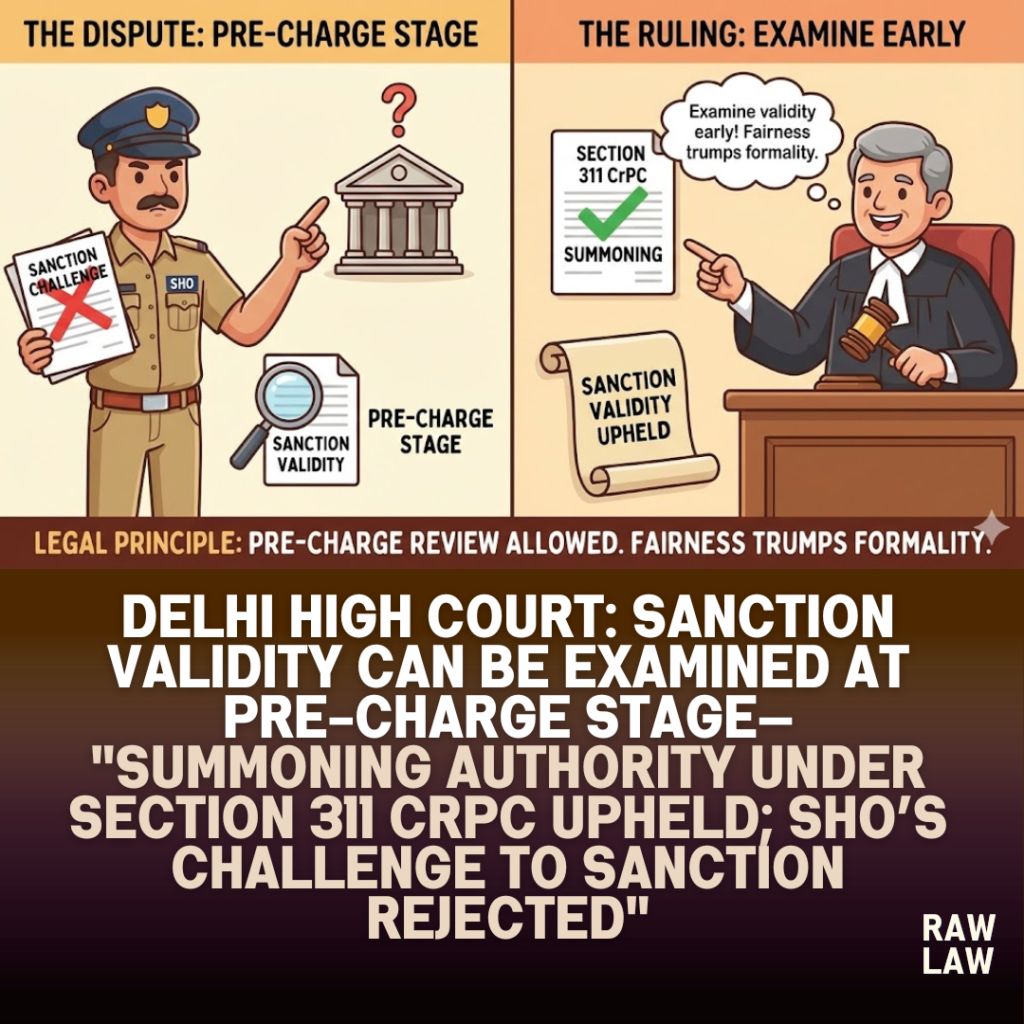

Court’s decision
The Delhi High Court dismissed the State’s petition challenging the Special Judge’s order summoning the sanctioning authority under Section 311 CrPC at the pre-charge stage. Simultaneously, it refused to quash the sanction order dated 05.07.2017 and the supplementary chargesheet filed against a former Station House Officer in a corruption case.
The Court held that while validity of sanction is ordinarily tested during trial, there is no legal bar to examining the sanctioning authority at the pre-trial stage in peculiar facts. Finding no patent illegality, the Court upheld the summoning order and declined to stifle prosecution at threshold.
Facts
The case arose from a complaint alleging demand of bribe by a Station House Officer in connection with construction activity in Shahdara, Delhi. It was alleged that the complainant paid ₹1 lakh initially and was later asked to pay ₹50,000 more.
A trap involving video recording allegedly captured co-accused Head Constable accepting ₹25,000 on behalf of the SHO and ₹5,000 for himself. The CFSL report matched voice samples of the co-accused. However, no audio/video recording directly implicated the SHO.
Initially, the chargesheet was filed only against the co-accused under Sections 7/13(1)(d) of the Prevention of Corruption Act and Section 384 IPC. The SHO was placed in Column 12 due to lack of corroborative evidence, and no sanction was sought against him.
Subsequently, while hearing arguments on charge, the Special Judge observed prima facie material against the SHO and directed the prosecution to obtain sanction. A sanction order dated 05.07.2017 was then issued by the Joint Commissioner of Police, followed by a supplementary chargesheet.
Issues
The High Court examined:
- Whether the Special Judge erred in summoning the sanctioning authority under Section 311 CrPC before framing of charge.
- Whether validity of sanction can be examined at the pre-trial stage.
- Whether the sanction order dated 05.07.2017 suffered from non-application of mind as it was issued after judicial direction.
- Whether the supplementary chargesheet was liable to be quashed.
Petitioner’s arguments (State)
The State contended that Section 311 CrPC cannot be invoked before framing of charge to test validity of sanction. It argued that sanction is a matter of evidence and should be examined only during trial.
Relying on precedents, it submitted that premature examination of sanctioning authority could derail proceedings and convert pre-charge stage into a mini-trial.
The State asserted that satisfaction of the sanctioning authority is a question of fact, and the Special Judge erred in entertaining objections at that stage.
Respondent’s arguments (Accused)
The accused argued that sanction under Section 19 of the Prevention of Corruption Act is a jurisdictional prerequisite. Absence or invalidity of sanction affects the very competence of the court to try the accused.
He contended that initially no sanction was sought and he was placed in Column 12. The subsequent sanction was granted only after judicial direction, raising apprehension of mechanical approval.
Relying on precedents including CBI v. Ashok Kumar Aggarwal and Nanjappa v. State of Karnataka, it was argued that validity of sanction can be challenged at any stage and preferably at the earliest.
Analysis of the law
The Court analysed Section 311 CrPC, emphasizing that it empowers the court to summon any witness at “any stage” of inquiry, trial or other proceeding if essential for a just decision.
It referred to Natasha Singh v. CBI and Ratanlal v. Prahlad Jat to reiterate the width of judicial discretion under Section 311.
On sanction jurisprudence, the Court examined CBI v. Ashok Kumar Aggarwal and State v. Mukesh Kumar Singh, which clarify that independent application of mind by sanctioning authority is a sine qua non.
While validity of sanction is generally examined during trial, courts are not barred from considering it at the pre-charge stage where jurisdictional competence is questioned.
Precedent analysis
The Court distinguished CBI v. Manohar Baburao Nandanwar, where pre-charge examination of sanctioning authority was disapproved, noting absence of detailed reasoning in that judgment.
It relied on Ashok Kumar Aggarwal (2014) 14 SCC 295 to hold that validity of sanction may, in exceptional cases, be examined before charge.
Further reliance was placed on State v. Mukesh Kumar Singh (2018 SCC OnLine Del 8136), which held that objections to sanction should be considered at the earliest to avoid continuation of void proceedings.
The Court also noted Nanjappa v. State of Karnataka (2015) 14 SCC 186, which treats sanction as foundational to court’s competence.
Court’s reasoning
The Court observed that initially no sanction was sought against the SHO, as the prosecution found insufficient evidence. Only after the Special Judge’s observations during charge arguments was sanction obtained.
Though no positive direction to grant sanction was issued, the possibility that the sanctioning authority was influenced by judicial observations could not be ruled out.
Given these peculiar facts, independent application of mind required closer scrutiny.
The Court held that summoning the sanctioning authority was justified to clarify whether the sanction was granted after independent consideration of materials or merely due to court direction.
It rejected the argument that Section 311 cannot be invoked at pre-charge stage, holding that the provision expressly permits action at “any stage.”
At the same time, the Court declined to quash the sanction order outright, observing that whether it suffers from non-application of mind can only be determined after examining the authority.
Conclusion
The High Court held:
• Section 311 CrPC can be invoked at pre-charge stage in exceptional cases.
• Validity of sanction may be examined early where jurisdictional competence is questioned.
• No ground existed to quash the sanction order or supplementary chargesheet at this stage.
Accordingly, the State’s petition was dismissed, and the accused’s petition was disposed of with liberty to raise all arguments at appropriate stage.
Implications
This ruling clarifies:
- Sanction under the Prevention of Corruption Act is foundational and jurisdictional.
- Courts may examine validity of sanction even before framing of charge in atypical cases.
- Section 311 CrPC has wide amplitude and is not confined to post-charge stage.
- Independent application of mind by sanctioning authority remains central to validity.
- Prosecution cannot rely solely on judicial prompting for grant of sanction.
The judgment balances protection of public servants with the need for effective anti-corruption prosecution.
Case law references
- Natasha Singh v. CBI (2013) 5 SCC 741
Section 311 CrPC can be exercised at any stage if essential for just decision. - CBI v. Ashok Kumar Aggarwal (2014) 14 SCC 295
Independent application of mind mandatory for valid sanction. - Nanjappa v. State of Karnataka (2015) 14 SCC 186
Sanction is jurisdictional; validity can be challenged at any stage. - State v. Mukesh Kumar Singh (2018 SCC OnLine Del 8136)
Validity of sanction should be examined at earliest stage.
FAQs
1. Can validity of sanction be examined before framing of charge?
Yes. Though generally tested during trial, courts may examine it earlier where jurisdictional competence is questioned.
2. Can a court summon the sanctioning authority under Section 311 CrPC before trial?
Yes. Section 311 permits summoning at “any stage” if essential for just decision.
3. Does judicial direction to obtain sanction invalidate it?
Not automatically. However, independent application of mind must be demonstrated.


