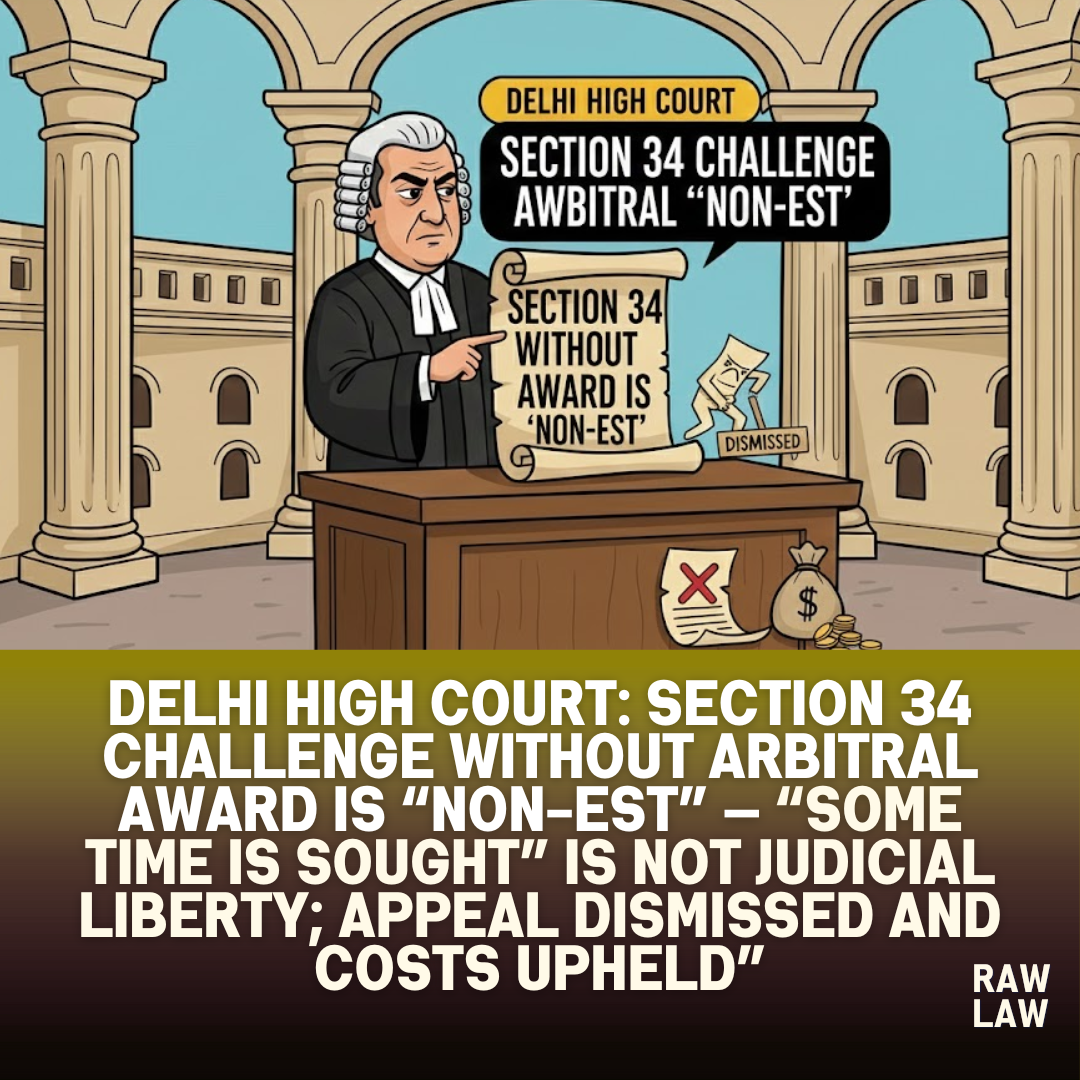
Delhi High Court: Section 34 challenge without arbitral award is “non-est” — “Some time is sought” is not judicial liberty; appeal dismissed and costs upheld

1. Court’s decision
The Delhi High Court dismissed an appeal filed by a government department against a commercial court’s order that had rejected its arbitration challenge as a “non-est” filing for not enclosing the arbitral award. The Court held that merely filing a Section 34 petition without the arbitral award does not constitute a valid institution in law and does not stop limitation from running. It also refused to dilute the statutory outer limit under Section 34(3) even after granting the benefit of the Supreme Court’s COVID-19 limitation extension directions. The High Court upheld the costs imposed by the commercial court, including the direction to recover costs from the concerned officer.
2. Facts
A Delhi government department engaged in skill development and vocational training approved a private vocational training provider to run training programmes under a government skill initiative, with reimbursement of training and assessment costs subject to strict compliance with guidelines hosted on the relevant government portal. Disputes arose when the department scrutinised reimbursement bills and noted discrepancies such as delayed submissions, duplication of trainers across simultaneous batches, and alleged non-compliance with attendance norms. The service provider invoked arbitration; after settlement discussions, it limited its claim to two disputed bills totalling ₹8,22,500, which the sole arbitrator allowed. The department then filed a Section 34 petition to set aside the award.
3. Issues
The appeal raised a sharply focused procedural question in arbitration law: whether a Section 34 petition filed without the arbitral award can be treated as a valid filing, capable of stopping limitation. Linked to this was the department’s argument that a later court order effectively granted it “liberty” to file the award subsequently, thereby curing the defect. The Court also had to decide whether the Supreme Court’s COVID-19 limitation relaxations could assist a litigant that failed to file an essential document, and whether filing the award months later could be considered within the maximum permissible time under Section 34(3). Finally, it examined whether the commercial court’s cost order warranted interference in appellate jurisdiction.
4. Petitioner’s arguments
The department argued that the commercial court wrongly dismissed the Section 34 petition on the ground that the arbitral award had not been filed along with the petition, despite an earlier order where “some time” was sought for filing the award and, according to the department, liberty was granted to file it later. It contended that once such liberty existed and had been acted upon, maintainability could not be revisited. It also relied on the Supreme Court’s pandemic-related limitation relaxations, asserting that e-filing systems were not fully streamlined and that the petition was placed in a filing box, which may have inadvertently led to the award being detached. The department further challenged the cost direction as harsh and disproportionate.
5. Respondent’s arguments
The private vocational training provider supported the commercial court’s view that filing the arbitral award with the Section 34 petition is a mandatory prerequisite and the failure renders the petition “non-est” from inception. It argued that the order relied upon by the department did not grant any express, categorical, or affirmative liberty to cure the defect; it merely recorded a submission seeking time. The provider also contended that COVID-19 limitation relaxations did not dispense with statutory requirements or absolve litigants from filing essential documents, and characterised the department’s e-filing and “detachment” explanation as vague. On costs, it maintained that the commercial court’s direction—including recovery from the concerned officer—did not call for appellate interference.
6. Analysis of the law
The Court treated the dispute as governed by a strict statutory architecture: Section 34(3) sets a three-month limitation period (with a further thirty-day condonable window on sufficient cause), beyond which courts have no jurisdiction to entertain the challenge. The High Court underscored that a Section 34 petition without the arbitral award is not a curable irregularity at the threshold stage but a foundational defect that prevents the petition from being recognised as a valid filing in law. As a result, the “non-est filing” doctrine becomes decisive because limitation continues to run uninterrupted. The Court then applied the Supreme Court’s COVID-19 limitation extension as far as it could, but held that even the extended timeline did not rescue a belated filing of the award.
7. Precedent analysis
The High Court relied on a binding Full Bench decision of the same court which holds that filing a copy of the impugned arbitral award is a bare minimum and mandatory requirement for a Section 34 application, and that non-filing makes the application “non-est,” thereby not stopping limitation. It applied that rule directly, treating it as determinative of the maintainability issue. The Court also referred to the Supreme Court’s suo motu COVID-19 limitation orders and extracted the key direction: where limitation commenced between 15 March 2020 and 28 February 2022, it recommenced from 1 March 2022. The High Court used this framework to calculate the department’s outer limit and concluded the award was filed far beyond even the benefit window.
8. Court’s reasoning
On the department’s “liberty” argument, the Court closely examined the earlier commercial court order and held it did not grant any permission or judicial indulgence to validate a later filing; it merely recorded that time was sought and proceeded to deal with service and notice. The Court went further and expressed strong disapproval of the department’s attempt to read into that order an authority “plainly absent” from its text. It then applied the Full Bench rule: the Section 34 petition filed on 14 December 2021 without the award was “non-est,” and the award was filed only on 7 September 2022. Even after the limitation recommenced on 1 March 2022 under the COVID-19 orders, the delay exceeded the statutory outer limit. The “detachment” plea was treated as an afterthought inconsistent with the contemporaneous record.
9. Conclusion
The High Court held that the commercial court’s dismissal of the Section 34 petition as barred by limitation and non-maintainable was legally correct and consistent with binding precedent. It found no infirmity, illegality, or perversity in the reasoning, and therefore declined to interfere in appeal. Importantly, it affirmed the consequence that a “non-est” Section 34 filing does not suspend limitation, making later attempts to place the award on record ineffective if the statutory window has lapsed. The Court also upheld the costs imposed by the commercial court and refused to interfere with the direction relating to recovery from the concerned officer, holding it did not warrant appellate intervention.
10. Implications
This ruling reinforces a hard procedural line in arbitration challenges: a Section 34 petition must be filed with the arbitral award, and courts will treat the omission as fatal, not as a minor defect that can be cured at leisure. For government departments and public authorities, the decision highlights how internal administrative delays, pandemic-era disruptions, or filing-system friction cannot substitute for statutory compliance, particularly under Section 34(3)’s rigid outer limit. It also signals that courts may scrutinise post-facto explanations—like “detachment” in filing boxes—and reject them if they do not align with contemporaneous orders. On costs, it underscores that procedural lapses in arbitration litigation can attract personal accountability directions, especially where courts perceive avoidable carelessness.
Case law references
- Pragati Construction Consultants v. Union of India (Full Bench, Delhi High Court)
Held: Filing the copy of the arbitral award under challenge is a mandatory prerequisite for a Section 34 application; non-filing makes it “non-est” and does not stop limitation from running.
Applied here: Treated as binding and determinative; the High Court held the department’s petition, filed without the award, was “non-est,” and the later filing could not revive limitation. - In Re: Cognizance for Extension of Limitation (Supreme Court, suo motu)
Held: COVID-19 directions extended/reconfigured limitation periods; where limitation commenced between 15.03.2020 and 28.02.2022, limitation recommenced from 01.03.2022.
Applied here: The High Court gave the department the full benefit of recommencement from 01.03.2022, yet found the award was filed on 07.09.2022—beyond the outer limit under Section 34(3).
FAQs
1. Is filing the arbitral award mandatory with a Section 34 petition to set aside an award?
Yes. The Delhi High Court reiterated that filing a copy of the arbitral award is a bare minimum and mandatory requirement; without it, the Section 34 petition is treated as “non-est” and limitation keeps running.
2. Can COVID-19 limitation extensions cure failure to file the arbitral award with the Section 34 petition?
No. The Court granted the benefit of the Supreme Court’s COVID-19 limitation framework but held that it does not dispense with the obligation to file essential documents. If the award is filed beyond the Section 34(3) outer limit even after recommencement, the challenge remains time-barred.
3. Does an order noting “time sought” amount to court permission to file the arbitral award later?
Not necessarily. The High Court held that an order merely recording that “some time is sought” for filing the award—without any express, categorical grant of liberty—cannot be treated as judicial condonation or validation of an otherwise “non-est” filing.