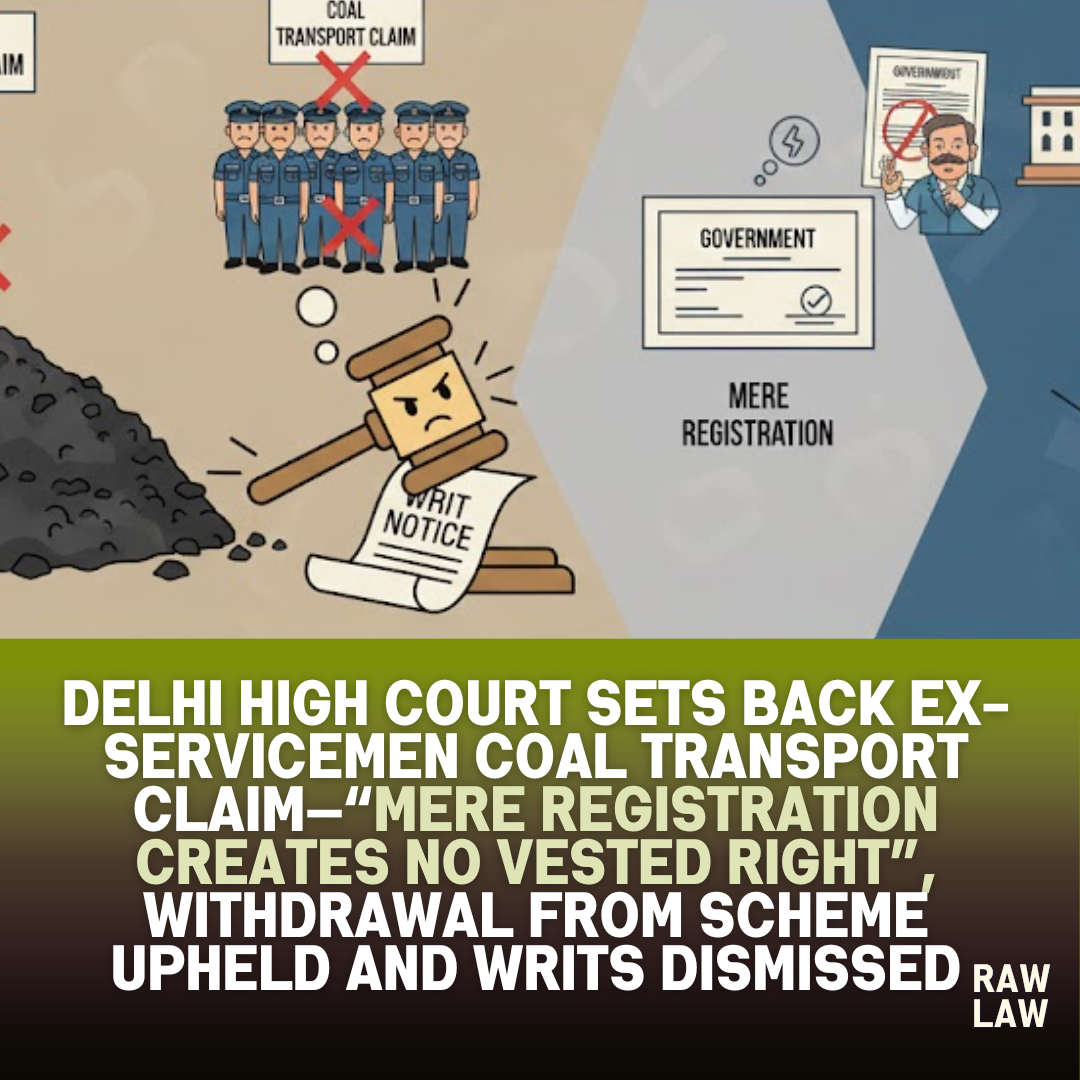
Delhi High Court sets back ex-servicemen coal transport claim—“Mere registration creates no vested right”, withdrawal from scheme upheld and writs dismissed

1. Court’s decision
The Delhi High Court dismissed a batch of writ petitions that sought to undo a public sector company’s exit from a long-running coal loading and transportation arrangement meant to facilitate resettlement opportunities for ex-servicemen and allied beneficiaries. The Court held that simply registering under the coal loading and transportation scheme does not create a vested, enforceable right to receive coal transportation work, and that the petitioners could not use writ jurisdiction to compel allocations or preserve seniority beyond the age limits in the governing policy. The petitions were therefore “dismissed and disposed of.”
2. Facts
The dispute arose after the public sector coal major unilaterally communicated that it was rescinding from a memorandum of understanding dated 12 December 2013, by letters dated 26 June 2020 and 30 June 2020, and would transition coal transportation work away from ex-servicemen coal transport companies to other contracting routes.
The petitions were filed by ex-servicemen beneficiaries who had registered under the scheme and alleged that allocations had slowed or stopped, and that the exit would deprive them of resettlement benefits. They sought quashing of the 2020 communications, directions to continue implementing the scheme, and demands such as a minimum allocation share and disclosure of the policy basis for allocating coal transportation work among different categories like ex-servicemen companies, civilian contractors, and project-affected persons.
3. Issues
The High Court framed the controversy as turning on whether writ relief could be granted to preserve or carry forward “seniority” and eligibility of those on the waiting list, especially after age disqualification under the resettlement policy. In the Court’s words, the central question was: whether petitioners should be allowed to retain their seniority in a new list introduced pursuant to a new memorandum of understanding, despite becoming overage under the policy’s eligibility criteria.
Closely connected were questions about enforceable rights: whether registration under the scheme created a legal entitlement to work allocation, whether doctrines like promissory estoppel and legitimate expectation could compel continuation of the benefit, and whether the Court should interfere with policy choices in the economic and contractual sphere.
4. Petitioner’s arguments
The petitioners argued that the coal loading and transportation scheme was a long-standing resettlement mechanism and that the State’s public sector undertaking could not unilaterally dismantle it. They contended that by periodic execution of memoranda of understanding and repeated operational practice, the respondents represented that benefits would be available; relying on that representation, registrants joined the scheme and claimed they were effectively shut out from other rehabilitation options. They alleged arbitrariness and lack of hearing in the exit letters, stressed the historical performance and contribution of ex-servicemen companies, and invoked promissory estoppel and legitimate expectation to insist that the scheme continue and that waiting-list seniority be protected even if age limits were crossed during litigation or scheme “freezing.”
5. Respondent’s arguments
The principal respondent defended the transition as a policy and economic decision not amenable to routine judicial interference, emphasizing that coal transportation contracts were not guaranteed and that competitive tendering and public procurement norms mattered. It argued that extension or renewal of contracts was discretionary and dependent on requirement and availability of work, and that most transportation was done through civilian contractors via open tenders, consistent with constitutional norms. It also challenged maintainability, insisting that writ jurisdiction requires a judicially enforceable right, and that mere registration under a scheme does not create such a right. It further contended that granting special treatment to certain waitlisted registrants would unfairly prejudice other eligible persons and distort seniority-based distribution under the resettlement framework.
6. Analysis of the law
The Court anchored its public law analysis in a familiar threshold: a writ remedy is ordinarily available to enforce a legal right or compel performance of a statutory/public duty, not to convert expectations under a policy into enforceable entitlements. That principle shaped the Court’s approach to the coal loading and transportation scheme. While the respondent entity was a State-owned enterprise, the Court distinguished between governance under public law and the claim of an individual registrant to be allocated coal transportation work as a matter of right.
The Court also engaged with the doctrines of promissory estoppel and legitimate expectation—often invoked in cases involving government representations and long-standing administrative practice. It reiterated that promissory estoppel cannot be used to enforce an assurance that is contrary to law or beyond the authority’s power, and that legitimate expectation requires more than hope or anticipation; it must rest on a right arising from a promise or consistent practice, and cannot override policy limits like eligibility rules.
7. Precedent analysis
The petitioners relied on decisions where courts granted one-time relief to prevent loss of eligibility due to administrative delays or exceptional circumstances, such as cases involving recruitment examinations and age relaxation. The High Court examined those precedents and found them distinguishable: for instance, in a Supreme Court case where candidates lost eligibility because exams did not occur for two years, the one-time measure did not prejudice others’ rights; but here, preserving overage seniority would disrupt seniority of those who remained eligible under the policy.
On promissory estoppel, the Court referred to Supreme Court authority emphasizing limits: estoppel cannot validate what is impermissible under statute or policy. It also referred to leading formulations of legitimate expectation distinguishing it from mere desire or anticipation, and outlining conditions under which the doctrine applies in public law—particularly the need for a promise or consistent practice and the requirement that the claim not be unreasonable or contrary to governing norms.
8. Court’s reasoning
A decisive factual and legal finding was that registration under the scheme did not accrue a vested right to be granted coal transport work. The Court observed that the petitioners had not shown that, when the memorandum of understanding was withdrawn, there was any “tangible or identifiable” work that must necessarily be allotted to those on the waiting list, and that the scheme functioned on the basis of requisitions and requirements from subsidiary entities rather than automatic entitlement. The Court treated the registration as, at best, creating a hope that if demand arose, allotment would follow seniority—rather than a guarantee enforceable in writ proceedings.
The Court also rejected reliance on communications suggesting the scheme was “frozen” and that seniority/eligibility was being maintained during pendency. It held that such communications could not be read as a legally enforceable assurance that overage registrants would retain seniority in a future arrangement, especially when the governing policy prescribed age limits. The Court noted that an authority cannot, through correspondence, agree to something not permissible under its own policy framework, and promissory estoppel cannot be invoked to compel a result beyond authority or contrary to policy.
Finally, the Court underscored restraint in policy matters: having held no vested right existed, it found no basis to interfere with the policy posture and administrative scheme governing resettlement and allocation decisions, and held the petitioners’ requested reliefs could not be granted.
9. Conclusion
The Delhi High Court concluded that the petitioners’ claims—framed as challenges to withdrawal from the memorandum of understanding and demands for allocation under the coal loading and transportation scheme—ultimately sought judicial creation of an entitlement the policy did not confer. Without a vested right, and with eligibility conditions operating against overage registrants, the Court declined to grant mandamus-type relief. The main batch of writ petitions was dismissed.
10. Implications
This ruling is a significant marker for judicial review of resettlement schemes and public sector contracting. It signals that even welfare-linked schemes tied to ex-servicemen resettlement will not automatically generate enforceable rights merely through registration, especially where allocation depends on operational demand and policy discretion. It also cautions litigants against relying on interim “status quo” or “freezing” communications to claim long-term preservation of seniority beyond policy eligibility limits. More broadly, it reinforces that courts may hesitate to interfere with transitions in government-linked economic arrangements unless a clear statutory duty or enforceable legal right is shown.
Case law references (as discussed/applied by the Court)
- High Court of Delhi v. Devina Sharma – The Supreme Court granted a one-time relaxation when exams did not occur for two years, so candidates lost eligibility through no fault of theirs. The High Court distinguished it, holding that granting similar relief here would disturb seniority of otherwise eligible registrants, unlike the exam cases where no comparable prejudice arose.
- Army Welfare Education Society v. Sunil Kumar Sharma (and the line of cases on legitimate expectation) – Cited for the proposition that legitimate expectation is a public law tool against arbitrariness, not a mechanism to override policy limits; it must be anchored in promise/practice and cannot be based on mere desire or hope. The Court used this framework to hold that waiting-list registration did not mature into a right to retain seniority despite age ineligibility.
- Ashok Kumar Maheshwari (Dr) v. State of Uttar Pradesh (with Kasinka Trading and Shabi Construction) – Reiterated that promissory estoppel cannot enforce a promise contrary to law or beyond authority. The Court relied on this to reject the argument that “freezing” communications created enforceable assurances contrary to the age-based eligibility policy.
- Motilal Padampat Sugar Mills v. State of Uttar Pradesh – Cited to describe the broad contours of promissory estoppel against the Government, but the Court emphasized that the doctrine remains bounded by legality, authority, and equity, and does not apply where there is no clear promise leading to detrimental alteration of position within permissible policy space.
FAQs
1) Does registration under an ex-servicemen resettlement scheme create a legal right to a government contract?
Not by itself. The Delhi High Court held that mere registration under the coal loading and transportation scheme does not create a vested right to be allotted coal transportation work, especially where allocation depends on demand and policy discretion.
2) Can promissory estoppel force the government or a public sector company to continue a welfare-linked scheme?
Only in limited circumstances. The Court reiterated that promissory estoppel cannot be invoked to enforce a representation that is beyond authority or contrary to policy/statute, and therefore cannot override eligibility rules like age limits.
3) If a scheme is “frozen” during litigation, can seniority be preserved even after crossing the age limit?
Not automatically. The Court held that “freezing” or interim maintenance communications cannot be treated as an assurance that seniority will continue despite policy-based age disqualification, and courts will not rewrite eligibility criteria through writ orders.