Delhi High Court: Suspicion Cannot Replace Proof — “Prosecution Failed to Establish Complete Chain of Circumstantial Evidence; ‘Last Seen Together’ Theory Coupled with Doubtful Belt Recovery Did Not Meet Proof Beyond Reasonable Doubt” — Murder Conviction Set Aside

Court’s decision
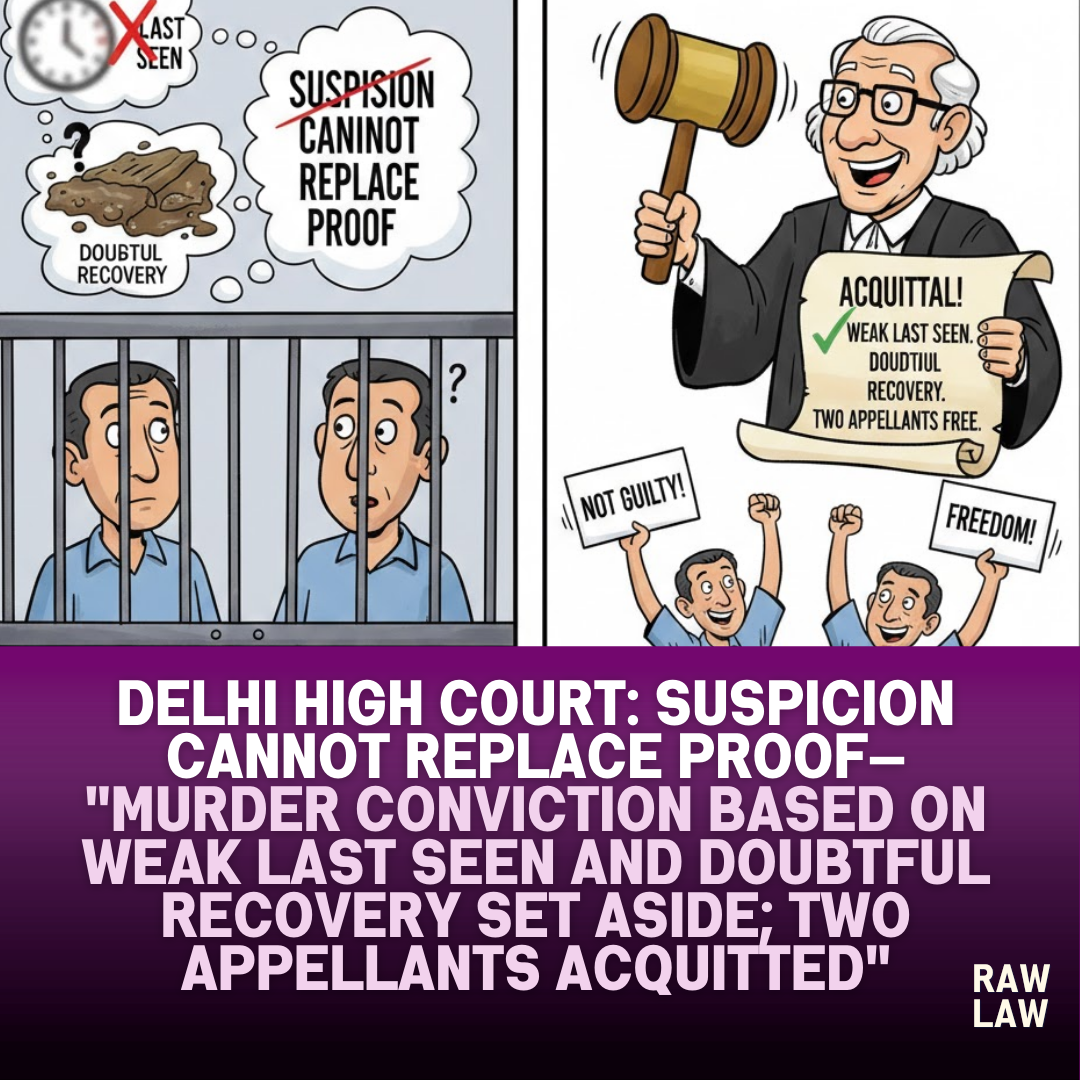
The Delhi High Court allowed the criminal appeals filed by Pradeep and Deepak and set aside their conviction under Section 302 read with Section 34 IPC. The Court held that the prosecution failed to establish a complete chain of circumstantial evidence and that the “last seen together” theory, coupled with a doubtful recovery of a belt allegedly used for strangulation, did not meet the threshold of proof beyond reasonable doubt. Observing that “suspicion, however grave, cannot take the place of proof,” the Court acquitted both appellants and directed their release forthwith.
Facts
The case arose from FIR No. 152/2017 registered at Police Station Dwarka North after an unidentified dead body was found near Orissa Sadan, Sector-16B, Dwarka, on 25 May 2017. The deceased, later identified as Marshal, had injury marks on his face and neck. The post-mortem report recorded multiple bruises and a transverse ligature mark around the neck. The cause of death was opined as asphyxia due to ligature strangulation, and the manner of death was homicide.
The prosecution alleged that the deceased was last seen with the appellants on the night of 24 May 2017. A traffic challan was issued to Deepak at Gurugram around 10:43 p.m., where the deceased was present in the car and already bore injury marks. Four days later, a belt allegedly used in the offence was recovered from Pradeep’s house. The Trial Court convicted both appellants for murder under Section 302/34 IPC but acquitted them under Section 201 IPC.
Issues
The High Court examined whether the prosecution had successfully established a complete chain of circumstantial evidence linking the appellants to the homicidal death.
It also considered whether the last seen theory and the forensic recovery of the belt and blood traces in the car were sufficient to sustain conviction.
Additionally, the Court evaluated the relevance of motive and the legal standards governing conviction based solely on circumstantial evidence.
Petitioners’ arguments
The appellants contended that the conviction was unsustainable as it rested entirely on circumstantial evidence without forming an unbroken chain. They argued that key prosecution witnesses, including PW-1 and PW-2, turned hostile and did not support the last seen narrative. PW-3, the wife of one appellant, partially supported the case but admitted strained relations and personal involvement with the deceased’s brother, casting doubt on her credibility.
It was further argued that the belt recovery was doubtful, having occurred four days after the incident, and no fingerprint evidence connected the appellants to the alleged weapon. The presence of blood in the car, according to the defence, was explainable as the deceased was already injured at the time of the traffic stop.
Respondent’s arguments
The State argued that the conviction was well-founded on circumstantial evidence, particularly the last seen circumstance established through traffic police officials who saw the deceased injured in the appellants’ car shortly before his death. The close proximity between the challan at 10:43 p.m. and the recovery of the dead body at 6:30 a.m. the next morning was emphasized.
The prosecution also relied on forensic evidence showing that the DNA from the belt and cloth pieces recovered from the car matched the deceased. Motive was attributed to alleged family acrimony arising from an extramarital relationship involving the wife of one appellant and the deceased’s brother.
Analysis of the law
The Court reiterated the settled principles governing conviction based on circumstantial evidence. It emphasized that every incriminating circumstance must be firmly established and collectively form a complete chain pointing only to the guilt of the accused. The chain must exclude every other hypothesis consistent with innocence.
The Court observed that absence of motive, while not always fatal, assumes significance in cases resting solely on circumstantial evidence. It also underscored that selective reliance on isolated circumstances cannot substitute for a coherent evidentiary chain.
Precedent analysis
The High Court relied extensively on Supreme Court jurisprudence, including Sharad Birdhichand Sarda v. State of Maharashtra, which laid down the five golden principles governing circumstantial evidence.
In Laxman Prasad v. State of M.P., the Supreme Court held that if even one crucial link in the chain is missing, conviction cannot be sustained.
The Court also cited State of Punjab v. Kewal Krishan and Raju v. State of Rajasthan, reiterating that circumstances must unerringly point towards guilt and exclude all other hypotheses.
Further reliance was placed on Nandu Singh v. State of M.P., where absence of motive was treated as a relevant factor favouring the accused when the chain of evidence was incomplete.
Applying these precedents, the High Court found the prosecution’s case deficient.
Court’s reasoning
The Court scrutinized the post-mortem findings, which confirmed homicidal death by ligature strangulation. However, the recovery of the belt from Pradeep’s residence four days after the incident was viewed with suspicion. The Court found it improbable that a person who had allegedly committed murder would retain an incriminating belt unwashed in his own house. No fingerprint evidence was recovered from the belt or vehicle.
Regarding the last seen theory, the Court noted a significant time gap between the traffic challan in Gurugram and the recovery of the body in Dwarka. There was no evidence proving continuous and exclusive custody of the deceased by the appellants during this interval. The deceased did not seek help from traffic officials despite being in their presence, and evidence suggested he even participated in offering a bribe to avoid challan.
The Court concluded that the prosecution failed to eliminate alternative hypotheses or establish a seamless chain of events.
Conclusion
The Delhi High Court set aside the conviction and sentence of life imprisonment imposed on the appellants. It acquitted them of charges under Section 302/34 IPC and directed their immediate release, unless required in any other case.
Implications
This judgment reinforces the rigorous standards required in cases based solely on circumstantial evidence. It underscores that last seen evidence, without proximity and continuity, cannot alone justify conviction.
The ruling serves as a reminder that forensic findings must be corroborative and reliable, not speculative. It also highlights judicial caution against relying on doubtful recoveries and incomplete narratives.
For criminal jurisprudence, the decision strengthens the doctrine that suspicion, however strong, cannot replace proof beyond reasonable doubt.
Case Law References
- Sharad Birdhichand Sarda v. State of Maharashtra (1984) 4 SCC 116
- Laxman Prasad v. State of M.P. (2023) 6 SCC 399
- State of Punjab v. Kewal Krishan (2023) 13 SCC 695
- Raju v. State of Rajasthan (2024) 14 SCC 444
- Nandu Singh v. State of M.P. (2022) 19 SCC 301
FAQs
1. What is the “last seen together” theory in murder cases?
It is a circumstantial principle where the accused is last seen with the deceased before death. However, it must be closely proximate in time and supported by additional evidence.
2. Can conviction be based solely on circumstantial evidence?
Yes, but only if the chain of circumstances is complete, consistent, and excludes every hypothesis of innocence.
3. Does absence of motive lead to acquittal?
Not necessarily, but in cases based purely on circumstantial evidence, absence of motive can strengthen the defence if other links are weak.