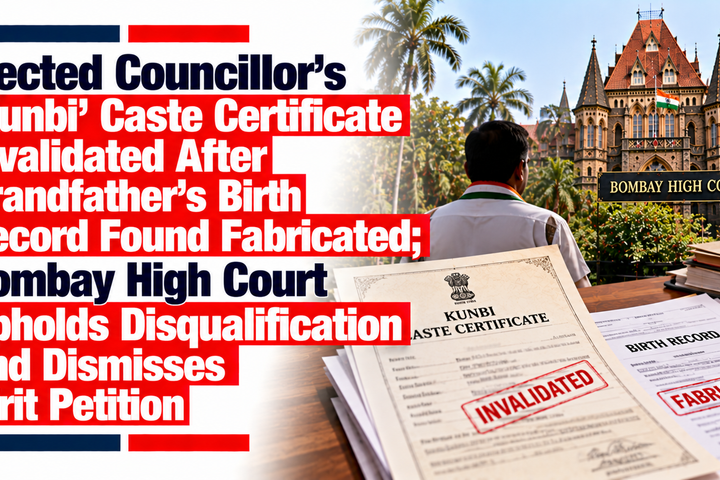
Delhi High Court Upholds 10-Year POCSO Sentence for Assault on 10-Year-Old Boy; Holds Child’s Consistent Testimony and Corroborative Evidence Proved Aggravated Sexual Assault

Delhi High Court Finds Minor Witness Discrepancies Cannot Defeat POCSO Prosecution; Upholds Conviction Where Child’s Consistent Account Was Corroborated by Immediate Disclosure and Evidence
Facts
The appellant, Ravinder Singh, challenged his conviction and sentence under Section 6 of the Protection of Children from Sexual Offences Act, 2012 (POCSO Act). The Trial Court had convicted him on 5 May 2018 and sentenced him on 7 May 2018.
The prosecution alleged that on 20 March 2013, at about 7:00 p.m. near Veer Bazar Road, Chander Vihar, New Delhi, the appellant subjected a 10-year-old boy to penetrative sexual assault and criminal intimidation. The charge-sheet alleged offences under Sections 377 and 506 IPC and Section 4 POCSO Act.
The child immediately returned home in a distressed condition without clothes and disclosed the incident to his family. His uncle lodged the FIR on the same day. According to the initial account, the accused had caught the child after his friend escaped, taken him to a secluded place, sexually assaulted him and threatened to kill him if he disclosed the incident.
The child’s statement under Section 164 CrPC gave a detailed account of the assault, including anal and oral penetration, physical violence and threats.
During trial, the child substantially maintained his allegations and identified Ravinder Singh as the perpetrator. His testimony remained intact during cross-examination.
The child’s mother and uncle corroborated his immediate return home without clothes, his distressed condition, disclosure of the incident and subsequent identification of the accused.
The medical examination revealed a bruise/redness in the perianal region, while the doctor stated that penetration could not be ruled out. More significantly, the FSL examination detected human semen on the child’s anal swab, though its source could not be identified.
The Trial Court convicted the appellant under Section 6 POCSO Act and sentenced him to 10 years’ rigorous imprisonment with a fine of ₹10,000.
Issues
The principal issues before the Delhi High Court were:
- Whether the testimony of the 10-year-old victim was sufficiently credible and reliable to sustain the conviction for aggravated penetrative sexual assault.
- Whether inconsistencies concerning the sequence of events, recovery of clothes, visit to the accused’s house and hospital created reasonable doubt.
- Whether the absence of conclusive medical evidence proving penetration weakened the prosecution case.
- What evidentiary value should be attached to the FSL finding of human semen on the child’s anal swab when its source was unidentified.
- Whether the allegation that the child’s family had attempted to obtain property from the accused established false implication.
- Whether the prosecution had proved aggravated penetrative sexual assault under Section 5(m), punishable under Section 6 POCSO Act, beyond reasonable doubt.
Petitioner/Appellant’s Arguments
There was no representation on behalf of the appellant when the appeal was finally heard. The Court therefore considered the appeal on merits after examining the complete record, relying upon Bani Singh & Ors. v. State of U.P.
The defence taken by Ravinder Singh during his examination under Section 313 CrPC was that the victim’s family wanted to usurp his property and had falsely implicated him because he resisted their attempts.
The defence also relied upon the child’s admission in cross-examination that his mother had participated in compromise talks during which it was suggested that the case could be withdrawn if the accused’s father transferred one of his properties to her.
The evidentiary circumstances potentially supporting the appellant included certain inconsistencies in the prosecution evidence concerning the sequence in which the parties visited the accused’s house, scene of occurrence and hospital, as well as circumstances surrounding recovery of the child’s clothes.
The medical evidence also did not conclusively establish penetration, as the doctor accepted that penetration might not have occurred and had merely stated that its possibility could not be ruled out.
Respondent’s Arguments
The State supported the Trial Court’s judgment and sentence and submitted that there was no illegality or infirmity warranting appellate interference.
The prosecution principally relied upon:
- the victim’s consistent account;
- his immediate disclosure after returning home;
- corroborative testimony of his mother and uncle;
- his identification of the accused;
- medical evidence showing perianal bruising;
- the doctor’s opinion that penetration could not be ruled out; and
- forensic detection of human semen on the victim’s anal swab.
The State’s case was that these circumstances cumulatively proved aggravated penetrative sexual assault beyond reasonable doubt.
Analysis of the Law
Ingredients of Section 6 POCSO
The Court identified three ingredients necessary to establish the offence in the present case:
- the victim must be a child;
- there must be penetration, however slight; and
- the assault must fall within an aggravated category — here, because the victim was below 12 years of age.
The child was approximately 10 years old when the offence occurred.
Sole Testimony of Child Victim Can Sustain Conviction
The Court reiterated that a conviction can rest upon the sole testimony of the victim where such testimony is of sterling quality.
Corroboration becomes necessary where the victim’s evidence suffers from material contradictions, inconsistencies or improvements going to the root of the prosecution case.
The crucial consideration is not the status of the witness but the truthfulness, naturalness and consistency of the testimony from the initial statement through deposition before the Court.
Applying this test, the High Court found nothing capable of discrediting the child’s testimony.
Minor Inconsistencies Did Not Destroy Prosecution Case
The Court acknowledged inconsistencies concerning:
- the sequence of visits to the accused’s house;
- the scene of occurrence;
- the hospital; and
- recovery of the child’s clothes.
However, these were held to be minor discrepancies that did not go to the root of the prosecution case.
Significantly, the Court observed that variations in narration by a child witness and family members recounting a traumatic incident are natural and may lend authenticity rather than necessarily undermine their evidence.
Medical Evidence Need Not Independently Prove Penetration
The medical examination found no major external injury except a bruise in the perianal region without any tear. The doctor stated that penetration could not be ruled out, though he accepted in cross-examination that penetration might possibly not have occurred.
The High Court explained that medical and forensic expert evidence under Section 45 of the Evidence Act principally assists the Court and corroborates other substantive evidence.
An expert report is not binding upon the Court and must be evaluated together with the ocular and other evidence.
Only a complete contradiction between medical evidence and ocular testimony may seriously undermine the prosecution case.
Here, the medical evidence did not rule out the sexual assault described by the child.
Forensic Evidence Provided Additional Corroboration
The FSL detected human semen on the child’s anal swab.
No semen was detected on certain other exhibits, including the child’s pants and underwear and the accused’s underwear and penile swab.
The forensic report could not identify the source of the semen.
Nevertheless, its presence on the anal swab constituted scientific evidence consistent with the child’s allegation and operated as corroborative evidence when considered with the prosecution case as a whole.
Precedent Analysis
1. Rai Sandeep @ Deepu v. State (NCT of Delhi), AIR 2012 SC 3157
The High Court relied upon Rai Sandeep for the concept of a witness of “sterling quality.”
The Court applied the principle that a conviction may rest upon the victim’s testimony when it remains natural and consistent from the initial statement through trial, without material prevarication concerning the occurrence, identity of the accused or sequence of essential events.
The child’s testimony satisfied that standard.
2. Dayal Singh v. State of Uttaranchal, (2012) 8 SCC 263
The Court relied upon Dayal Singh while assessing the relationship between expert evidence and ocular testimony.
Medical or forensic evidence assists the Court but is not independently binding. It must be evaluated alongside the remaining evidence, and only a serious contradiction capable of undermining the prosecution narrative would justify rejection of otherwise credible ocular evidence.
3. Bani Singh & Ors. v. State of U.P., (1996) 4 SCC 720
As neither the appellant nor his counsel appeared at the final hearing, the High Court relied upon Bani Singh and proceeded to decide the criminal appeal on merits after examining the entire record, rather than allowing the absence of representation to prevent adjudication.
4. Moidu K. v. State of Kerala, 2009 SCC OnLine Ker 2888
The Trial Court had failed to provide the hearing contemplated by Section 232 CrPC after examining the accused under Section 313.
The High Court held that such non-compliance does not ipso facto vitiate the proceedings unless it causes serious and substantial prejudice to the accused.
Since Ravinder Singh did not demonstrate any such prejudice, this procedural omission did not invalidate the trial.
Court’s Reasoning
The Court found the child victim’s evidence to be the central and most reliable component of the prosecution case.
His account remained substantially consistent from his immediate disclosure through his Section 164 CrPC statement and eventual testimony before the Trial Court.
His mother and uncle independently corroborated important surrounding circumstances: the child returned home naked and distressed, immediately disclosed the assault and subsequently identified the accused.
The discrepancies relied upon by the defence concerned peripheral matters rather than the actual commission of the sexual assault.
The medical evidence did not contradict the child’s version. The perianal bruise and the possibility of penetration were compatible with his allegations, while the detection of human semen on his anal swab provided additional scientific corroboration.
The Court also rejected the false-implication theory based upon the property dispute.
Although the child admitted that his mother later participated in compromise discussions involving transfer of property, the Court held that this circumstance did not establish that the original allegation had been fabricated. The Court considered that circumstance consistent with an attempt to secure withdrawal of an already existing case rather than proof that the case itself had been invented.
The prosecution therefore established beyond reasonable doubt that Ravinder Singh committed aggravated penetrative sexual assault upon a child below 12 years, attracting Section 5(m), punishable under Section 6 POCSO Act.
Conclusion
The Delhi High Court dismissed Ravinder Singh’s appeal and affirmed his conviction under Section 6 of the POCSO Act.
It held that the Trial Court’s findings were based upon proper appreciation of evidence and suffered from no perversity or illegality warranting appellate interference.
Accordingly, the appellant’s sentence of 10 years’ rigorous imprisonment with a fine of ₹10,000 remained undisturbed.
Key Legal Principle
A POCSO conviction can rest upon the sole testimony of a child victim where it is consistent and trustworthy. Minor discrepancies concerning peripheral events do not discredit otherwise reliable testimony, particularly where medical and forensic evidence does not contradict and instead corroborates the core prosecution case.
Case Details
Case: Ravinder Singh v. State (Govt. of NCT of Delhi)
Court: High Court of Delhi at New Delhi
Case Number: CRL.A. 821/2018; CNR No. DLHC011597152018
Judge: Justice Chandrasekharan Sudha
Date: 20 August 2026; judgment reserved on 17 August 2026
Result: Appeal dismissed; conviction under Section 6 POCSO Act and sentence of 10 years’ rigorous imprisonment with ₹10,000 fine upheld for aggravated penetrative sexual assault on a 10-year-old boy.
Read also: Delhi High Court Upholds ₹33 Crore OEM Turnover Condition for Hemodialysis RO Tender; Holds MSE Purchase Preference Applies Only After Meeting Mandatory Eligibility Criteria