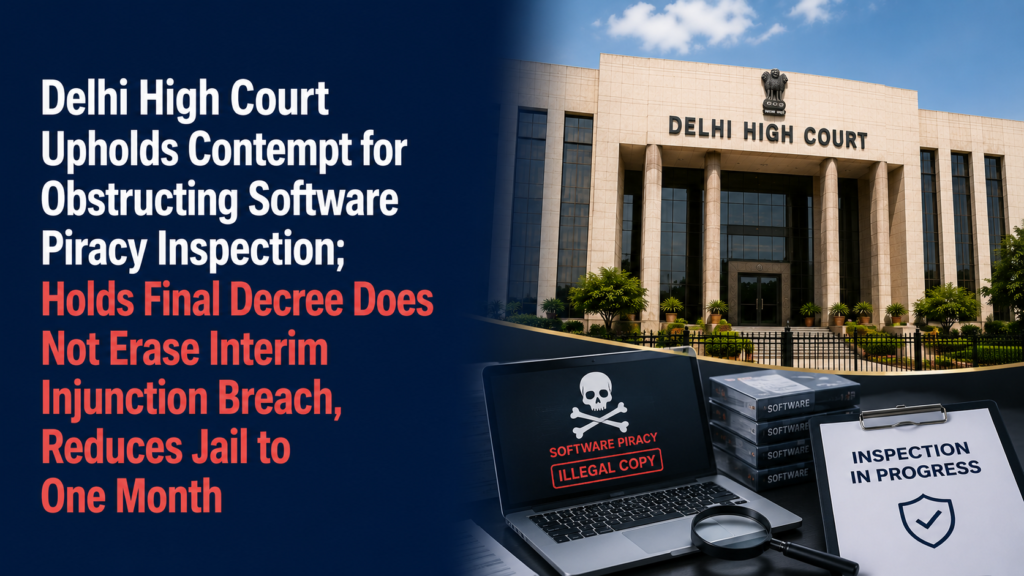
Delhi High Court Upholds Contempt for Obstructing Software Piracy Inspection; Holds Final Decree Does Not Erase Interim Injunction Breach, Reduces Jail to One Month

Delhi High Court Finds Personal Involvement in Blocking Local Commissioner’s Inspection; Upholds Civil Contempt Despite Final Decree, Reduces Detention to One Month
Facts
The Delhi High Court decided an appeal filed by Nilesh Dhanukar against orders of the Commercial Court at Saket in contempt proceedings arising from a copyright infringement suit filed by Siemens Industry Software Inc. and another. The appeal was decided on 13 August 2026 by Justice V. Kameswar Rao and Justice Manmeet Pritam Singh Arora.
The underlying commercial suit concerned alleged infringement of Siemens’ proprietary “NX” software. On 10 August 2023, the Trial Court granted an ex parte ad interim injunction restraining the appellant from using the software. It also appointed a Local Commissioner under Order XXVI Rule 9 CPC to inspect the appellant’s premises and verify compliance.
During the inspection on 17 and 18 August 2023, the Local Commissioner found approximately 25–35 computer systems, some allegedly running NX software. According to his report, employees surrounded and obstructed the inspection team and attempted to transfer eight CPUs and three hard disks to adjoining premises, thereby allegedly concealing evidence.
The Local Commissioner’s report further recorded that around 50–60 employees gathered and physically obstructed the team. Eight CPUs and three hard disks were subsequently discovered in an adjoining property, whose owner stated that they had been placed there by the defendants’ employees without permission.
When the Commission returned with police assistance, the appellant was present and offered to permit inspection only subject to several restrictions, including limitations on technicians, mobile phones, pen drives, photography, videography and server access. Those conditions were not accepted, and the factory gate was ultimately closed, preventing execution of the Commission.
The appellant also filed a complaint under the Scheduled Castes and Scheduled Tribes (Prevention of Atrocities) Act, 1989 against the Local Commissioner and the respondents’ team, which he subsequently withdrew.
The Trial Court found him guilty of civil contempt under Order XXXIX Rule 2A CPC, rejected his apology and sentenced him to two months’ detention in civil prison.
Issues
The principal issue before the High Court was whether the Trial Court was justified in:
- Holding the appellant guilty of civil contempt under Order XXXIX Rule 2A CPC for obstructing execution of the interim injunction and Local Commission; and
- Sentencing him to two months’ detention in civil prison.
A significant legal issue was whether proceedings under Order XXXIX Rule 2A, instituted during pendency of a suit for breach of an interim injunction, survive after the suit is finally decreed.
The Court also considered whether:
- the appellant was personally involved in the obstruction or was being held vicariously responsible for his employees;
- post-decree conduct and non-payment of damages had improperly influenced sentencing;
- the apology warranted leniency; and
- civil imprisonment should be replaced by a non-custodial sanction.
Appellant’s Arguments
The appellant’s principal argument was that once the underlying suit was finally decreed on 19 February 2026, the Order XXXIX Rule 2A proceedings ceased to survive.
It was argued that an interim injunction is ancillary to the suit and, once a final decree is passed, the interim injunction merges into or is superseded by the decree. Any subsequent enforcement must therefore proceed under Order XXI Rule 32 CPC, rather than Order XXXIX Rule 2A.
Since the Trial Court recorded guilt on 18 May 2026 and imposed sentence on 25 July 2026—after the final decree—the appellant contended that the Trial Court lacked jurisdiction to continue the contempt proceedings.
The appellant further argued that non-payment of damages under the final decree could not constitute or aggravate contempt of an earlier interim injunction because a money decree must be enforced through execution proceedings.
On personal liability, it was contended that there was insufficient evidence that the appellant personally instructed his employees to obstruct the Local Commissioner or remove the computer hardware. Since detention in civil prison is a personal coercive consequence, deliberate personal disobedience had to be established through cogent evidence.
Alternatively, the appellant sought a reformative approach. He asked the Court to substitute imprisonment with costs, an undertaking, technical audit, deposit, community service or other non-custodial measures.
Respondents’ Arguments
Siemens defended the Trial Court’s order by emphasizing what occurred during execution of the Local Commission.
The respondents argued that the appellant and his employees deliberately prevented the Court-appointed Commissioner from inspecting the factory and preserving evidence of alleged use of unlicensed or pirated NX software.
They relied upon the Local Commissioner’s account that employees surrounded and manhandled the inspection team, attempted to shift computer hardware to adjoining premises and obstructed implementation of the Court’s order.
The respondents further relied upon the appellant’s own conduct when he subsequently appeared: he allegedly refused unconditional execution of the Commission and imposed numerous restrictions upon how the inspection could be conducted.
Accordingly, the respondents maintained that the contempt arose from a deliberate and wilful obstruction of judicial process rather than merely technical non-compliance.
Analysis of the Law
1. Local Commissioner Is an Extended Arm of the Court
The High Court strongly reaffirmed the status of a court-appointed Local Commissioner.
It held that a Local Commissioner acts as an extended arm and agent of the Court and effectively serves as its “eyes and ears” when carrying out functions outside the courtroom.
Consequently, deliberately obstructing a Local Commissioner from implementing a judicial order constitutes obstruction of justice and warrants serious consequences to preserve the rule of law.
This principle assumes particular importance in software infringement cases because electronic evidence can readily be removed or destroyed before inspection.
2. Final Decree Does Not Erase Earlier Breach of Interim Injunction
This was the central legal ruling.
The appellant relied upon Kanwar Singh Saini v. High Court of Delhi to contend that once the suit had been decreed, enforcement had to proceed exclusively under Order XXI Rule 32 CPC.
The High Court rejected that submission.
The contempt petition had been instituted on 18 September 2023, while the suit was still pending and long before the final decree dated 19 February 2026. The breach complained of related to the interim order dated 10 August 2023.
The subsequent decree therefore did not nullify the already committed disobedience.
The Court drew an important distinction:
- Breach of the final decree itself must be enforced under Order XXI Rule 32 CPC.
- Breach of an interim injunction committed while the injunction operated may continue to be adjudicated under Order XXXIX Rule 2A, notwithstanding a subsequent final decree.
Thus, passing a final decree does not retrospectively wipe out contempt already committed.
3. Even Setting Aside an Injunction Does Not Erase Past Disobedience
The Court relied upon Samee Khan v. Bindu Khan and Lavanya C. v. Vittal Gurudas Pai.
Those decisions establish that even where an interim injunction is subsequently set aside, disobedience committed while the injunction was operative does not disappear.
The High Court applied the same reasoning here: if subsequent setting aside of an injunction does not erase its earlier breach, a subsequent final decree likewise cannot erase wilful disobedience committed while the interim injunction remained operative.
Personal Liability of the Appellant
The High Court rejected the argument that Nilesh Dhanukar was being held liable merely because he occupied a managerial or controlling position.
The Local Commissioner’s report showed that the appellant himself was present at the Police Chowki on 17 August 2023 and at the premises on 18 August 2023.
More importantly, when present at the factory, he personally denied entry to the Local Commissioner unless his stipulated “conditions” were accepted.
The Court therefore concluded that this was not a case of vicarious contempt liability. The appellant was personally involved in obstructing execution of the Commission and thereby personally participated in breach of the Trial Court’s order.
Post-Decree Conduct and Non-Payment of Damages
The appellant argued that the Trial Court improperly relied upon:
- alleged post-decree conduct;
- non-payment of damages; and
- allegations of continued unauthorised software use.
The High Court rejected the challenge.
It interpreted the Trial Court’s orders as fundamentally based upon the events surrounding the attempted execution of the Local Commission in August 2023.
References to subsequent conduct, non-payment of damages and continued software use were treated as circumstances demonstrating that the appellant’s later apology was not sincere or adequate, rather than as independent instances of contempt forming the foundation of conviction.
Precedent Analysis
Autodesk Inc. v. Arup Das
The High Court approved the Trial Court’s reliance upon Autodesk.
That decision recognised the Local Commissioner as the Court’s extended arm and emphasised the importance of local commissions in intellectual-property disputes involving software because evidence stored electronically may otherwise be destroyed or concealed.
Autodesk further held that deliberately refusing to permit execution of a Local Commission constitutes wilful disobedience capable of amounting to civil contempt.
It also supported rejection of an apology that appeared belated and inconsistent with the contemnor’s earlier conduct.
Samee Khan v. Bindu Khan
This Supreme Court authority was central to the survival of the contempt proceedings.
It establishes that subsequent setting aside of an injunction does not erase a breach already committed while the injunction remained operative.
Lavanya C. v. Vittal Gurudas Pai
The High Court noted that the principle in Samee Khan had been followed by the Supreme Court in Lavanya C. in 2025, reinforcing the proposition that later developments concerning an injunction do not retrospectively extinguish prior disobedience.
Kanwar Singh Saini v. High Court of Delhi
The appellant relied on this decision for the proposition that Order XXXIX Rule 2A proceedings operate during pendency of the suit and that enforcement after decree belongs under Order XXI Rule 32.
The High Court distinguished it because no interim injunction under Order XXXIX Rules 1 or 2 existed in that case; the issue concerned an undertaking on the basis of which the suit itself had been disposed of.
Here, by contrast, there was a specific interim injunction under Order XXXIX Rules 1 and 2, and its breach occurred while it was operative.
Court’s Reasoning
The Court found the factual record established an obvious and conscious breach of the Trial Court’s order.
The Local Commissioner had been appointed specifically to inspect the premises, inventory computers and preserve evidence relating to suspected pirated NX software.
Instead of facilitating the Commission:
- employees physically obstructed the team;
- CPUs and hard disks were shifted to adjoining premises;
- access was restricted;
- the appellant personally imposed conditions inconsistent with execution of the Commission;
- the factory gate was ultimately closed; and
- a police complaint under the SC/ST Act was subsequently filed against the Commissioner and respondents’ team before later being withdrawn.
The Court considered the appellant’s conduct a direct affront to judicial authority.
It therefore rejected the request to replace detention with admonition, community service or another non-custodial sanction, observing that there was no convincing reason to revoke the sentence altogether.
Sentence Reduced From Two Months to One Month
Although the conviction was upheld, the High Court granted limited relief on sentence.
It took into account the appellant’s personal circumstances: he was stated to be a divorced parent having custody of a minor child and the sole caregiver of his ailing father.
On that basis alone, the Court reduced detention in civil prison from two months to one month.
The appellant was granted 15 days to surrender before Central Jail, Tihar.
Conclusion
The Delhi High Court substantially upheld the Trial Court’s civil contempt finding.
It laid down the significant principle that a final decree does not erase an earlier wilful violation of an interim injunction. Where an Order XXXIX Rule 2A proceeding was validly initiated for a breach committed while the interim order operated, the Trial Court may continue those proceedings even after the underlying suit is finally decreed.
At the same time, any fresh breach of the final decree itself must be enforced through Order XXI Rule 32 CPC.
The Court found the appellant personally involved in obstructing the Local Commissioner and upheld his liability for civil contempt. However, considering his family circumstances, it reduced the civil imprisonment from two months to one month.
Case Details
Case: Nilesh Dhanukar v. Siemens Industry Software Inc. & Anr.
Court: High Court of Delhi at New Delhi
Case Number: FAO (COMM) 218/2026
Judge: Justice V. Kameswar Rao and Justice Manmeet Pritam Singh Arora
Date: 13 August 2026
Result: Civil contempt upheld; challenge to Order XXXIX Rule 2A proceedings rejected; two-month civil imprisonment reduced to one month, with 15 days granted to surrender.